
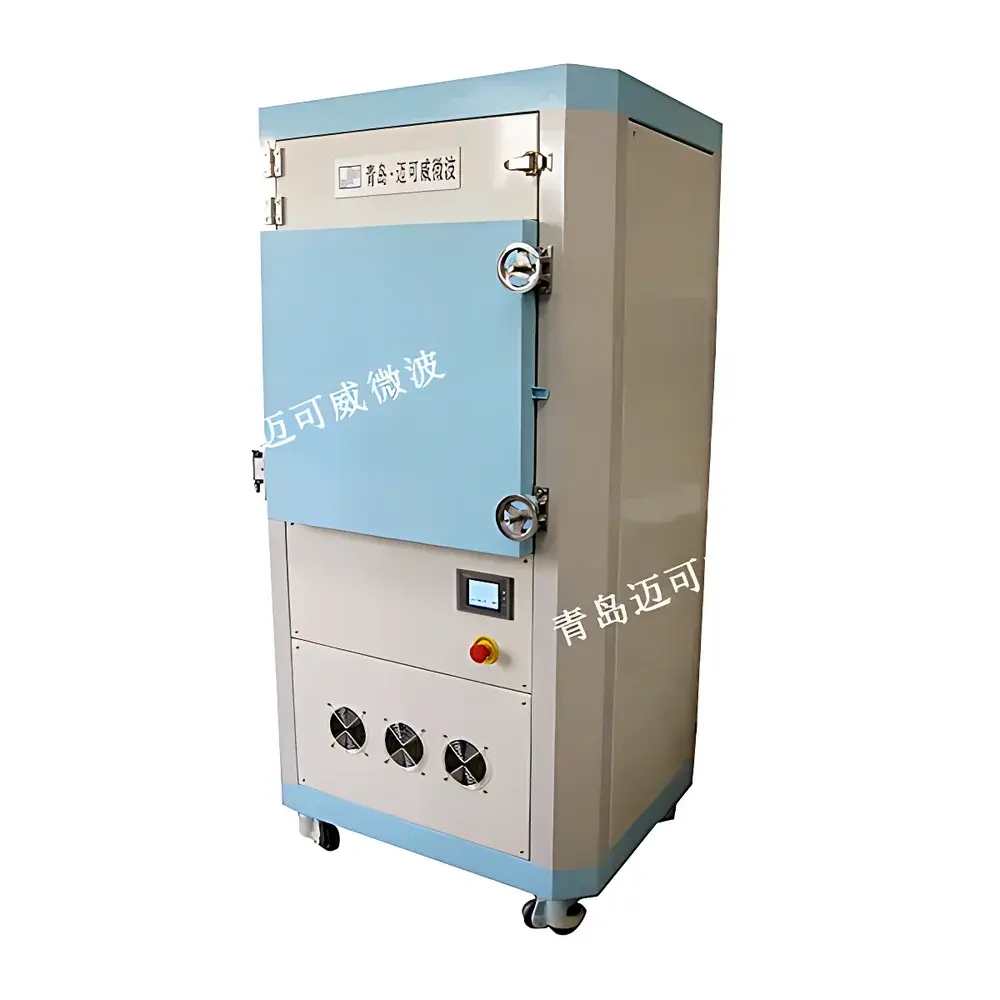
MakeWave MKX-R4HB Vertical Microwave Rapid Ashing Furnace
| Brand | MakeWave |
|---|---|
| Origin | Shandong, China |
| Manufacturer Type | Direct Manufacturer |
| Product Origin | Domestic (China) |
| Model | MKX-R4HB |
| Price Range | USD 14,000 – 42,000 (FOB China) |
Overview
The MakeWave MKX-R4HB Vertical Microwave Rapid Ashing Furnace is an advanced thermal processing instrument engineered for high-efficiency ash content determination in compliance with standardized analytical protocols including ASTM D3174, ISO 1171, USP <281>, and AOAC 942.05. Unlike conventional resistance-heated muffle furnaces—which rely on convective and conductive heat transfer—the MKX-R4HB employs 2450 MHz continuous-wave microwave energy to directly couple with polar molecules and ionic species within the sample matrix. This volumetric, non-contact heating mechanism enables rapid, uniform thermal decomposition under controlled atmospheric conditions, significantly reducing ashing cycle times by up to 70% while minimizing thermal gradient artifacts and crucible wall interactions. Designed for vertical integration into laboratory workflows, the system supports both single-vessel (up to 10 L quartz crucible) and parallel multi-vessel (48-position, 50 mL crucibles) configurations—making it suitable for high-throughput quality control labs and research environments requiring reproducible, traceable, and atmospherically flexible ashing procedures.
Key Features
- 3200 W rated continuous microwave power output at 2450 MHz, with non-pulsed, infinitely variable power modulation for precise thermal ramping and hold control.
- 55 L high-integrity cavity constructed from welded 304 stainless steel with hermetic sealing capability—enabling operation under micro-positive pressure, inert (N₂/Ar), oxidizing (O₂-enriched), or low-oxygen atmospheres.
- Multi-layer insulation architecture incorporating low-dielectric-loss ceramic fiber composites (thermal conductivity ≈ 0.226 W/m·K) and integral quartz lining to prevent particulate contamination and ensure sample purity.
- PLC-based closed-loop temperature control system with Type K thermocouple feedback, operating range 0–800 °C (peak capability: 900 °C), with real-time power–temperature curve logging and programmable ramp/soak profiles.
- Dual-safety interlock door mechanism featuring λ/4 choke suppression, mechanical overtravel limiters, and automatic power cutoff upon door actuation—verified microwave leakage < 5 mW/cm² (IEC 61000-3-2 compliant).
- Modular exhaust interface compatible with optional catalytic scrubbers or alkali-trap systems for SOₓ, NOₓ, halogenated, or volatile metal fume abatement.
Sample Compatibility & Compliance
The MKX-R4HB accommodates a broad spectrum of organic and composite matrices—including foodstuffs, pharmaceutical excipients, polymer resins, coal and coke, animal feed, glass frits, synthetic elastomers, and petrochemical catalysts—without requiring pre-grinding or dilution beyond standard method requirements. Its large-volume chamber (0.155 m² floor area) supports heterogeneous samples up to 10 L in capacity, enabling direct analysis of environmental sediment cores, biomass slurries, or industrial filter cakes. The system conforms to GLP documentation standards via embedded audit trail functionality (user ID, timestamp, parameter set, execution log), and supports 21 CFR Part 11-compliant data integrity when paired with validated software extensions. All structural and electrical components meet ISO 9001:2015 certified manufacturing practices.
Software & Data Management
The integrated HMI touchscreen interface provides intuitive access to up to 100 user-defined thermal programs, each storing target temperature, ramp rate, dwell time, atmosphere flow rates, and power setpoints. Real-time graphical display shows concurrent temperature, power, and elapsed time curves. Data export is supported via USB 2.0 to CSV or Excel-compatible formats, with optional Ethernet connectivity for centralized lab information management system (LIMS) integration. Firmware updates are performed offline using signed binary packages to maintain validation integrity. System diagnostics include cavity standing wave ratio (SWR) monitoring, thermocouple continuity checks, and door seal integrity verification—all logged automatically with timestamps.
Applications
- Routine ash content quantification per AOAC 942.05 (food), ASTM D3174 (coal), and ISO 1171 (general solids).
- Volatile matter determination and fixed carbon calculation in fuel characterization workflows.
- Preparation of inorganic residues for subsequent elemental analysis (ICP-OES/MS, XRF) without silica contamination.
- Thermal stability screening of flame-retardant polymers and battery cathode materials.
- Controlled pyrolysis and char yield assessment in biochar and waste-to-energy R&D.
- Low-oxygen ashing of halogen-rich plastics to suppress dioxin formation during residue generation.
FAQ
What atmosphere options are supported during ashing?
The system supports ambient air, nitrogen, argon, oxygen-enriched mixtures, and vacuum-compatible configurations via optional gas mass flow controllers and pressure regulation modules.
Can the MKX-R4HB be validated for GMP-regulated environments?
Yes—when deployed with IQ/OQ documentation packages, electronic signature-enabled software, and calibrated thermocouples traceable to NIST standards, the furnace meets core GMP Annex 15 and FDA guidance for equipment qualification.
Is quartz crucible compatibility confirmed for all operational temperatures?
Standard fused quartz crucibles are rated to 1100 °C; however, sustained operation above 900 °C requires custom high-purity quartz or silicon carbide alternatives to maintain dimensional stability.
How is temperature uniformity verified across the 55 L cavity?
Uniformity mapping is performed per ASTM E220 using nine-point thermocouple arrays; typical deviation is ±8 °C at 800 °C under static load conditions.
Does the system support remote monitoring or integration with SCADA platforms?
Yes—via Modbus TCP or OPC UA protocol extensions (optional hardware module), enabling real-time telemetry and alarm forwarding to central process control systems.



