
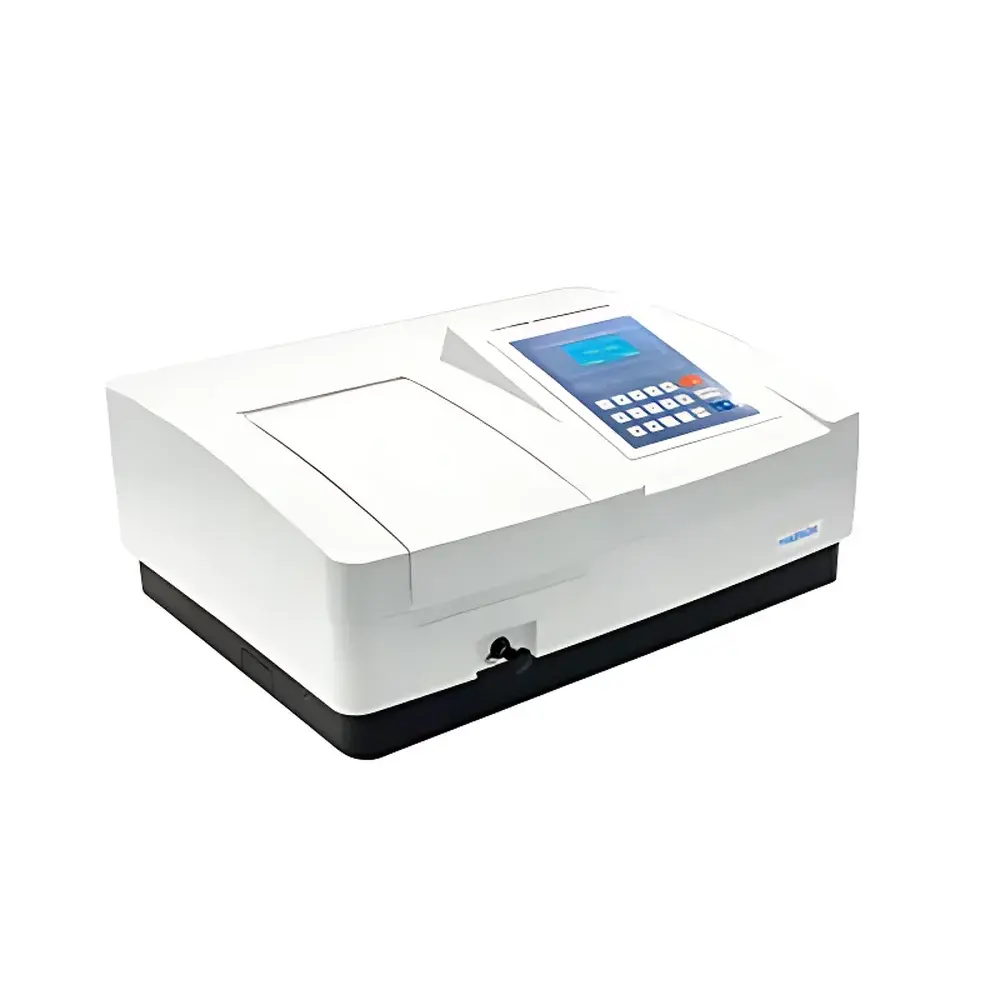
Mapada V-1600 Visible Spectrophotometer
| Brand | Mapada |
|---|---|
| Origin | Shanghai, China |
| Manufacturer Type | Direct Manufacturer |
| Regional Origin | Domestic (China) |
| Model | V-1600 |
| Price Range | USD 1,150 – 2,150 |
| Optical Design | Pseudo-Double-Beam |
| Detector | Silicon Photodiode (Imported) |
| Wavelength Range | 320–1100 nm |
| Wavelength Accuracy | ±0.5 nm |
| Spectral Bandwidth | 4 nm |
| Wavelength Setting | Motorized Auto-Scan |
| Display | 128 × 64 Dot-Matrix LCD |
| Measurement Modes | Transmittance (%T), Absorbance (A), Concentration (C), Energy (E) |
| Display Range | 0–200% T, –0.3 to 3.0 A |
| Light Source | Long-Life Tungsten Halogen Lamp |
| Data Interface | USB Port |
| Print Interface | Parallel Port |
| Power Supply | AC 220 V / 50 Hz or AC 110 V / 60 Hz |
| Dimensions (W×D×H) | 490 × 360 × 240 mm |
| Net Weight | 12 kg |
Overview
The Mapada V-1600 Visible Spectrophotometer is a precision optical instrument engineered for quantitative and qualitative analysis in the visible and near-UV spectral region (320–1100 nm). Based on pseudo-double-beam optical architecture, it compensates for source intensity drift and detector sensitivity variation by continuously referencing a fixed reference beam—enhancing measurement stability and long-term reproducibility without requiring manual baseline correction before each assay. The system employs a high-efficiency 1200-line/mm holographic grating monochromator and an imported silicon photodiode detector, delivering consistent photometric performance across its full wavelength range. Designed for routine laboratory use in quality control, environmental monitoring, educational instruction, and industrial R&D, the V-1600 complies with fundamental principles outlined in ISO 6425 (spectrophotometer performance verification) and aligns with technical expectations for Class B instruments per ASTM E275–22 (Standard Practices for Describing and Measuring Performance of UV-Visible Spectrophotometers).
Key Features
- Pseudo-double-beam optical path architecture for improved photometric stability and reduced baseline drift during extended operation.
- Motorized automatic wavelength scanning and positioning—enabling precise, repeatable spectral acquisition without manual adjustment.
- Integrated dual-lamp management: automatic switching between tungsten halogen lamp (for >350 nm) and optional deuterium lamp (not included, but socket-compatible); real-time lamp usage time logging for predictive maintenance.
- Large-capacity sample compartment accommodating cuvettes from 5 mm to 100 mm pathlength—including standard 10 mm square cells and micro-volume holders (adapter required).
- High-contrast 128 × 64 dot-matrix LCD display supporting simultaneous visualization of absorbance spectra, kinetic curves, calibration plots, and numerical data tables (up to 200 data points on-screen).
- Onboard memory stores up to 100 user-defined calibration curves and 200 independent measurement datasets—retained after power cycling.
- Plug-and-play USB interface compliant with USB 2.0 standards; supports direct connection to Windows-based PCs for data export, report generation, and remote instrument control.
- Modular lamp design: socket-mounted tungsten and (optional) deuterium lamps allow field replacement without optical realignment or recalibration.
Sample Compatibility & Compliance
The V-1600 accepts standard quartz, glass, or plastic cuvettes with optical path lengths ranging from 5 mm to 100 mm. Its wide dynamic range (–0.3 to 3.0 A) accommodates highly concentrated and dilute samples alike when paired with appropriate dilution protocols or variable-pathlength accessories. While classified as a visible-range spectrophotometer, its 320 nm lower limit permits limited near-UV applications such as nitrate/nitrite analysis (per EPA Method 353.2), certain dye assays, and transition metal complex quantification. The instrument meets essential electrical safety requirements per IEC 61010-1:2010 and conforms to electromagnetic compatibility (EMC) standards EN 61326-1:2013. It supports GLP-compliant workflows through timestamped data logging and software-assisted audit trails when used with Mapada’s optional professional scanning software.
Software & Data Management
The V-1600 operates standalone via front-panel controls, but achieves full functional expansion when paired with Mapada’s optional ScanPro Professional Software (Windows 10/11 compatible). This validated application enables full-spectrum scanning (320–1100 nm), time-resolved kinetic measurements, multi-wavelength quantitation, and advanced curve-fitting algorithms (linear, quadratic, cubic, and 4-parameter logistic models). All exported datasets are saved in CSV and XML formats—ensuring interoperability with LIMS platforms, Microsoft Excel, and statistical analysis tools. The software supports 21 CFR Part 11–ready configuration options including electronic signatures, user access levels, and immutable audit logs—facilitating compliance in regulated environments where documentation integrity is mandatory.
Applications
- Quantitative determination of analytes in pharmaceutical formulations (e.g., paracetamol, caffeine) per USP guidelines.
- Enzyme kinetics studies (e.g., NADH/NADPH oxidation at 340 nm) using time-scan mode with configurable interval timing.
- Water quality testing: phosphate, silicate, and iron concentration via colorimetric methods (APHA Standard Methods 4500-P E, 4500-SiO2 G).
- Food and beverage analysis: color index (L*a*b* derived), preservative content (e.g., sulfites), and pigment concentration (e.g., chlorophyll, anthocyanins).
- Academic teaching labs: Beer–Lambert law validation, spectral identification of dyes, and comparative analysis of absorption maxima across compound classes.
FAQ
Is the V-1600 capable of UV measurements below 320 nm?
No—the V-1600 is optimized for the visible spectrum and near-UV down to 320 nm. For true UV capability (190–320 nm), a dedicated UV-Vis spectrophotometer with deuterium lamp and quartz optics is required.
Can the instrument be calibrated to NIST-traceable standards?
Yes—users may perform wavelength calibration using certified holmium oxide or didymium filters, and photometric calibration using neutral density filters traceable to NIST SRM 930e.
Does the V-1600 support RS-232 or Ethernet connectivity?
No—it features only USB and parallel printer ports. Network integration requires external USB-to-Ethernet adapters configured at the host PC level.
What is the typical warm-up time before stable readings?
Less than 15 minutes under ambient laboratory conditions (20–25 °C); lamp stabilization and thermal equilibrium of the optical bench are complete within this period.
Is firmware upgrade supported in the field?
Yes—Mapada provides downloadable firmware updates via USB flash drive; version history and release notes are available upon request from authorized distributors.






