
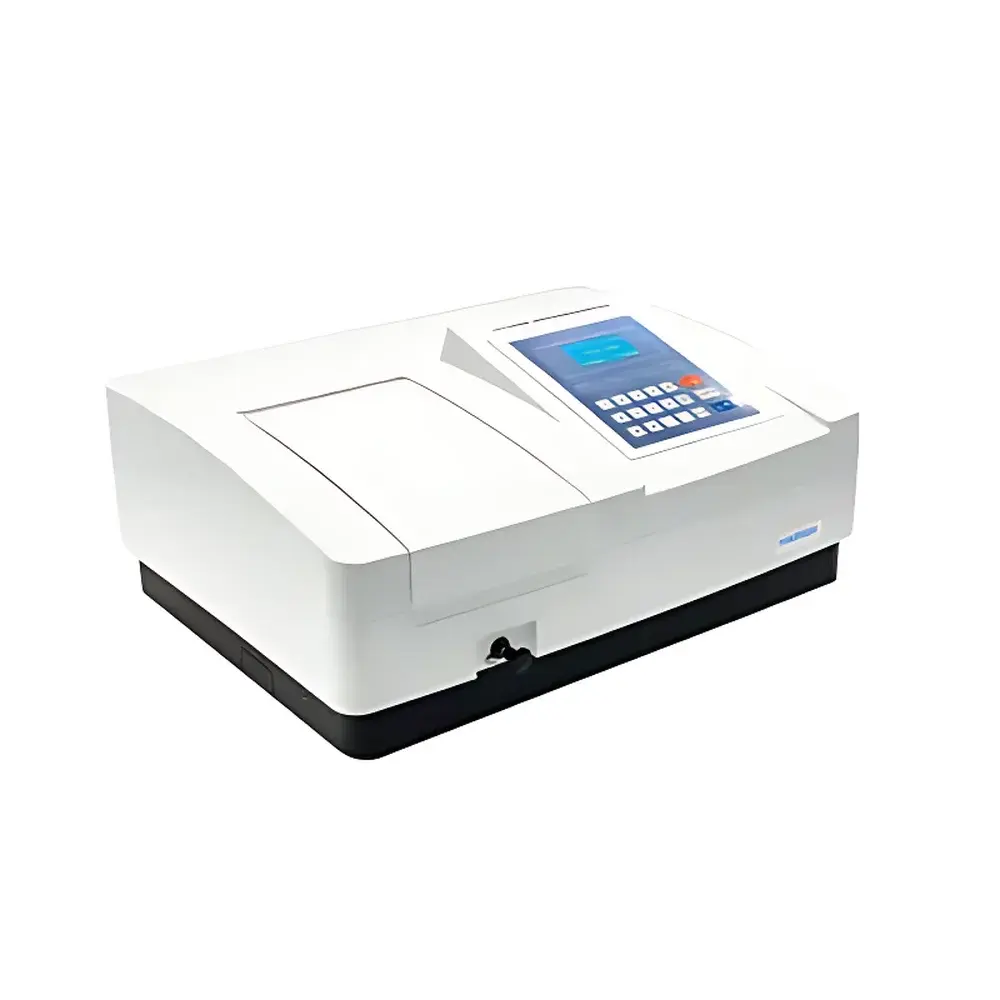
Mapada V-1800 Visible Spectrophotometer
| Brand | Mapada |
|---|---|
| Origin | Shanghai, China |
| Manufacturer Type | Original Equipment Manufacturer (OEM) |
| Product Category | Domestic |
| Model | V-1800 |
| Detector Type | Silicon Photodiode |
| Wavelength Range | 320–1100 nm |
| Automation Level | Automatic Wavelength Scanning |
| Spectral Bandwidth | 2 nm |
| Wavelength Accuracy | ±0.5 nm |
| Display | 128×64 Dot-Matrix LCD |
| Optical Path | Single-Beam with Dual-Lamp Auto-Switching (Tungsten Lamp Only for Visible Range) |
| Data Interface | USB Port |
| Print Interface | Parallel Port |
| Power Supply | AC 220 V / 50 Hz or AC 110 V / 60 Hz |
| Dimensions (W×D×H) | 470 × 370 × 180 mm |
| Net Weight | 14 kg |
Overview
The Mapada V-1800 Visible Spectrophotometer is a single-beam, microprocessor-controlled analytical instrument engineered for high-reproducibility absorbance and transmittance measurements in the visible and near-UV spectral region (320–1100 nm). It operates on the principle of Beer–Lambert law-based quantitative analysis, utilizing a fixed-grating monochromator with 1200 lines/mm holographic grating to deliver precise wavelength selection. Designed for routine laboratory applications—including quality control, educational instruction, and environmental monitoring—the V-1800 integrates a long-life imported tungsten-halogen lamp as its sole light source (optimized for ≥350 nm), automatic lamp switching logic (though no deuterium lamp is installed in this visible-only variant), and real-time lamp usage tracking. Its optical architecture ensures minimal stray light (<0.1% T at 360 nm), stable baseline performance, and compliance with fundamental photometric accuracy requirements defined in ISO 6060 and ASTM E275 for visible spectrophotometry.
Key Features
- 128×64 dot-matrix LCD display supporting simultaneous visualization of absorbance/transmittance spectra, calibration curves (with linear regression equation), kinetic time-scan profiles, and up to 200 stored measurement records
- Internal memory capacity for 100 user-defined calibration curves and 200 data sets—enabling offline quantitative analysis without PC connectivity
- Optimized optical train featuring a precision 1200 lines/mm blazed grating, thermally stabilized detector housing, and low-noise silicon photodiode detector for enhanced signal-to-noise ratio
- Full automation suite: automatic wavelength initialization, zero-adjustment, and lamp management—including runtime logging and intelligent warm-up sequencing
- Spacious sample compartment accommodating cuvettes from 5 mm to 100 mm pathlength, compatible with standard square and rectangular quartz/glass cells
- Tactile membrane keypad with dedicated function keys for rapid access to T/A/C/E modes, wavelength entry, and data recall
- USB 2.0 interface compliant with USB CDC class protocols—enabling direct communication with Windows-based host systems without proprietary drivers
- Modular lamp design: plug-in tungsten lamp assembly allows field replacement without optical realignment or collimation recalibration
Sample Compatibility & Compliance
The V-1800 is validated for use with transparent liquid samples in standard optical cuvettes (10 mm pathlength recommended for routine assays). It supports common solvents including water, ethanol, acetone, and dilute aqueous buffers. The instrument meets mechanical and electrical safety requirements per IEC 61010-1:2010 and electromagnetic compatibility (EMC) standards IEC 61326-1:2013. While not certified for GMP-regulated environments out-of-the-box, its data integrity features—including timestamped measurements, non-editable result logs, and USB-exportable CSV files—support alignment with GLP documentation practices. Optional Mapada SpectraPro software provides audit-trail functionality suitable for internal QA/QC workflows.
Software & Data Management
The V-1800 interfaces seamlessly with Mapada’s SpectraPro v3.x professional software (Windows 10/11 compatible), enabling advanced operational modes beyond onboard capabilities: full-wavelength scanning (320–1100 nm at 1 nm intervals), multi-point kinetic assays (up to 999 time points), multi-wavelength quantitation, and derivative spectral analysis. All acquired datasets are saved in native .msp binary format and exportable as ASCII text or Excel-compatible CSV. Software-generated reports include instrument metadata (serial number, lamp hours, calibration date), measurement parameters, and statistical summaries—facilitating traceability in academic and industrial settings. USB data transfer preserves original timestamp and measurement mode tags, ensuring chain-of-custody continuity.
Applications
- Routine concentration determination of colored analytes (e.g., Cu²⁺, Fe²⁺/Fe³⁺, nitrate, phosphate, dye intermediates) via standard curve methodology
- Enzyme kinetics monitoring (e.g., NADH/NADPH oxidation at 340 nm, though limited by absence of deuterium lamp)
- Water quality assessment: COD estimation, turbidity correction, and chromophore quantification in treated effluents
- Pharmaceutical excipient verification (e.g., color intensity of iron oxide pigments, titanium dioxide dispersion stability)
- Food science applications: carotenoid and chlorophyll quantification in plant extracts, browning index in fruit juices
- Academic teaching labs: validation of Lambert–Beer law, filter characterization, and comparative spectral analysis of transition metal complexes
FAQ
Does the V-1800 include a deuterium lamp for UV measurements below 350 nm?
No. The V-1800 is configured exclusively for visible-range operation (320–1100 nm) using a tungsten-halogen lamp. For true UV-Vis capability (190–1100 nm), consider the Mapada UV-1800 series.
Is wavelength calibration traceable to NIST standards?
The factory calibration uses holmium oxide and didymium glass reference filters; users may perform verification with optional NIST-traceable holmium oxide solution (NIST SRM 2034) or neutral density filters.
Can the instrument operate standalone without a computer?
Yes. All core functions—including photometric mode, quantitative analysis, and kinetic scanning—are fully functional via front-panel controls and internal memory.
What is the maximum sampling rate during kinetic measurements?
The instrument supports configurable time intervals from 0.5 s to 9999 s per point, with up to 200 data points stored internally.
Is the USB interface compatible with macOS or Linux systems?
The native USB port is CDC-class compliant; however, Mapada’s SpectraPro software is Windows-only. Raw data export via USB mass-storage emulation is not supported.






