
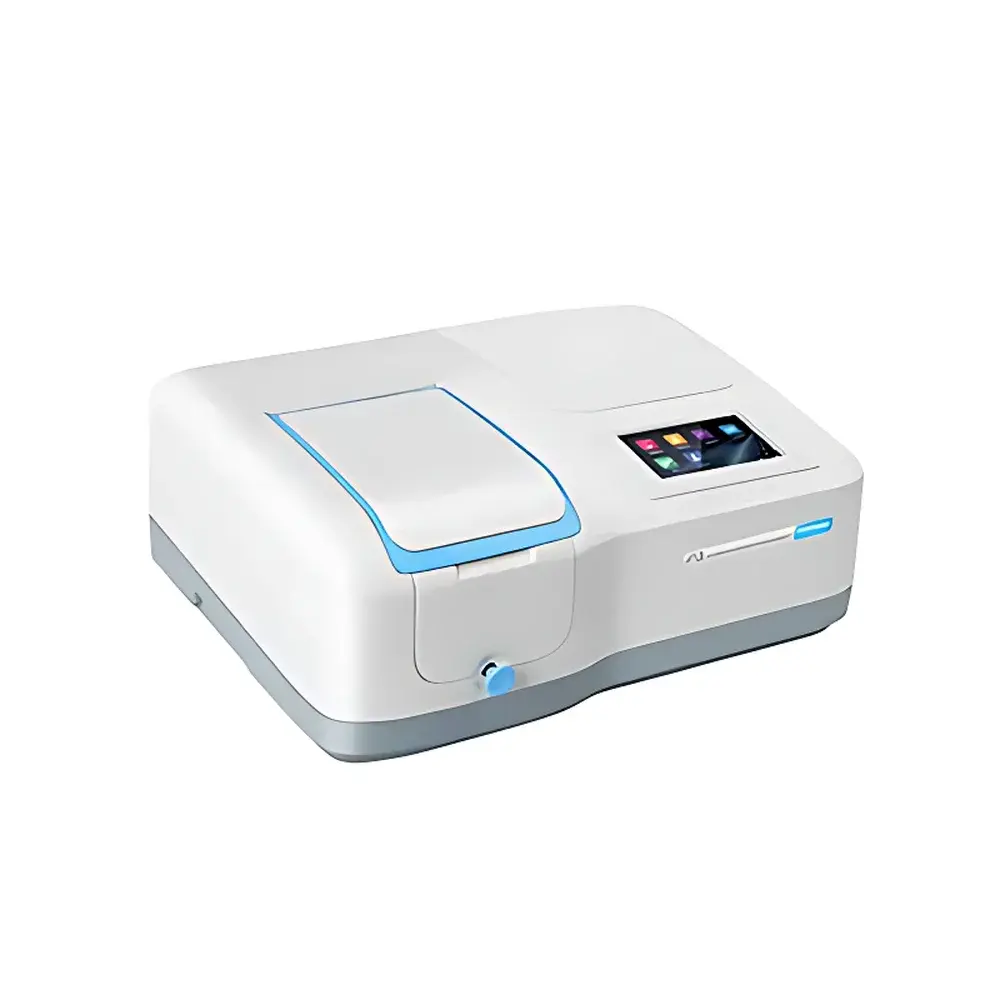
Mapada P3 Single-Beam Ultraviolet-Visible Spectrophotometer
| Brand | Mapada |
|---|---|
| Origin | Shanghai, China |
| Manufacturer Type | Original Equipment Manufacturer (OEM) |
| Product Origin | Domestic (China) |
| Model | P3 |
| Price Range | USD 1,400 – 2,800 |
| Optical Design | Single-Beam |
| Detector Type | Silicon Photocell |
| Wavelength Range | 190–1100 nm |
| Wavelength Scanning Mode | Motorized Auto-Scanning |
| Spectral Bandwidth | 4 nm |
| Wavelength Accuracy | ±0.5 nm |
Overview
The Mapada P3 Single-Beam Ultraviolet-Visible Spectrophotometer is a precision optical instrument engineered for routine quantitative and qualitative analysis of absorbance, transmittance, and concentration across the ultraviolet, visible, and near-infrared spectral regions. Based on Beer–Lambert law principles, the P3 employs a fixed single-beam optical architecture with a tungsten-halogen lamp for the visible–NIR range and a deuterium lamp for the UV region, enabling continuous spectral coverage from 190 nm to 1100 nm. Its 4 nm spectral bandwidth ensures adequate resolution for standard laboratory applications—including pharmaceutical assay validation, water quality monitoring, dye concentration profiling, and educational spectroscopy—while maintaining robust signal-to-noise performance under ambient lab conditions. Designed for reliability in high-throughput QC environments and teaching laboratories, the P3 delivers traceable wavelength accuracy of ±0.5 nm (verified against NIST-traceable holmium oxide and didymium filters), conforming to fundamental requirements outlined in ISO 6227:2020 (Spectrophotometers — Performance verification) and ASTM E275-22 (Standard Practice for Describing and Measuring Performance of UV–Vis Spectrophotometers).
Key Features
- Single-beam optical path with dual-lamp source switching (deuterium lamp for 190–350 nm; tungsten-halogen lamp for 350–1100 nm), ensuring stable baseline and minimal photometric drift during extended measurements.
- Motorized auto-wavelength scanning system with stepper-motor-driven monochromator, supporting programmable wavelength selection, fixed-wavelength mode, and time-scan kinetics over user-defined intervals.
- Silicon photocell detector offering linear response across full spectral range, optimized for low-noise analog signal acquisition and high repeatability (photometric repeatability ≤ ±0.002 A at 0.5 A).
- Integrated cuvette holder accommodating standard 10 mm pathlength cells (including optional holders for 5 mm, 20 mm, or micro-volume cells via accessory kit).
- Front-panel LCD interface with intuitive menu navigation, real-time spectrum preview, and direct access to common functions—absorbance, %T, concentration, and kinetic scan—without external software dependency.
- Rugged mechanical design with thermally stabilized optical bench and anti-vibration mounting, minimizing thermal drift and mechanical misalignment during multi-hour operation.
Sample Compatibility & Compliance
The P3 supports liquid, solution-phase samples in quartz, fused silica, or high-transmission glass cuvettes—compatible with organic solvents (e.g., acetonitrile, methanol, chloroform), aqueous buffers, and acidic/basic media within standard pH and UV transparency constraints. It meets core functional compliance for GLP-aligned workflows: wavelength calibration traceability per ISO/IEC 17025 guidelines, documented maintenance logs, and built-in self-test routines (lamp intensity check, zero alignment, and dark current verification). While not FDA 21 CFR Part 11–certified out-of-the-box, its data export capability (via RS-232 or USB-to-serial interface) enables integration into validated LIMS or ELN systems where audit trails and electronic signatures are managed externally.
Software & Data Management
The P3 operates autonomously via embedded firmware but is fully compatible with Mapada’s optional Windows-based PC control software (v3.2.1), which provides advanced functionality including spectral overlay, derivative spectroscopy, peak identification, multi-component analysis using classical least-squares algorithms, and customizable report generation compliant with internal SOP templates. Raw absorbance/time/wavelength data exports in CSV and ASCII formats support downstream processing in MATLAB, Python (NumPy/Pandas), or statistical packages such as JMP and Minitab. All software modules undergo version-controlled release cycles and include digital signature verification to ensure integrity during installation.
Applications
- Pharmaceutical quality control: Assay of active pharmaceutical ingredients (APIs) per USP and EP 2.2.25, including dissolution testing and excipient interference screening.
- Environmental analysis: Quantification of nitrate, phosphate, COD, and heavy metal complexes (e.g., Cr(VI) via diphenylcarbazide method) in wastewater and surface water per EPA Methods 353.2 and 365.1.
- Food & beverage: Color index determination (e.g., AOAC 971.25 for honey), preservative content (sorbic acid, benzoic acid), and antioxidant capacity (FRAP assay).
- Academic instruction: Teaching core concepts in molecular absorption theory, ligand field transitions, conjugated system characterization, and calibration curve methodology aligned with ACS and RSC undergraduate curricula.
- Materials science: Thin-film transmittance/absorption profiling of transparent conductive oxides (TCOs) and polymer optical filters in the UV–VIS–NIR range.
FAQ
What is the recommended calibration frequency for the P3?
We recommend wavelength calibration every 3 months using certified holmium oxide reference standards, and photometric calibration annually using neutral density filters traceable to NIST SRM 930e.
Can the P3 measure turbid or particulate-containing samples?
The P3 is optimized for clear, homogeneous solutions. For turbid samples, users should apply appropriate filtration (e.g., 0.45 µm PVDF membrane) or employ matched cuvettes with scattering correction protocols—though dedicated double-beam or integrating sphere configurations are advised for routine suspension analysis.
Is the deuterium lamp replaceable by the end user?
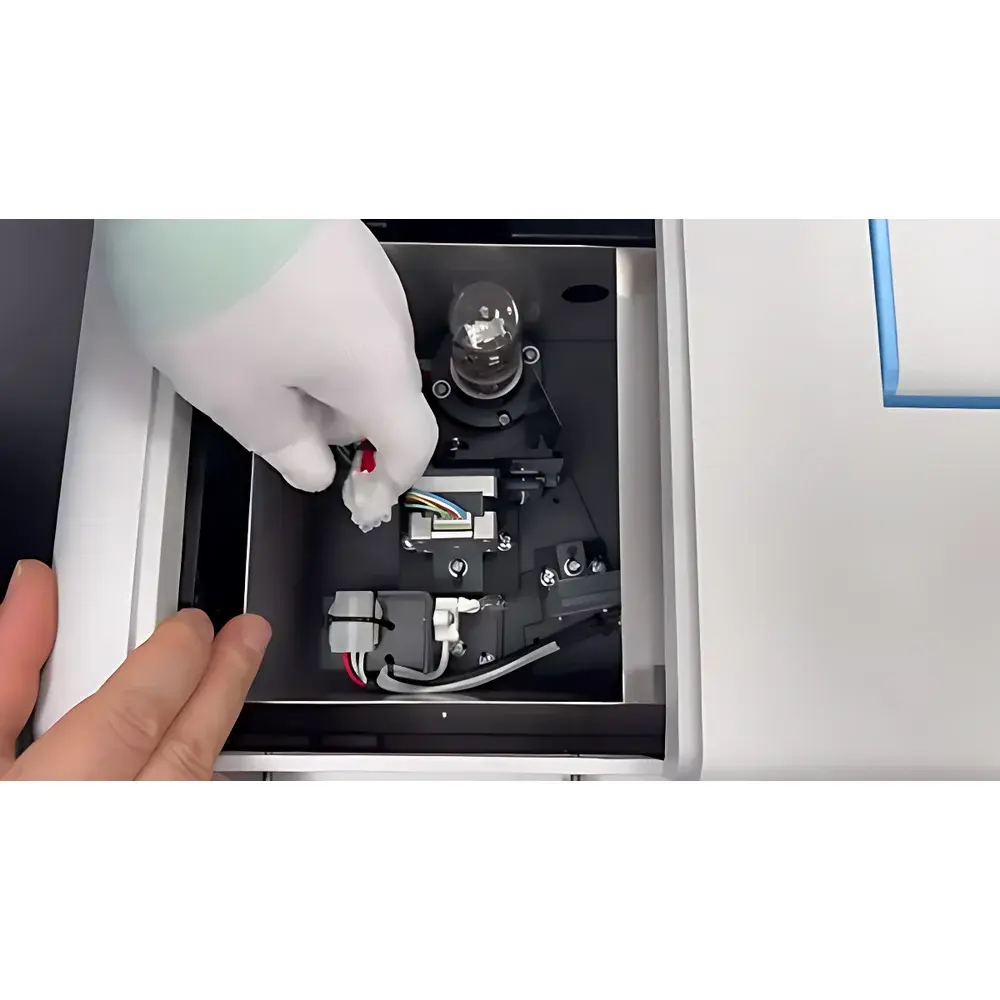
Yes—the lamp module is field-replaceable with standard Torx T10 tools and requires no optical realignment; lamp lifetime is rated at ≥1,000 hours under typical usage conditions.
Does the P3 support GLP-compliant data archiving?
While the instrument itself does not generate electronic signatures or audit trails, all measurement metadata (date/time stamp, operator ID input, method name, and raw spectra) are embedded in exported files—enabling full traceability when imported into validated third-party data management platforms.
What power supply specifications does the P3 require?
The P3 operates on 100–240 V AC, 50/60 Hz, with internal universal switching power supply; no external voltage stabilizer is required under standard laboratory electrical conditions (IEC 61000-4-11 compliant).




