
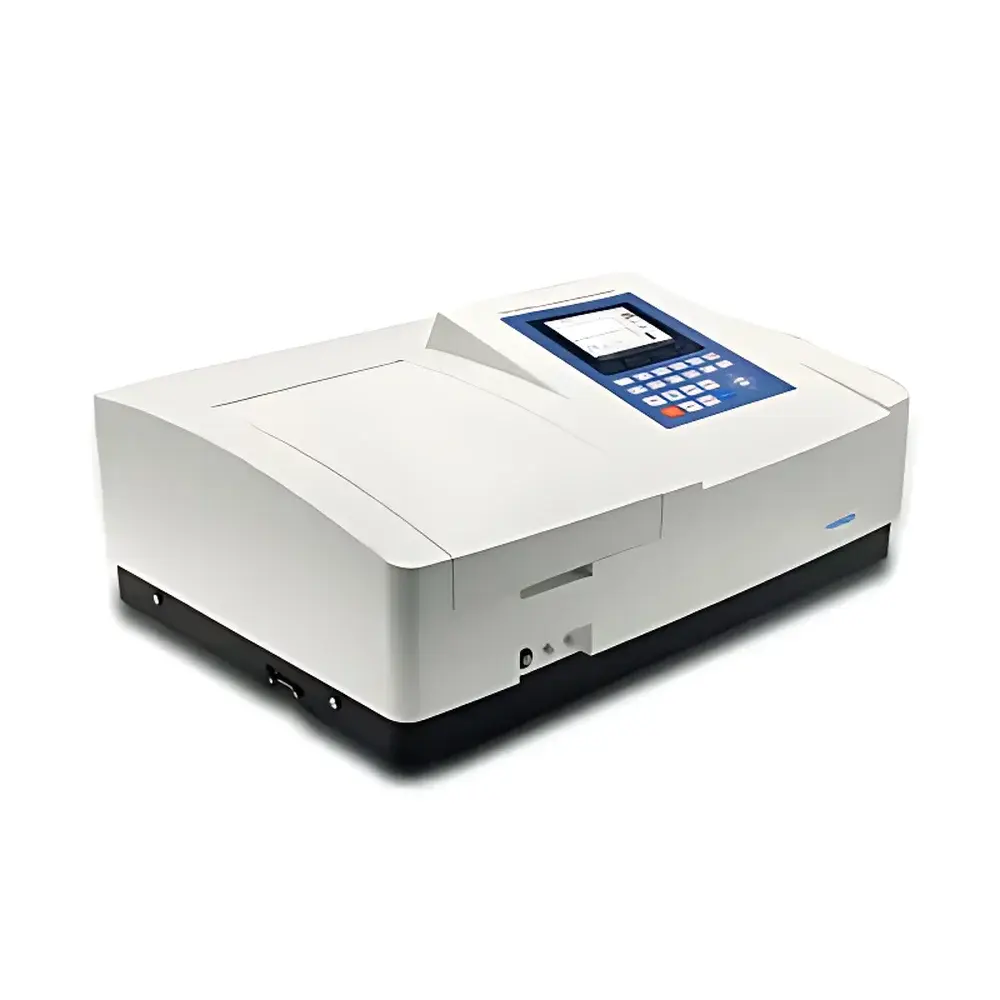
Mapada UV-3100PC Scanning Ultraviolet-Visible Spectrophotometer
| Brand | Mapada |
|---|---|
| Origin | Shanghai, China |
| Manufacturer Type | Direct Manufacturer |
| Instrument Architecture | Pseudo-Double-Beam |
| Detector | Silicon Photodiode (Imported) |
| Wavelength Range | 190–1100 nm |
| Spectral Bandwidth | 2 nm |
| Wavelength Accuracy | ±0.5 nm |
| Display | 320 × 240 LCD (5-inch) |
| Operating Modes | Transmittance (T), Absorbance (A), Concentration (C), Energy (E) |
| Scan Speed Options | High/Medium/Low (up to 3800 nm/min) |
| Wavelength Setting | Automatic |
| Photometric Range | 0–200% T, –4.0 to +4.0 A |
| Light Sources | Imported long-life deuterium lamp & tungsten-halogen lamp |
| Sample Compartment | Accommodates cuvettes from 5 mm to 100 mm pathlength |
| Data Interface | USB port |
| Printer Interface | Parallel port |
| Power Supply | AC 220 V/50 Hz or AC 110 V/60 Hz |
| Dimensions (W × D × H) | 490 × 360 × 240 mm |
| Net Weight | 14 kg |
Overview
The Mapada UV-3100PC is a pseudo-double-beam scanning ultraviolet-visible (UV-Vis) spectrophotometer engineered for routine and research-grade quantitative and qualitative analysis in academic, pharmaceutical, environmental, and industrial laboratories. Based on the principle of Beer–Lambert law absorption spectroscopy, the instrument measures the intensity of light transmitted through or reflected from a sample across a continuous wavelength range (190–1100 nm), enabling precise determination of analyte concentration, spectral characterization, kinetic profiling, and method validation. Its optical architecture incorporates a high-efficiency 1200 lines/mm holographic grating and a thermally stabilized silicon photodiode detector, delivering consistent photometric performance with minimal stray light contribution. The system employs imported deuterium and tungsten-halogen lamps—both designed for extended operational lifetime—and features ozone-reduced deuterium lamp housing to support safe benchtop deployment in non-ventilated environments.
Key Features
- Pseudo-double-beam optical design minimizes baseline drift and improves photometric stability during extended scans or temperature fluctuations.
- 5-inch high-resolution 320 × 240 monochrome LCD display supports real-time visualization of absorbance/transmittance spectra, calibration curves, kinetic time courses, and multi-wavelength overlays—fully navigable via intuitive Chinese-English bilingual menu interface.
- Modular lamp assembly with socket-type mounting allows rapid, alignment-free replacement of both deuterium and tungsten lamps—eliminating recalibration downtime and reducing maintenance overhead.
- Integrated lamp-hour monitoring system logs cumulative usage time for each source, supporting predictive maintenance planning and GLP-compliant instrument lifecycle documentation.
- Wide sample compartment accommodates standard rectangular cuvettes (5–100 mm pathlength), flow cells, and optional accessories including temperature-controlled holders and solid-sample reflectance attachments.
- Onboard GLP self-diagnostic function enables user-initiated verification of wavelength accuracy (via holmium oxide or didymium filter) and photometric accuracy (using neutral density filters), generating timestamped compliance reports traceable to internal audit logs.
- USB interface supports direct data export to external storage devices or host PCs; parallel port enables direct connection to legacy dot-matrix or thermal printers for hard-copy documentation of spectra and quantitative results.
Sample Compatibility & Compliance
The UV-3100PC is compatible with liquid-phase samples in quartz, glass, or plastic cuvettes, as well as solid and semi-solid specimens using optional diffuse reflectance or integrating sphere modules. It meets core requirements for method validation under ISO/IEC 17025-accredited testing laboratories and supports analytical workflows aligned with pharmacopeial standards (e.g., USP , EP 2.2.25). While not inherently 21 CFR Part 11 compliant in standalone mode, its Mapada professional scanning software (included) provides optional electronic signature capability, audit trail logging, and user-access control when deployed on validated Windows platforms—facilitating GxP-aligned operation where required.
Software & Data Management
The instrument operates natively via embedded firmware but achieves full functionality when connected to a Windows PC running Mapada’s proprietary UV-Vis scanning software. This application enables advanced spectral processing—including baseline correction, peak detection, derivative spectroscopy, multi-component analysis, and custom equation-based concentration calculation. All acquired datasets—including raw spectra, kinetic series, and calibration tables—are stored in vendor-neutral ASCII or CSV formats, ensuring long-term readability and compatibility with third-party statistical or chemometric tools (e.g., MATLAB, Origin, R). Internal memory retains up to 500 spectra and 100 method configurations, with unlimited archival capacity via USB export.
Applications
- Quantitative assay of nucleic acids and proteins (e.g., A260/A280 ratios, Bradford/Lowry assays)
- Pharmaceutical quality control: assay uniformity, dissolution testing, excipient interference screening
- Environmental monitoring: nitrate, phosphate, COD, and heavy metal ion quantification via colorimetric protocols
- Food and beverage analysis: pigment content (anthocyanins, carotenoids), antioxidant capacity (FRAP, DPPH)
- Chemical kinetics: real-time monitoring of reaction progress under controlled conditions
- Educational laboratories: demonstration of electronic transitions, solvent effects, and ligand-field theory
FAQ
What is the optical configuration of the UV-3100PC, and how does it differ from true double-beam systems?
The UV-3100PC utilizes a pseudo-double-beam design: a single beam is split temporally—not spatially—by a rotating sector mirror, alternating rapidly between sample and reference paths. This architecture reduces cost and complexity while maintaining adequate baseline stability for most routine applications, though it does not compensate for instantaneous source fluctuations like a simultaneous dual-detector system.
Is the instrument suitable for regulatory submissions under FDA or EMA guidelines?
As supplied, the UV-3100PC satisfies technical performance criteria outlined in USP and ISO 14731 for UV-Vis instrumentation. For regulated environments requiring electronic records integrity, implementation must include validated software, documented IQ/OQ/PQ protocols, and procedural controls per ALCOA+ principles.
Can the UV-3100PC perform spectral deconvolution or multivariate calibration?
No—the onboard firmware and standard Mapada software do not include chemometric modeling engines. However, exported ASCII spectra are fully compatible with external multivariate analysis packages such as Unscrambler or Pirouette.
What lamp lifetime can be expected under typical usage conditions?
The imported deuterium lamp is rated for ≥2000 hours; the tungsten-halogen lamp for ≥5000 hours. Actual service life depends on duty cycle, warm-up/cool-down frequency, and ambient operating temperature.
Does the instrument support automatic wavelength calibration using internal standards?
No internal calibration standard is integrated. Wavelength verification requires external reference materials (e.g., holmium oxide solution, didymium filter) and manual execution of the GLP self-test procedure.




