
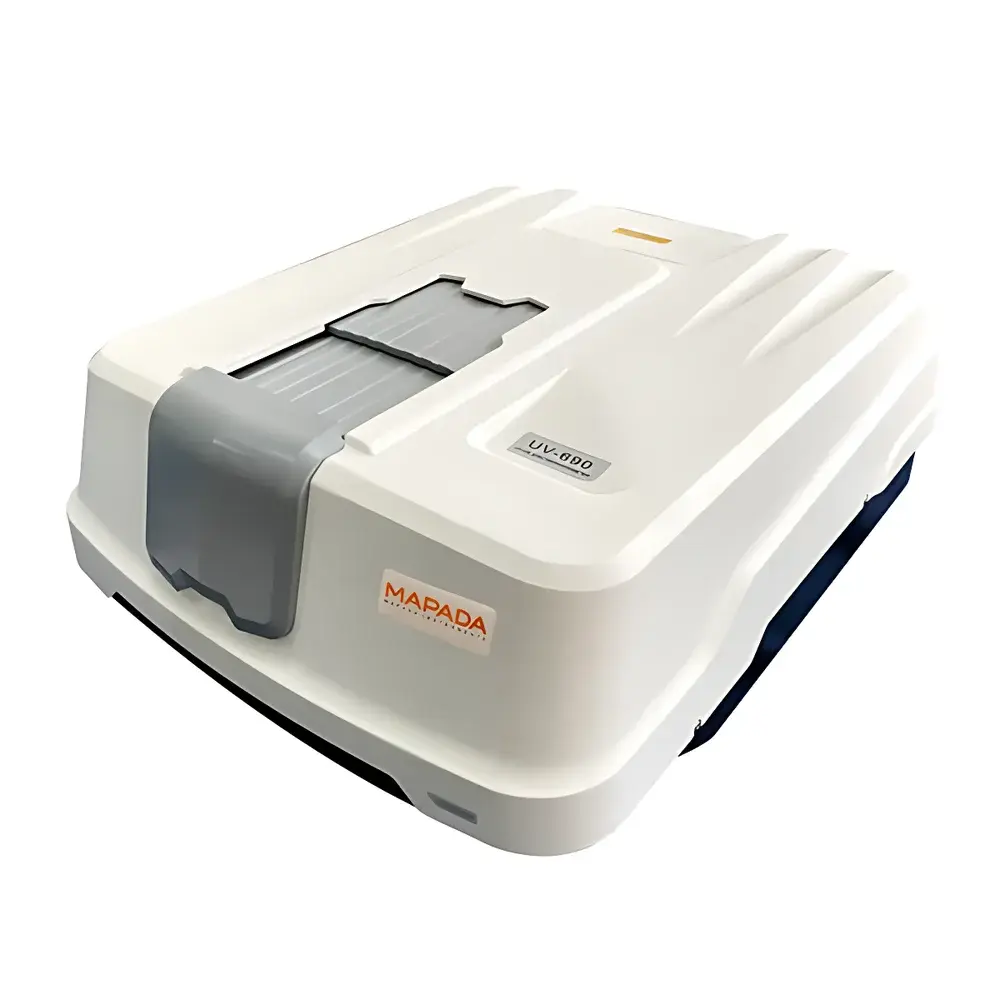
Mapada UV-670 Dual-Beam Ultraviolet-Visible Spectrophotometer
| Brand | Mapada |
|---|---|
| Origin | Shanghai, China |
| Manufacturer Type | Direct Manufacturer |
| Instrument Type | Domestic |
| Model | UV-670 |
| Price Range | USD 14,000–21,000 (FOB Shanghai) |
| Optical Design | Dual-Beam |
| Detector | Photomultiplier Tube (PMT) |
| Wavelength Scanning | Motorized Auto-Scanning |
| Wavelength Range | 190–900 nm |
| Spectral Bandwidth | 0.1 / 0.2 / 0.5 / 1.0 / 2.0 / 4.0 nm (selectable) |
| Wavelength Accuracy | ±0.3 nm |
| Wavelength Repeatability | ≤0.1 nm |
| Light Source | Imported Long-Life Deuterium Lamp & Tungsten-Halogen Lamp |
| Grating | Holographic, 1600 lines/mm |
| Measurement Modes | Absorbance (A), Transmittance (T), Concentration (C), Energy (E) |
| Data Interface | USB 2.0 + Parallel Printer Port |
| Power Supply | AC 220 V / 50 Hz or AC 110 V / 60 Hz |
| Dimensions | 600 × 480 × 260 mm |
| Weight | 32 kg |
Overview
The Mapada UV-670 is a high-performance dual-beam ultraviolet-visible (UV-Vis) spectrophotometer engineered for precision quantitative and qualitative analysis across academic research laboratories, pharmaceutical quality control (QC), environmental monitoring, and industrial R&D settings. It operates on the fundamental principle of Beer–Lambert law-based absorbance measurement, utilizing a stable dual-beam optical architecture to continuously compensate for source intensity drift and detector response variation. This design ensures high photometric stability and long-term baseline reproducibility—critical for kinetic studies, multi-point calibration, and compliance-driven workflows. The instrument integrates a holographic grating (1600 lines/mm) with motorized wavelength scanning and real-time beam balancing, enabling reliable spectral acquisition from deep UV (190 nm) through near-infrared (900 nm). Its broad wavelength coverage and variable spectral bandwidth selection support diverse applications—from nucleic acid quantification at 260 nm to colorimetric assays in the visible range and solvent cutoff evaluation in UV-transparent solvents.
Key Features
- Dual-beam optical path with real-time reference beam compensation for enhanced photometric accuracy and reduced baseline drift over extended measurement sessions.
- Selectably adjustable spectral bandwidth (0.1–4.0 nm in six discrete steps), allowing users to optimize resolution versus signal-to-noise ratio based on sample matrix complexity and regulatory requirements.
- High-sensitivity photomultiplier tube (PMT) detector with low dark current and wide dynamic range, enabling detection of low-concentration analytes and high-transmittance measurements with <1%T resolution.
- Imported long-life deuterium and tungsten-halogen lamps provide stable, low-noise output across the full 190–900 nm range, minimizing lamp replacement frequency and associated downtime.
- Motorized automatic wavelength scanning with ±0.3 nm accuracy and ≤0.1 nm repeatability—validated per ISO 8579-1 and ASTM E275 for spectrophotometer performance verification.
- Modular PC-controlled operation via USB 2.0 interface; supports both standalone use (with optional external monitor/keyboard) and integrated software-driven workflows.
Sample Compatibility & Compliance
The UV-670 accommodates standard 10-mm rectangular quartz or glass cuvettes, as well as micro-volume adapters (e.g., 50–200 µL pathlength options) and optional fiber-optic probes for non-contact or flow-through configurations. Its optical design meets the essential performance criteria outlined in pharmacopeial standards—including USP <857>, EP 2.2.25, and JP 2.05—for UV-Vis absorbance instrumentation used in assay validation and release testing. While not pre-certified for FDA 21 CFR Part 11, the system supports audit-trail-capable third-party software integration (e.g., LabSolutions UV-Vis or custom LIMS interfaces) to fulfill GLP/GMP data integrity requirements. All firmware and calibration protocols are traceable to NIST-traceable reference materials (e.g., holmium oxide, didymium, and potassium dichromate solutions).
Software & Data Management
The UV-670 operates with Mapada’s proprietary UVWin software (Windows 10/11 compatible), offering intuitive method setup, spectral overlay, peak identification, derivative spectroscopy, and multi-component quantitative analysis using simultaneous equation solving. Raw spectral data are exported in ASCII (.txt) and CSV formats for post-processing in MATLAB, Origin, or Python-based analytical pipelines. The USB interface enables direct instrument control from custom scripts (via LabVIEW or Python pySerial), supporting automated batch processing in regulated environments. Data files include embedded metadata—date/time stamp, operator ID (if configured), instrument serial number, and measurement parameters—ensuring ALCOA+ (Attributable, Legible, Contemporaneous, Original, Accurate) compliance when paired with appropriate procedural controls.
Applications
- Pharmaceutical QC: Active pharmaceutical ingredient (API) assay, excipient purity screening, dissolution profile monitoring, and cleaning validation swab extract analysis.
- Life sciences: DNA/RNA quantification and purity assessment (A260/A280, A260/A230), protein concentration determination (Bradford, BCA, Lowry), and enzyme kinetics (e.g., NADH/NADPH oxidation at 340 nm).
- Environmental testing: Nitrate/nitrite, phosphate, heavy metal (e.g., Cr(VI), Fe(II)) and organic pollutant (e.g., phenol, formaldehyde) quantification per EPA methods 353.2, 365.2, and ISO 6878.
- Materials science: Thin-film transmittance/absorbance mapping, bandgap estimation of semiconductors, and dye stability profiling under accelerated UV exposure.
- Food & beverage: Color index (e.g., AOAC 993.02), antioxidant capacity (FRAP, DPPH), and adulterant detection (e.g., melamine in milk via complexometric reaction).
FAQ
What is the typical warm-up time required before achieving photometric stability?
The UV-670 achieves thermal and electronic equilibrium within 30 minutes after power-on, with optimal stability attained after 45 minutes—consistent with ISO 8579-1 recommendations for routine calibration.
Can the instrument be validated according to IQ/OQ/PQ protocols?
Yes. Comprehensive validation documentation—including test protocols, acceptance criteria, and raw data templates—is available upon request and aligns with ASTM E2500 and EU Annex 15 guidelines.
Is there an option for GMP-compliant electronic signatures and audit trails?
The base instrument does not include embedded 21 CFR Part 11 functionality; however, it interoperates with validated third-party chromatography data systems (CDS) and LIMS platforms that provide full electronic signature and audit trail capabilities.
How often should wavelength calibration be performed?
Wavelength calibration is recommended prior to each analytical session or at least daily in high-throughput labs; verification using holmium oxide solution (NIST SRM 2034) is advised weekly or after lamp replacement.
What maintenance is required for the PMT detector?
The PMT requires no user-serviceable parts and is sealed for lifetime operation; periodic verification of dark current and gain response—using built-in diagnostics—is sufficient under normal usage conditions.





