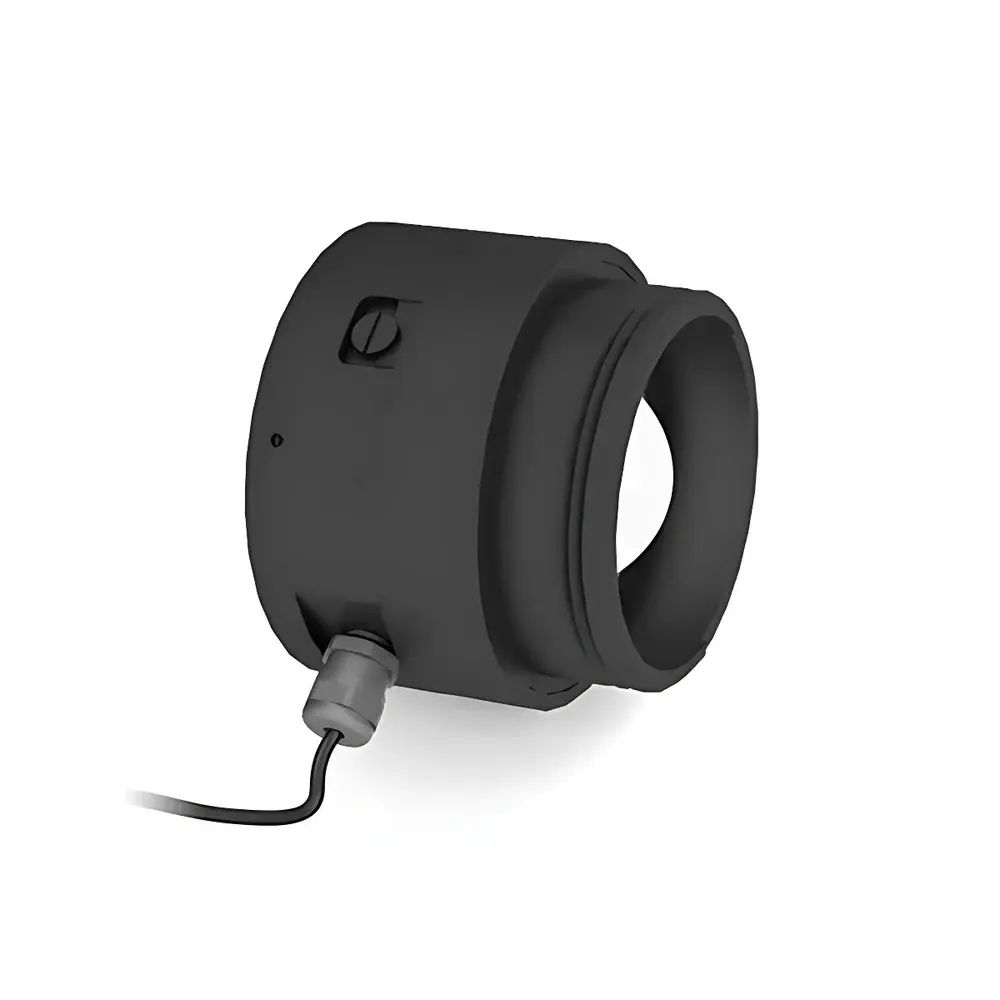
Marzhauser LED 100 Microscope Illumination Source
| Brand | Marzhauser |
|---|---|
| Origin | Germany |
| Model | LED 100 |
| Power Input | ~3 W |
| Color Options | Cool White / Warm White |
| Brightness Range | 0.5–100% (infinitely adjustable) |
| Beam Divergence | ~5° |
| Turn-on Delay | ~35 µs |
| Turn-off Delay | ~25 µs |
| Operating Voltage | 10.8–13.2 V DC |
| Housing Material | Anodized Black Aluminum |
| Weight | ~0.5 kg (including 2 m cable) |
| Dimensions | Ø69.5 mm × 37.3 mm (excluding adapter) |
| Compliance | RoHS-compliant, halogen-free, mercury-free |
Overview
The Marzhauser LED 100 is a high-performance, solid-state illumination source engineered specifically for upright and inverted optical microscopes used in life science research, pathology, and industrial quality control laboratories. Unlike conventional halogen or metal-halide lamps, the LED 100 operates on a precisely regulated constant-current driver architecture to deliver stable, flicker-free illumination across its full intensity range. Its core measurement principle relies on high-efficiency phosphor-converted white LED emitters coupled with precision collimation optics—ensuring minimal thermal load on specimens and optical pathways while maintaining consistent chromaticity and spectral stability over time. Designed for integration into both manual and motorized microscope platforms, the LED 100 serves as a drop-in replacement for legacy illumination systems without requiring modifications to the microscope’s optical train or mechanical structure.
Key Features
- Ultra-low power consumption (~3 W), reducing energy costs and heat dissipation in temperature-sensitive imaging environments
- Extended operational lifetime (>20,000 hours) with zero maintenance requirements—no lamp replacements, no filament degradation, no output drift
- Flicker-free, non-modulated output synchronized to camera frame rates; eliminates interference with sCMOS, EMCCD, and scientific CMOS detectors
- Negligible thermal emission (<1.5 °C surface temperature rise at full output), preserving live-cell viability and preventing stage drift during long-term timelapse experiments
- Sub-millisecond switching dynamics (35 µs turn-on, 25 µs turn-off), enabling precise temporal control when paired with Marzhauser’s TANGO controller or DSU-1 control unit
- Infinitely adjustable brightness (0.5–100%) via analog voltage input or digital TTL/USB command—supports intensity ramping, multi-channel synchronization, and hardware-triggered exposure gating
- Compact, lightweight aluminum housing (Ø69.5 mm × 37.3 mm) with black anodized finish for optimal stray-light suppression and EMI shielding
Sample Compatibility & Compliance
The LED 100 is compatible with all major microscope brands—including Zeiss, Leica, Nikon, Olympus, and Motic—via standard C-mount, SMA905, or custom adapter interfaces. Its narrow beam divergence (~5°) ensures efficient coupling into Köhler illumination paths without vignetting or hotspot formation. The device conforms to EU Directive 2011/65/EU (RoHS 2), containing no mercury, lead, cadmium, hexavalent chromium, polybrominated biphenyls (PBB), or polybrominated diphenyl ethers (PBDE). It meets IEC 61000-6-3 (EMC emission limits) and IEC 61000-6-2 (immunity standards) for laboratory-grade instrumentation. While not classified as a medical device under MDR 2017/745, it supports GLP/GMP-aligned workflows through deterministic intensity control and audit-ready triggering logs when used with TANGO or DSU-1 units compliant with FDA 21 CFR Part 11 electronic record requirements.
Software & Data Management
The LED 100 operates natively with Marzhauser’s TANGO microscope control platform and DSU-1 dedicated illumination controller. Both support USB 2.0 and RS-232 communication protocols, enabling bidirectional parameter interrogation (e.g., actual current draw, thermal status, firmware version) and real-time intensity modulation. Integration with third-party acquisition software—including Micro-Manager, NIS-Elements, ZEN Blue, and MetaMorph—is achieved via standardized TTL trigger inputs and analog 0–5 V control signals. All intensity adjustments are logged with timestamp resolution ≤1 ms when recorded through the controller’s internal memory or external DAQ system—facilitating reproducible experimental metadata capture per ISO/IEC 17025 clause 7.7.
Applications
- Widefield fluorescence microscopy requiring stable excitation intensity across multi-color acquisitions
- Time-lapse imaging of thermally sensitive biological samples (e.g., zebrafish embryos, neuronal cultures)
- Phase contrast and DIC imaging where consistent contrast-to-noise ratio depends on illumination uniformity
- Automated slide scanning systems demanding rapid on/off cycling between fields of view
- Teaching laboratories seeking reliable, low-cost illumination with no consumables or calibration routines
- Industrial metrology setups using transmitted light inspection of semiconductor wafers or thin-film coatings
FAQ
Can the LED 100 be used with older microscopes lacking digital control interfaces?
Yes—it supports analog 0–5 V dimming and passive TTL triggering, allowing seamless integration with legacy microscopes equipped only with basic power supplies or mechanical shutter controllers.
Is spectral output data available for quantitative fluorescence applications?
Marzhauser provides normalized relative spectral power distribution (SPD) curves for both cool white and warm white variants upon request, referenced to NIST-traceable spectroradiometric calibration.
Does the LED 100 require active cooling or forced airflow?
No—its thermally optimized aluminum housing and low-power architecture enable passive convection cooling under continuous operation at ambient temperatures up to 40 °C.
How is intensity linearity verified across the 0.5–100% range?
Each unit undergoes factory calibration using a calibrated photodiode sensor traceable to PTB (Physikalisch-Technische Bundesanstalt), with linearity deviation <±1.2% across the full range.
What mounting options are supported for vertical or inverted configurations?
Standard adapters include C-mount, M27×0.75, and custom-machined brackets for OEM integration; mechanical drawings and STEP files are available under NDA.