
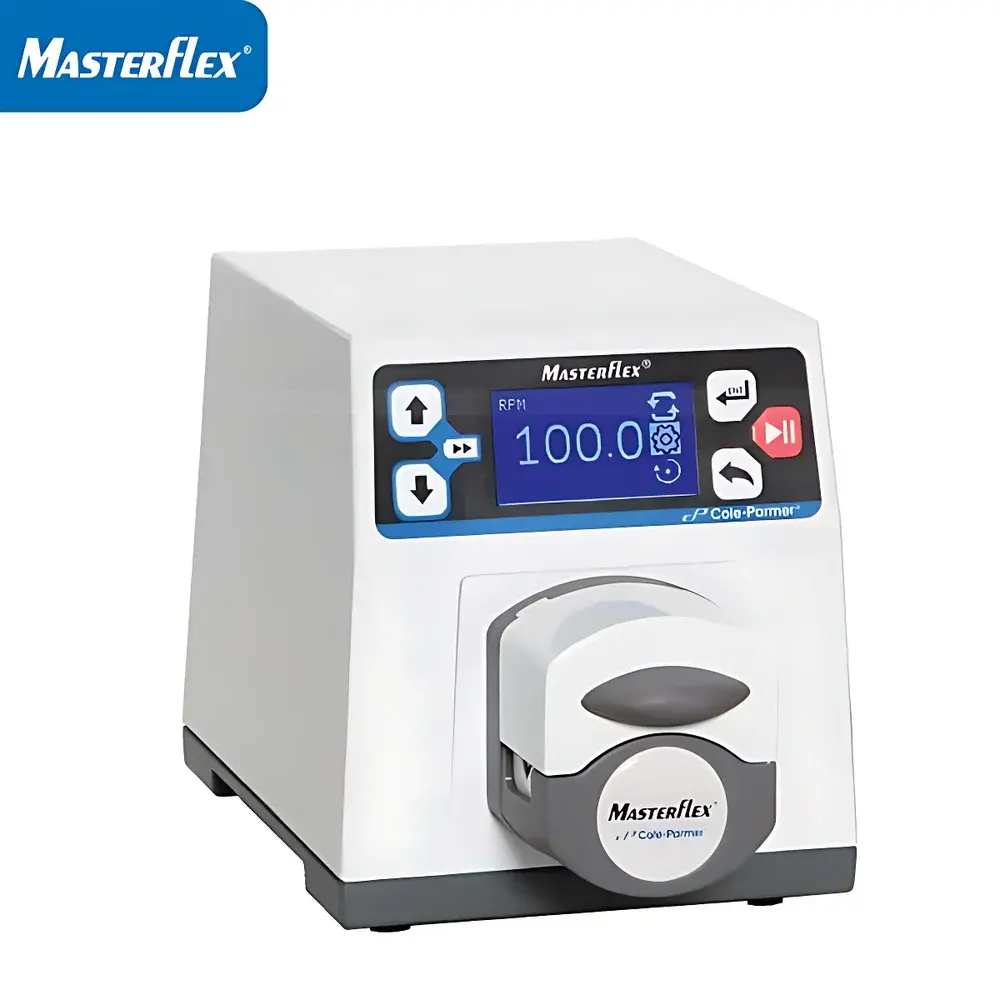
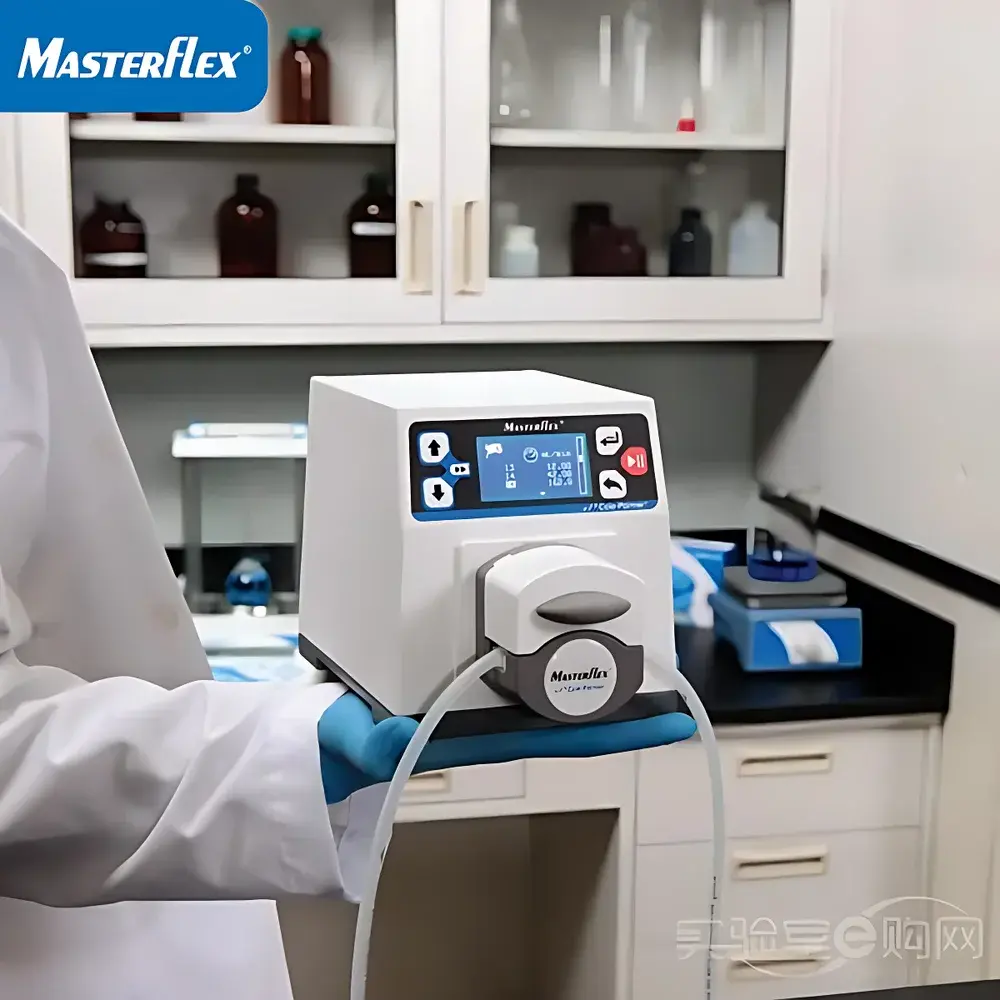
Masterflex L/S Digital Miniflex Peristaltic Pump
| Brand | Masterflex |
|---|---|
| Origin | USA |
| Model | 07525-20 |
| Flow Rate Range | 0.004–315 mL/min |
| Speed Range | 0.1–300 rpm |
| Accuracy (Repeatability) | ±0.1% |
| Motor | Bidirectional DC |
| IP Rating | IP33 |
| Dimensions (L×W×H) | 23.9 × 14.0 × 15.7 cm |
| Power Supply | 90–260 VAC, 50/60 Hz |
| Weight | 0.2 kg (at 230 VAC) |
| Certifications | NIST-traceable calibration available (Option 17050-01) |
Overview
The Masterflex L/S Digital Miniflex Peristaltic Pump is a compact, precision-engineered peristaltic pumping system designed for reliable, contamination-free fluid handling in analytical laboratories, bioprocessing workflows, and quality control environments. Operating on the principle of positive displacement via occlusion—where rollers compress flexible tubing against a curved housing to generate flow—the Miniflex delivers highly repeatable volumetric delivery without internal wetted parts. Its digital drive architecture integrates microprocessor-based speed control with real-time feedback, enabling stable operation across a wide dynamic range (0.1–300 rpm) while maintaining ±0.1% repeatability under consistent load conditions. The pump’s modular design supports both single- and dual-channel configurations (models 07525-20 and 07525-40), making it suitable for applications requiring parallel or sequential fluid transfer, such as reagent dispensing, sample dilution, or continuous perfusion in cell culture systems.
Key Features
- Digital speed control with intuitive icon-based menu interface and LED display for precise rpm setting and status monitoring
- Open-head sensor (OHS) safety interlock: automatically halts motor operation when the pump head is opened, complying with laboratory equipment safety best practices
- Auto-tube positioning mechanism ensures rapid, repeatable tube loading and alignment—minimizing setup time and operator variability
- Durable ABS housing with wipe-clean surface, supporting routine decontamination in regulated environments (e.g., ISO Class 5–8 cleanrooms)
- Miniflex pump head engineered with broad occlusion angle and self-lubricating thermoplastic polyester rollers—reducing friction, wear, and backflow at rated pressure limits
- Rear-panel DB25 male connector enables seamless integration into automated systems via TTL, analog voltage (0–10 V), or RS-232 signals (with optional interface modules)
- Stackable chassis design allows vertical space optimization in crowded benchtop settings without compromising ventilation or service access
Sample Compatibility & Compliance
The Miniflex accommodates standard L/S-series silicone or fluoropolymer tubing (e.g., L/S 13, L/S 14, L/S 16, L/S 25), with flow performance calibrated per tube ID and wall thickness. Tubing compatibility extends to aqueous buffers, organic solvents (depending on material selection), and low-viscosity biological media (e.g., PBS, cell culture supernatants, enzyme solutions). All tubing paths remain fully isolated from drive components—eliminating cross-contamination risk and supporting GLP/GMP-aligned workflows. Optional NIST-traceable calibration documentation (Part No. 17050-01) provides metrological traceability for audit-ready records. While the unit itself carries no CE or UL certification mark, its electrical design conforms to IEC 61010-1 requirements for laboratory equipment, and the IP33 rating ensures protection against vertically falling droplets and solid objects ≥2.5 mm—suitable for typical lab ambient conditions.
Software & Data Management
As a standalone analog/digital hybrid instrument, the Miniflex does not include embedded software or cloud connectivity. However, its DB25 interface supports deterministic remote command protocols compatible with LabVIEW™, MATLAB® Instrument Control Toolbox, and custom PLC-based SCADA systems. When integrated into validated environments, the pump can be configured to log operational parameters—including run duration, total revolutions, and direction changes—via external data acquisition hardware. For FDA 21 CFR Part 11 compliance, users may pair the pump with electronic lab notebooks (ELNs) or LIMS platforms that enforce audit trails, electronic signatures, and role-based access control over pump configuration files and calibration records.
Applications
- Automated reagent dispensing in ELISA, PCR setup, and microplate washing systems
- Continuous perfusion in bioreactors and organ-on-chip platforms
- Mobile phase delivery in preparative HPLC fraction collection
- Calibration standard delivery in ICP-MS and AAS sample introduction lines
- Low-shear transfer of shear-sensitive biologics (e.g., viral vectors, exosomes) where diaphragm or piston pumps introduce unacceptable stress
- Environmental water sampling—paired with filtration manifolds for unattended field deployment
FAQ
What tubing sizes are supported, and how does flow rate vary with tubing selection?
The Miniflex is compatible with L/S 13 (0.04–12 mL/min), L/S 14 (0.014–42 mL/min), L/S 16 (0.05–162 mL/min), and L/S 25 (0.11–315 mL/min) tubing. Flow is linearly proportional to rpm and tubing inner diameter; published ranges assume nominal wall thickness and 23°C silicone tubing.
Is the pump suitable for sterile applications?
Yes—provided appropriate gamma-irradiated, USP Class VI-certified tubing is used and the pump head is sterilized via ethanol wipe or vapor-phase hydrogen peroxide (VHP); no internal components contact fluid.
Can the pump be operated in reverse direction?
Yes—the bidirectional DC motor allows programmable forward/reverse sequencing, useful for priming, backflushing, or bidirectional dialysis setups.
Does the unit support analog speed modulation?
Yes—via the DB25 port, a 0–10 VDC input signal maps linearly to 0–300 rpm, enabling analog PID loop integration with process controllers.
What accessories are required for full system validation?
For IQ/OQ/PQ documentation, users should procure the NIST-traceable calibration report (17050-01), calibrated flowmeter (e.g., Bronkhorst CORI-FLOW), and optionally the handheld remote controller (07523-97) for manual intervention during qualification runs.
Related Products



