
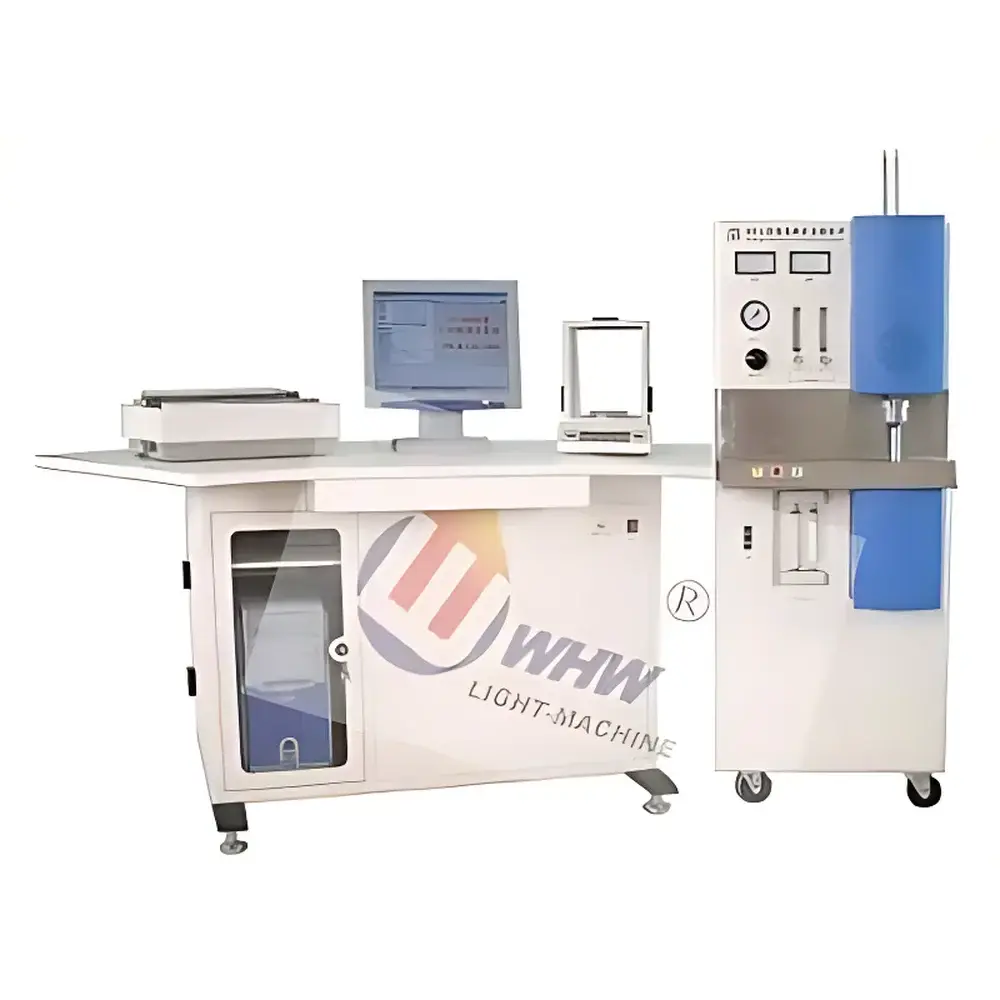
MC017-CS-8800 High-Frequency Infrared Carbon-Sulfur Analyzer
| Origin | Shanghai, China |
|---|---|
| Manufacturer Type | Authorized Distributor |
| Origin Category | Domestic (PRC) |
| Model | MC017-CS-8800 |
| Pricing | Upon Request |
Overview
The MC017-CS-8800 High-Frequency Infrared Carbon-Sulfur Analyzer is a fully integrated elemental combustion analyzer engineered for precise, trace-level quantification of total carbon (C) and sulfur (S) in solid inorganic and metallurgical samples. It operates on the principle of high-frequency induction combustion followed by non-dispersive infrared (NDIR) spectroscopic detection. In this process, a weighed sample is combusted in a high-purity oxygen atmosphere within a 20 MHz high-frequency furnace, converting carbon and sulfur into CO₂ and SO₂ gases, respectively. These gaseous oxides are then swept through optimized gas pathways into dual gold-plated infrared absorption cells, where their concentrations are determined via Beer-Lambert law-based photometric measurement using high-stability platinum infrared sources and ultra-sensitive pyroelectric detectors (sensitivity down to 10⁻¹¹ W/Hz¹ᐟ²). Designed for routine QC/QA laboratories in steel mills, foundries, mining, cement production, and catalyst R&D, the system delivers ISO-compliant performance with robust interference rejection, wide dynamic range, and long-term signal stability.
Key Features
- High-frequency combustion furnace with 7.5 kVA rated power and ≥2.7 kVA operational output—capable of no-load preheating, reducing thermal stress and extending component life
- Dual independent NDIR detection modules: two gold-coated carbon cells and two sulfur cells, each paired with thermally stabilized pyroelectric detectors for simultaneous, cross-validated C/S measurement
- Proprietary dust management architecture: includes heated furnace head, automatic ash removal (patented ZL2005200691557), and 0.4 µm sintered metal filtration to prevent particulate carryover into optical paths
- Multi-stage electromagnetic isolation: fiber-optic coupling between furnace and detector, multi-layer shielded circuitry, and concealed grounding schemes eliminate high-frequency coupling noise
- Modular dual-CPU architecture: upper-level PC handles data acquisition, user interface, and database management; lower-level embedded controller manages real-time combustion sequencing, gas flow regulation, and safety interlocks
- Four-channel configurable detection: independent selection among high-carbon, low-carbon, high-sulfur, and low-sulfur analysis cells—enabling optimal signal-to-noise ratio across concentration ranges
- Real-time dynamic integration at 20 Hz sampling rate, with linearization, baseline drift correction, and auto-zero compensation applied during analysis
Sample Compatibility & Compliance
The MC017-CS-8800 accommodates a broad spectrum of solid materials including ferrous and non-ferrous metals (steels, cast irons, alloys), ores, slags, refractories, cement clinker, catalyst supports, graphite electrodes, and foundry core sands. Sample mass is precisely measured using a Sartorius analytical balance (0.1 mg readability), supporting both fixed-mass and variable-mass weighing protocols. The system complies with ISO 9556 (carbon determination in steels and irons) and ISO 4935 (sulfur determination in steels and irons), and its measurement repeatability meets RSD ≤ 0.5% for carbon and ≤ 1.5% for sulfur under standard operating conditions. Gas purity requirements—oxygen ≥99.5%, nitrogen or oil-free compressed air for carrier gas—are aligned with ASTM E1019 and USP elemental impurity guidelines. All hardware and software functions support GLP/GMP-aligned workflows, including full audit trail logging, user access control, and electronic signature-ready reporting.
Software & Data Management
The analyzer runs proprietary Windows-based application software built in Delphi, featuring a bilingual-capable UI framework (English default, Chinese optional). Communication between host PC and instrument occurs via USB 2.0 (high-speed, low-latency) and optically isolated fiber links. Data storage utilizes Microsoft Access relational databases, preserving raw time-resolved detector signals, calibration curves, sample metadata (operator ID, timestamp, sample ID, batch number), and final C/S results with full traceability. Software capabilities include: multi-user role-based permissions; unlimited channel configuration (up to 8 carbon + 8 sulfur channels); automated blank subtraction and curve fitting (linear, quadratic, cubic); dynamic release curve visualization; statistical summary (mean, SD, RSD, CPK); customizable report templates for lab or regulatory submission; and built-in diagnostic tools for leak testing, pressure verification, and cell integrity validation. All calibration and analysis events are timestamped and logged with operator context for 21 CFR Part 11–compatible record retention.
Applications
This analyzer serves as a primary tool in quality assurance laboratories requiring rapid, accurate bulk C/S analysis for incoming raw material inspection, melt process control, finished product certification, and failure root-cause investigation. Typical use cases include: monitoring carbon segregation in alloy steel billets; verifying sulfur content in low-sulfur pipeline steels per API 5L specifications; quantifying residual carbon in spent petrochemical catalysts; assessing coke reactivity index (CRI) precursors; certifying low-carbon refractory ceramics; and validating sulfur levels in limestone flux used in blast furnace operations. Its extended range (C: 0.0001–99.999 wt%; S: 0.0001–99.999 wt%) also supports research applications involving carbides, sulfides, and carbon-black composites. With analysis times adjustable from 25–60 seconds (typical 35 s), throughput exceeds 120 samples per 8-hour shift when operated with automated sample loading accessories.
FAQ
What is the minimum detectable concentration for carbon and sulfur?
The system achieves a minimum reading resolution of 0.1 ppm (mass fraction), supported by high-gain pyroelectric detection and low-noise signal conditioning.
Is the instrument compliant with FDA 21 CFR Part 11 requirements?
Yes—the software implements electronic signatures, audit trails, user authentication, and secure data archiving, enabling compliance with 21 CFR Part 11 when deployed in validated environments.
Can the analyzer be integrated into a LIMS environment?
Yes—data export is supported via CSV, XML, and ODBC-compatible database queries; custom API extensions are available upon request for enterprise-level LIMS synchronization.
What maintenance intervals are recommended for the combustion furnace and IR cells?
Furnace crucibles require replacement after ~500–1,000 analyses depending on matrix; IR cells and detectors are sealed and maintenance-free for ≥5 years under normal operation with proper gas purification.
Does the system support external balance integration?
Yes—it natively supports RS-232 and USB interfaces for Sartorius, Mettler Toledo, and other ISO/IEC 17025–accredited balances, enabling direct mass transfer without manual entry.




