
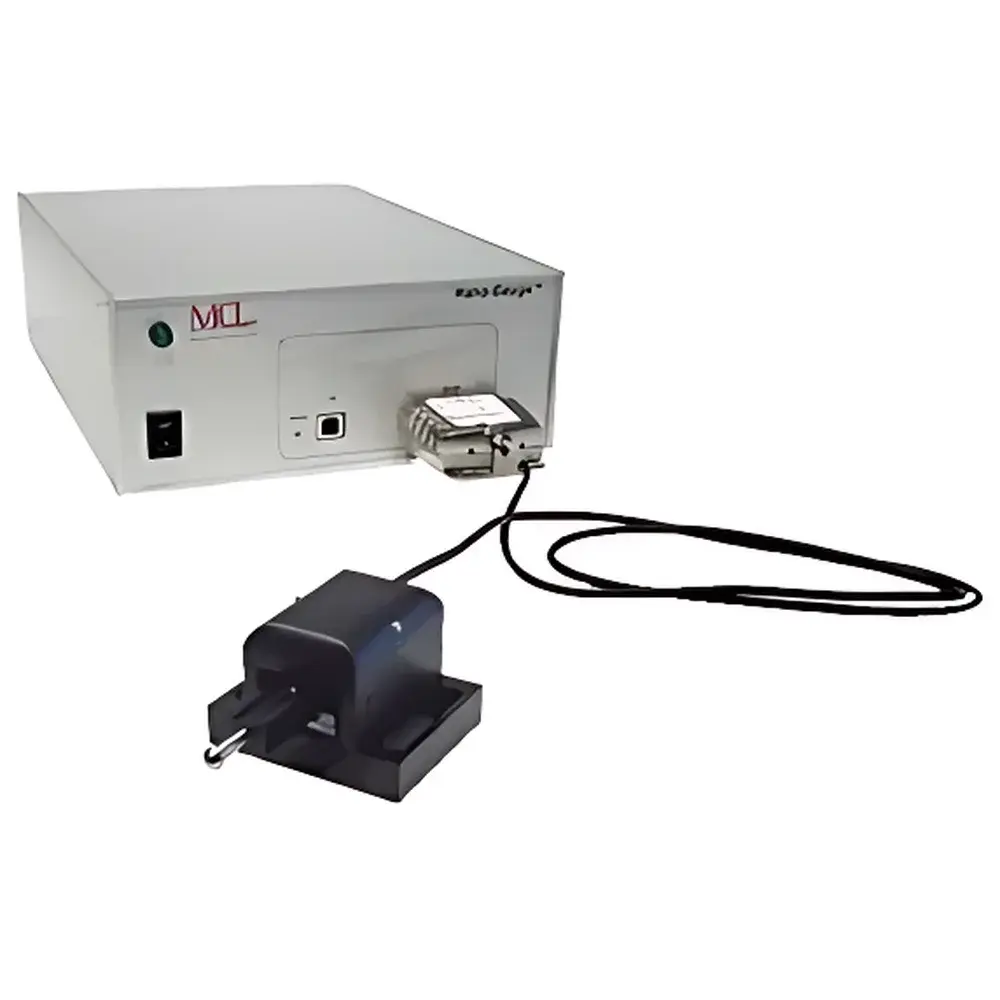
MCL Think Nano Nano-Gauge™ Ultra-High-Resolution Single-Axis Displacement Sensor
| Brand | MCL Think Nano |
|---|---|
| Origin | USA |
| Model | Nano-Gauge™ |
| Type | Motorized Translation Stage |
| Measurement Resolution | 1.5 nm (Nano-Gauge™1) / 5.0 nm (Nano-Gauge™5) |
| Full-Scale Range | 25 mm |
| Output Interface | USB 2.0 (Plug & Play) |
| Probe Loading Range | 1–10 lb/in |
| Probe Tip Options | Hardened steel, sapphire, silicon nitride balls (Ø 0.25–8 mm) |
| Housing Material | Aluminum |
| Dimensions | 63.5 × 79.2 × 42.9 mm |
| Data Acquisition Interval | 50 ms – 60 s |
| Compliance | CE-marked, RoHS-compliant |
Overview
The MCL Think Nano Nano-Gauge™ is an ultra-high-resolution, single-axis displacement sensor engineered for sub-nanometer metrology in precision motion control and calibration environments. Utilizing a proprietary capacitive or interferometric sensing architecture—optimized for stability, low drift, and minimal hysteresis—the Nano-Gauge™ delivers traceable linear displacement measurements with resolution down to 1.5 nm (0.06 µin) over its full 25 mm (1 inch) range. Unlike conventional LVDTs or strain-gauge-based position sensors, the Nano-Gauge™ integrates a compact, rigid aluminum sensor head with a thermally stable mechanical design that minimizes thermal expansion artifacts and mechanical compliance errors. Its modular probe interface supports direct integration into nanopositioning stages, piezoelectric actuators, and custom motion platforms—making it suitable for both laboratory metrology and production-line validation workflows where ISO/IEC 17025-compliant traceability is required.
Key Features
- Two resolution variants: Nano-Gauge™1 (1.5 nm) and Nano-Gauge™5 (5.0 nm), selectable at time of order based on application sensitivity requirements
- USB 2.0 “Plug & Play” digital interface with real-time streaming to Windows-based host systems; no external power supply or driver installation required
- User-adjustable probe loading via internal spring mechanism (1–10 lb/in), with optional magnetically coupled probes eliminating mechanical preload entirely
- Interchangeable probe tips: standard hardened steel ball (Ø 0.25–8 mm), plus optional sapphire or silicon nitride spheres for enhanced wear resistance and chemical inertness
- Compact footprint (63.5 × 79.2 × 42.9 mm) and breadboard-compatible mounting pattern—designed for rapid integration onto optical tables, vacuum chambers, or custom mechanical fixtures
- Configurable acquisition rate from 50 ms to 60 seconds per data point, enabling optimization for dynamic creep analysis or long-term stability monitoring
- On-screen zeroing function and bidirectional measurement display replicate the intuitive operation of high-end digital calipers while maintaining metrological rigor
Sample Compatibility & Compliance
The Nano-Gauge™ is compatible with non-magnetic, non-conductive, and moderately conductive surfaces—provided surface roughness remains below Ra < 50 nm to ensure consistent probe contact geometry. It operates effectively under ambient laboratory conditions (15–30 °C, < 60% RH, non-condensing), and its aluminum housing provides EMI shielding sufficient for use near electromagnetic sources common in laser labs or SEM facilities. The device complies with CE marking directives (EMC Directive 2014/30/EU and RoHS Directive 2011/65/EU) and meets IEC 61326-1:2013 Class A requirements for laboratory measurement equipment. While not certified for FDA-regulated GMP environments out-of-the-box, its deterministic output format, timestamped data logging, and absence of volatile memory make it adaptable to 21 CFR Part 11-compliant workflows when deployed with validated third-party software and audit-trail-enabled acquisition protocols.
Software & Data Management
The Nano-Gauge™ ships with a lightweight Windows-native application supporting real-time plotting, statistical analysis (mean, std dev, min/max, trendline fitting), and CSV export with millisecond-precision timestamps. Raw data streams are delivered via HID-compliant USB protocol, enabling seamless integration with LabVIEW (via NI-VISA), MATLAB (Instrument Control Toolbox), or Python (pyUSB/pySerial) for automated test sequences. All configuration parameters—including zero offset, measurement rate, unit selection (nm/mm/inch), and probe type—are stored persistently in onboard flash memory. No cloud connectivity or telemetry is implemented; all data remains local to the host PC, satisfying ITAR and institutional data sovereignty policies. Optional SDKs provide C/C++, .NET, and Python API documentation for OEM-level system integration.
Applications
- Calibration of nanopositioners (e.g., piezo stages, voice coil actuators) against NIST-traceable reference standards
- Dynamic characterization of transducer linearity, hysteresis, and repeatability per ASTM E2574 and ISO 10360-2
- In-situ alignment verification of optical components (mirrors, gratings, fiber couplers) during active stabilization routines
- Long-duration position creep and relaxation studies in viscoelastic materials or MEMS devices
- Validation of closed-loop feedback performance in ultra-precision machining tools and semiconductor wafer handling systems
- Development and verification of indentation systems requiring sub-5 nm depth resolution (e.g., nanoindentation, AFM tip calibration)
FAQ
What is the difference between Nano-Gauge™1 and Nano-Gauge™5?
The Nano-Gauge™1 offers 1.5 nm resolution optimized for static or quasi-static metrology applications requiring maximum sensitivity. The Nano-Gauge™5 provides 5.0 nm resolution with improved signal-to-noise ratio for higher-speed acquisitions or environments with elevated mechanical vibration.
Can the Nano-Gauge™ be used in vacuum or cleanroom environments?
Yes—its all-metal construction and lack of outgassing plastics allow operation in ISO Class 5 cleanrooms. For UHV applications (<10⁻⁶ Torr), consult MCL Think Nano for custom O-ring sealing and venting options.
Is probe tip wear compensated in software?
No. Wear compensation requires periodic physical recalibration using traceable gauge blocks or interferometric references; the instrument does not perform automatic tip-wear correction.
Does the Nano-Gauge™ support analog output?
No. It is digitally native only—USB 2.0 HID interface ensures noise immunity and eliminates DAC-related quantization error inherent in analog voltage outputs.
How is traceability established for calibration reports?
MCL Think Nano provides optional factory calibration certificates traceable to NIST via A2LA-accredited laboratories; users may also perform in-house calibration using certified step gauges or laser interferometers per ISO/IEC 17025 procedures.





