
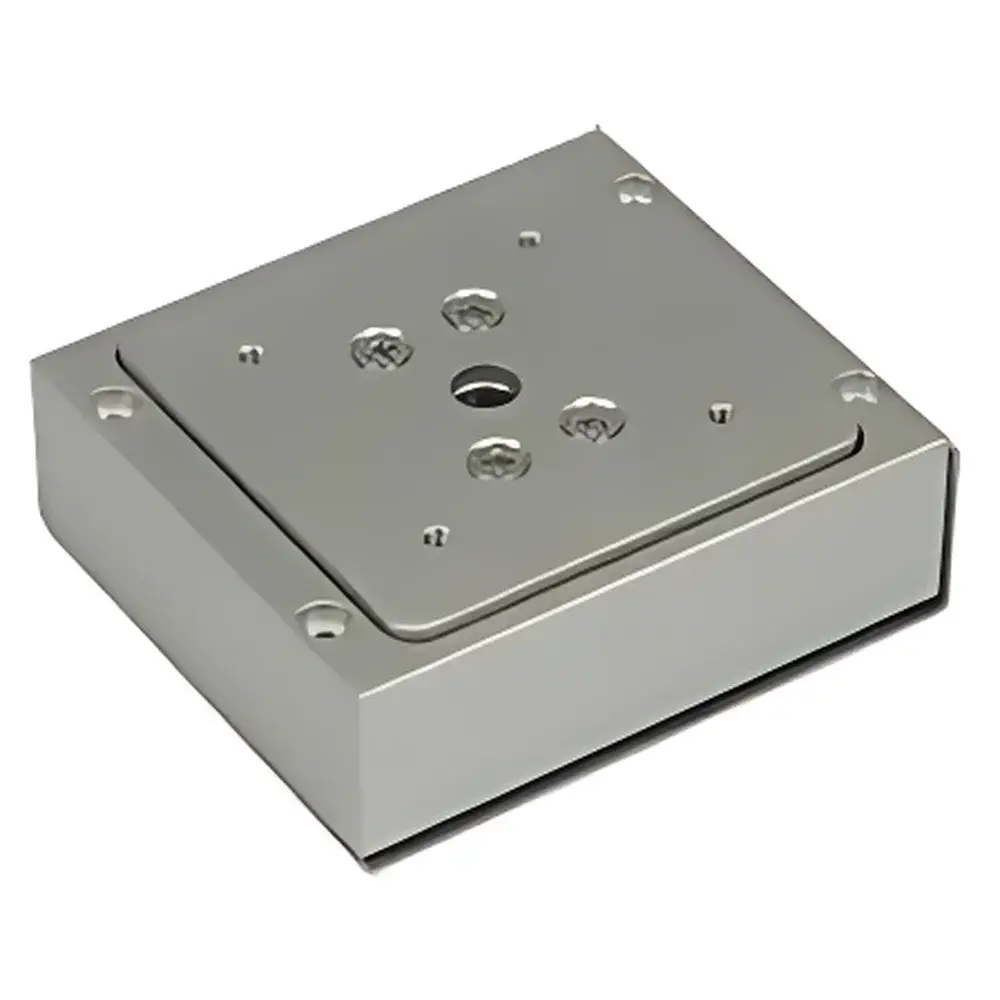
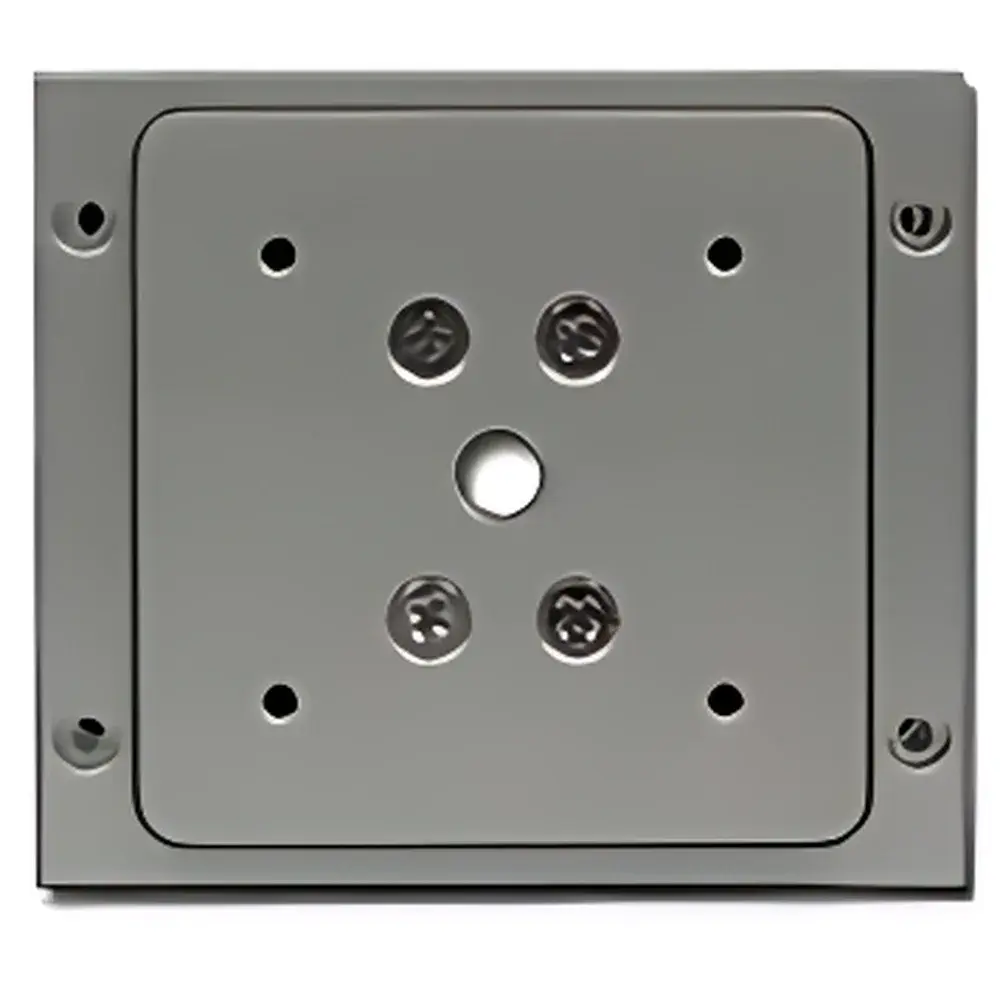
MCL Think Nano Nano-MZ Compact Closed-Loop Piezoelectric Z-Axis Translation Stage
| Brand | MCL Think Nano |
|---|---|
| Origin | USA |
| Model | Nano-MZ |
| Motion Axis | Z-only |
| Drive Type | Piezoelectric |
| Control Mode | Closed-loop with integrated PicoQ® position sensing |
| Travel Range (Z) | 25 µm |
| Resolution | 0.05 nm |
| Resonant Frequency | 1100 Hz ±20% |
| Stiffness | 1.0 N/µm |
| Max Horizontal Load | 0.5 kg |
| Center Aperture Diameter | 0.25" |
| Height (Low Profile) | 0.8" |
| Body Material | Aluminum |
| Controller | Nano-Drive® |
Overview
The MCL Think Nano Nano-MZ is a high-precision, compact piezoelectric Z-axis translation stage engineered for applications demanding sub-nanometer positioning stability and repeatability in space-constrained optical and metrological setups. Utilizing proprietary PicoQ® capacitive position sensing technology embedded directly within the actuator stack, the Nano-MZ delivers true absolute position feedback without homing or reference calibration—enabling deterministic, drift-free vertical displacement control over its full 25 µm travel range. Its monolithic aluminum construction, low 0.8-inch profile, and centered 0.25-inch clear aperture facilitate seamless integration beneath objective lenses, within interferometric cavities, or inside vacuum-compatible optical breadboards. Unlike open-loop piezo stages, the Nano-MZ operates exclusively in closed-loop mode, ensuring long-term positional fidelity under thermal fluctuation, mechanical load, or extended dwell time—critical for quantitative scanning probe microscopy (SPM), adaptive optics alignment, and laser cavity length stabilization.
Key Features
- Sub-angstrom resolution: 0.05 nm minimum incremental motion enabled by high-gain analog feedback and 24-bit DAC-controlled Nano-Drive® electronics.
- PicoQ® integrated capacitive sensor: Provides real-time, absolute position measurement with <1 pm short-term noise floor and <0.01% linearity error across full stroke.
- High dynamic stiffness: 1.0 N/µm lateral and axial stiffness supports stable operation under inertial loading during rapid step-and-settle maneuvers.
- Resonant frequency of 1100 Hz ±20% ensures fast response (typical settling time <1 ms to 0.1 nm band) and immunity to low-frequency environmental vibrations.
- Hermetically sealed internal electronics and gold-plated flexure joints minimize outgassing—validated for use in UHV environments down to 1×10⁻⁹ Torr when paired with compatible accessories.
- Standard SMA-connectorized analog input (±10 V) and digital interface (USB 2.0 + optional RS-485) enable synchronization with third-party DAQ systems and timing controllers.
Sample Compatibility & Compliance
The Nano-MZ is designed for integration into ISO-standard optical tables, SEM/AFM columns, and custom-built photonic test benches. Its aluminum body meets RoHS Directive 2011/65/EU and REACH Annex XVII requirements. When operated with the Nano-Drive® controller, the system complies with IEC 61326-1:2013 for electromagnetic compatibility (EMC) in laboratory environments. While not certified as medical or industrial safety equipment, its closed-loop architecture and hardware-enforced travel limits satisfy functional safety expectations outlined in ISO 13849-1 for Category 1 control systems. For GLP/GMP-aligned metrology workflows, audit-trail-capable firmware logging (via Nano-Drive® v3.2+) supports 21 CFR Part 11-compliant electronic records when deployed with validated IT infrastructure.
Software & Data Management
The Nano-MZ is fully supported by MCL’s Nano-Drive® software suite (Windows/macOS/Linux), offering both GUI-based manual control and scriptable API access via Python, MATLAB, and LabVIEW drivers. Real-time position streaming at up to 10 kHz enables synchronized acquisition with external detectors (e.g., lock-in amplifiers, photon counters). All position data are timestamped using system UTC and stored in HDF5 format—preserving metadata including voltage commands, sensor readings, temperature compensation offsets, and controller firmware revision. Batch calibration reports—including hysteresis mapping, creep characterization, and thermal drift profiles—are exportable as PDF/CSV for traceability in ISO/IEC 17025-accredited labs.
Applications
- Vertical focus stabilization in confocal and multiphoton microscopes requiring <5 nm axial jitter suppression.
- Z-height calibration and nanoscale surface profiling in white-light interferometry and optical coherence tomography (OCT) platforms.
- Active cavity length tuning in external-cavity diode lasers (ECDLs) and fiber Fabry–Pérot resonators.
- Probe-sample distance control in non-contact atomic force microscopy (NC-AFM) and scanning tunneling microscopy (STM).
- Alignment of polarization-sensitive components (waveplates, polarizing beam splitters) where angular coupling must be minimized via pure Z-motion.
- Modular multi-axis assemblies: The Nano-MZ serves as the foundational Z-element in hybrid stages such as the Nano-M350 (X-Y-Z) and Nano-Man5 (X-Y-Z-θX-θY), maintaining kinematic consistency across degrees of freedom.
FAQ
Is the Nano-MZ compatible with vacuum environments?
Yes—when equipped with UHV-rated cabling and mounted using stainless-steel fasteners, the Nano-MZ has been validated for continuous operation at pressures ≤1×10⁻⁹ Torr.
Can multiple Nano-MZ stages be synchronized for coordinated motion?
Yes—the Nano-Drive® controller supports daisy-chained USB or RS-485 bus architectures, enabling sub-microsecond inter-stage timing alignment via hardware trigger inputs.
Does the system support custom waveform generation (e.g., sawtooth, sine sweep)?
Yes—arbitrary waveform playback up to 10 kHz is supported through the Nano-Drive® scripting engine, with user-defined amplitude, offset, and phase parameters.
What is the recommended maintenance interval for long-term accuracy retention?
No periodic recalibration is required due to the absolute nature of PicoQ® sensing; however, annual verification against NIST-traceable interferometric standards is advised for ISO/IEC 17025 compliance.
How does thermal drift affect performance at ambient temperature fluctuations?
The integrated temperature sensor feeds real-time compensation coefficients into the control loop, reducing thermally induced positional drift to <0.3 nm/°C over the 15–30 °C operating range.




