
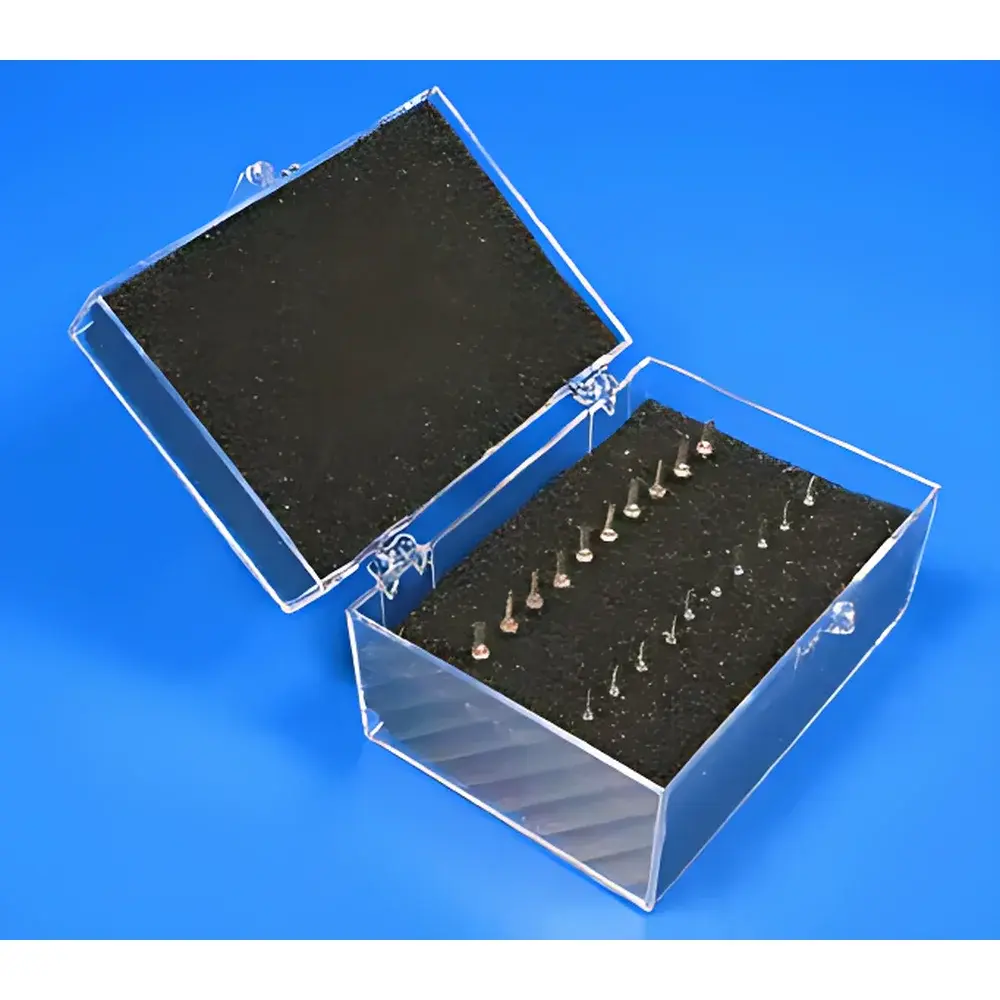
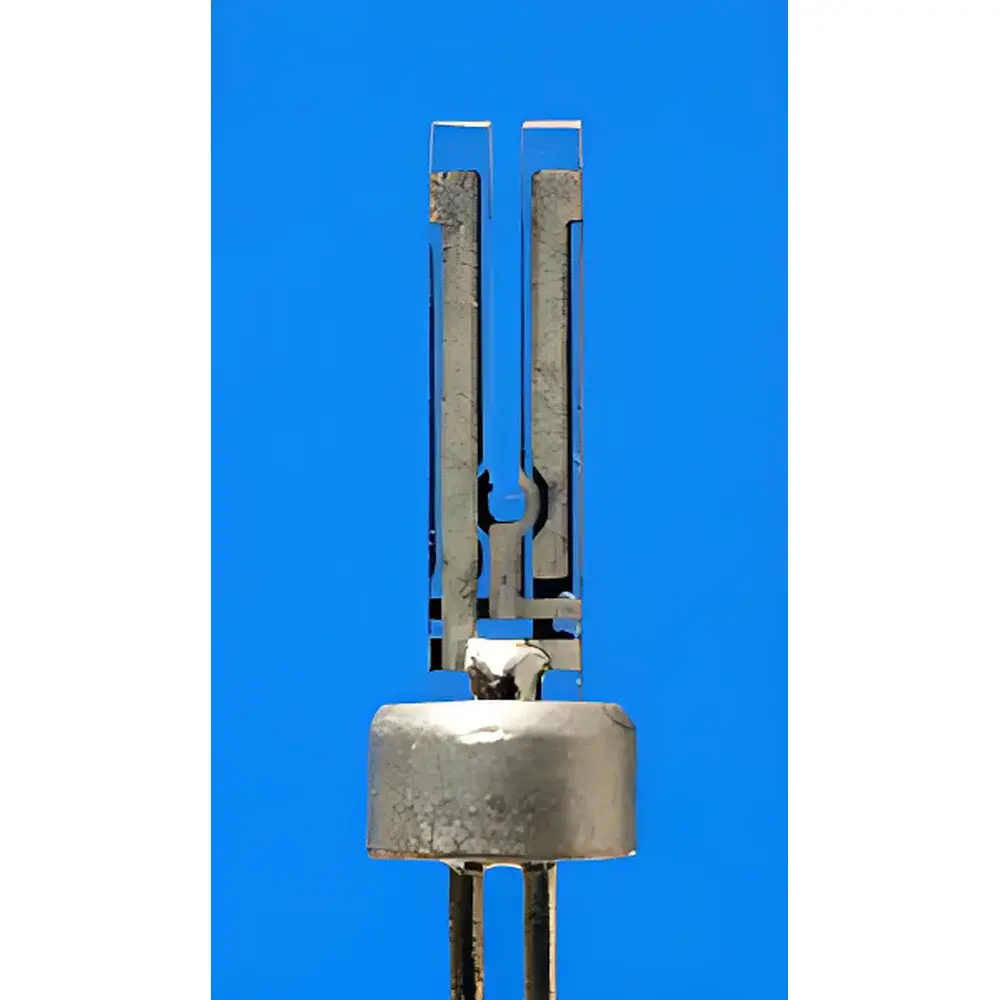
MCL Think Nano Tuning Fork for Quartz Enhanced Atomic Force Microscopy (AFM) and Scanning Probe Microscopy (SPM)
| Brand | MCL Think Nano |
|---|---|
| Origin | USA |
| Model | Tuning Forks |
| Center Frequency | 32.768 kHz |
| Oscillation Mode | Fundamental |
| Series Resistance (max.) | 30 kΩ |
| Tolerance (at 25 °C) | ±18 ppm |
| Operating Temperature Range | −10 °C to +60 °C |
| Frequency Stability Over Temperature | −0.038 ppm/°C |
| Drive Level | 10 µW |
| Shunt Capacitance (max.) | 1.7 pF |
| Motional Capacitance | 2.5 fF |
| Load Capacitance | 12.5 pF |
| Aging (max.) | ±3 ppm/year |
| Packaging | Pre-cleaned, “out-of-the-can” ready-to-mount configuration |
| Available Sizes | Medium and Large |
Overview
MCL Think Nano Tuning Forks are high-stability quartz resonators engineered specifically for frequency-modulated (FM) and amplitude-modulated (AM) scanning probe microscopy (SPM), including atomic force microscopy (AFM), scanning tunneling microscopy (STM), and near-field scanning optical microscopy (NSOM). Unlike conventional silicon cantilevers that rely on optical beam deflection for displacement sensing, these tuning forks operate on the principle of piezoresistive or self-sensing resonance—leveraging the intrinsic electromechanical coupling of AT-cut quartz crystals. Each fork exhibits a well-defined fundamental resonance at 32.768 kHz, with exceptional thermal stability (−0.038 ppm/°C) and low aging drift (≤±3 ppm/year), enabling long-duration, drift-critical measurements in ambient, liquid, or vacuum environments. Their monolithic quartz construction ensures mechanical robustness, reproducible Q-factors (>10,000 in air), and immunity to photonic interference—making them especially suitable for NSOM experiments where stray laser light must be minimized.
Key Features
- Pre-processed “out-of-the-can” configuration: Cylindrical metal housing removed prior to shipment, eliminating manual de-packaging and reducing contamination risk during tip mounting.
- Integrated dual-electrode architecture: Two solderable leads enable direct electrical excitation and detection—compatible with Mad City Labs’ MadPLL® phase-locked loop controller and third-party SPM electronics supporting low-noise current/voltage readout.
- High mechanical stiffness (~1800 N/m effective spring constant for medium fork) and sub-nanometer oscillation amplitudes (<1 nm peak-to-peak in FM mode), enhancing force sensitivity and surface proximity control in non-contact and dynamic modes.
- Low drive-level requirement (10 µW typical), minimizing Joule heating and thermal drift during extended acquisition.
- Two standardized geometries: Medium fork optimized for high-resolution topographic imaging; large fork designed for enhanced signal-to-noise ratio in low-frequency spectroscopy or combined electro-optical measurements.
- Traceable metrology-grade specifications: All units tested per MIL-PRF-3098 and ISO/IEC 17025-accredited calibration protocols for center frequency, series resistance, and load capacitance.
Sample Compatibility & Compliance
MCL Think Nano Tuning Forks support a broad range of conductive and non-conductive probe materials—including electrochemically etched tungsten (tip radius <1 nm), Pt/Ir wire, carbon nanotubes, and diamond-coated tips—via epoxy, silver paste, or focused ion beam (FIB) welding. The quartz substrate is chemically inert in aqueous buffers, organic solvents, and mild acids, permitting use in biological AFM, electrochemical SPM, and in situ corrosion studies. Devices comply with RoHS 2011/65/EU and REACH SVHC screening requirements. For regulated environments, fork-based AFM configurations may be validated under GLP (21 CFR Part 58) or GMP (21 CFR Part 211) frameworks when integrated with audit-trail-capable controllers such as MadPLL® (FDA 21 CFR Part 11–compliant firmware optional).
Software & Data Management
These tuning forks interface natively with Mad City Labs’ open-architecture SPM control software suite, which supports real-time FFT-based resonance tracking, automated Q-control, and multi-harmonic demodulation. Raw analog output (±10 V differential) is digitized at ≥2 MS/s via PCIe DAQ systems, enabling time-domain waveform capture for transient event analysis (e.g., tip-sample snap-in events). Export formats include HDF5 (with embedded metadata per NI-DAQmx standards), ASCII, and Bruker .spm-compatible headers. Third-party compatibility includes WITec Project, Gwyddion, and IGOR Pro via TCP/IP or shared memory APIs. Firmware updates and parameter logging adhere to ISO/IEC 17025 traceability requirements, with full revision history retained in system audit logs.
Applications
- Ultra-high-resolution topography of 2D materials (graphene, MoS₂) and semiconductor heterostructures under ambient conditions.
- Quantitative nanomechanical mapping (elastic modulus, adhesion hysteresis) using AM-FM hybrid modes.
- NSOM tip-enhanced Raman spectroscopy (TERS) with simultaneous topographic feedback—eliminating laser-induced background in plasmonic antenna characterization.
- In situ electrochemical AFM of battery electrode interfaces during charge/discharge cycling.
- Low-drift force spectroscopy on soft biomolecular layers (DNA monolayers, lipid bilayers) over >12-hour acquisition windows.
- Sub-5 nm tip fabrication workflows via electrochemical tungsten etching, supported by documented application notes and CAD drawings for custom holder integration.
FAQ
What is the recommended method for attaching a tungsten tip to the tuning fork?
Electrochemical etching followed by conductive epoxy bonding is the most widely adopted approach; detailed protocols—including lamella geometry, KOH concentration, and voltage ramp profiles—are provided in Application Note “Tungsten Tip Etching Station”.
Can these tuning forks be used in liquid environments?
Yes—quartz’s hydrophobic surface and hermetic electrode isolation allow stable operation in deionized water, PBS, and ethanol; Q-factor reduction is predictable and compensatable via automatic gain control.
Is there a difference in noise floor between medium and large tuning forks?
The large fork offers ~4 dB lower thermal noise density (N/√Hz) due to higher motional capacitance and improved signal coupling, making it preferable for spectroscopic applications requiring high dynamic range.
Do I need a specialized controller to operate these forks?
While compatible with generic lock-in amplifiers, optimal performance requires a phase-locked loop (PLL) system capable of sub-millihertz frequency resolution and real-time Q-compensation—such as the MadPLL® platform.
Are calibration certificates available for individual units?
Yes—NIST-traceable calibration reports (including resonance frequency, series resistance, and temperature coefficient) are supplied upon request for GLP/GMP-compliant deployments.



