
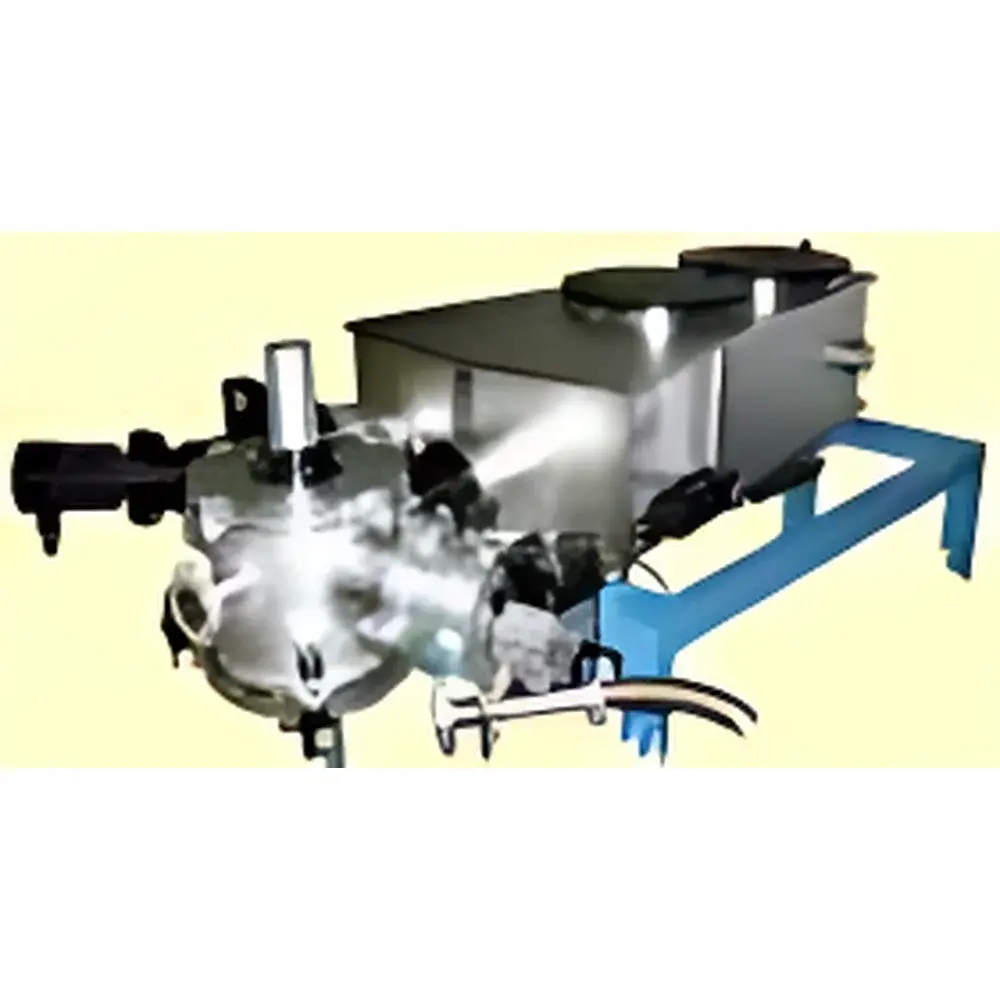
McPherson Vacuum Ultraviolet Grating Spectrometer
| Brand | McPherson |
|---|---|
| Origin | USA |
| Model | VUV Grating Spectrometer Series |
| Wavelength Range | 30 nm – 1200 nm (model-dependent) |
| Spectral Resolution | down to <0.0025 nm |
| Focal Length | 200 mm – 5000 mm |
| Optical Configuration | Czerny-Turner, Seya-Namioka, Normal Incidence (Autofocus & Off-Plane Eagle), Corrected Concave Holographic |
| Grating Mount | Motorized Multi-Grating Tower |
| Detector Compatibility | PMT, MCP, CCD, and Back-Illuminated Deep-UV/Soft-X-ray Arrays |
| Stray Light Suppression | <10⁻⁶ (typical, model- and grating-dependent) |
| Wavelength Accuracy | ±0.005 nm (with He-Ne reference laser calibration) |
| Dispersion | 1.2–8.5 nm/mm (depending on grating groove density and focal length) |
| Scan Functionality | Fully automated wavelength scanning with closed-loop encoder feedback |
| Multichannel Detection | Supported via fiber-coupled or direct-mount array detectors |
| Compliance | Designed for UHV-compatible operation (<1×10⁻⁷ Torr) |
Overview
The McPherson Vacuum Ultraviolet Grating Spectrometer series is a precision optical instrumentation platform engineered for high-resolution spectral analysis in the vacuum ultraviolet (VUV) through near-infrared (NIR) spectral domains — spanning 30 nm to 1200 nm. Unlike conventional spectrometers limited by atmospheric absorption below 190 nm, these instruments operate under high-vacuum or ultra-high-vacuum (UHV) conditions, enabling unattenuated transmission and detection of photons in the critical 30–200 nm range where atomic hydrogen Lyman-series lines, molecular nitrogen bands, and photoionization thresholds reside. Core optical architectures include standard and corrected Czerny-Turner, Seya-Namioka, normal-incidence (autofocusing), and off-plane Eagle configurations — each optimized for specific trade-offs among throughput, resolution, aberration correction, and polarization sensitivity. All models integrate motorized multi-grating turrets with encoded positioning, permitting rapid switching between groove densities (e.g., 2400–3600 grooves/mm for VUV; 300–1200 grooves/mm for NIR) without realignment.
Key Features
- Vacuum-compatible stainless-steel or aluminum alloy optical bench with bakeable flanges (CF-100/CF-160), rated for continuous UHV operation ≤1×10⁻⁷ Torr
- Thermally stabilized monolithic optical mounts minimizing drift during long-duration scans (±0.002 nm/h stability at 25°C ambient)
- High-efficiency, aberration-corrected holographic or ruled gratings with custom blaze profiles for VUV quantum efficiency >25% at 58.4 nm (He I)
- Integrated wavelength calibration via internal He-Ne laser reference channel (632.8 nm) and optional deuterium lamp (115–400 nm) with NIST-traceable line lists
- Motorized entrance/exit slits (10–300 µm width, 0.1 µm resolution) with programmable aperture sequencing
- Modular detector interface supporting side-on PMTs, microchannel plate (MCP) intensifiers, and deep-depletion, back-thinned CCD/CMOS arrays with TE cooling to –80°C
Sample Compatibility & Compliance
These spectrometers are routinely integrated into synchrotron beamlines, laser-produced plasma diagnostics, atomic/molecular beam experiments, and space-qualified calibration facilities. Sample interfaces include standard DN63KF and CF100 ports, accommodating gas cells (Ar, Ne, H₂), cryogenic targets (≤10 K), and laser ablation plumes. All mechanical and vacuum components conform to ASME BPE-2021 surface finish standards (Ra ≤ 0.4 µm) and are passivated per ASTM A967. Optical coatings meet MIL-C-48497A for low outgassing (<1×10⁻¹² g/cm²·s). The system architecture supports GLP/GMP-compliant data acquisition when paired with validated software environments compliant with FDA 21 CFR Part 11 requirements for electronic records and signatures.
Software & Data Management
Control and acquisition are managed via McPherson’s SpectraPro Suite v5.x — a Windows-based application supporting LabVIEW, Python (PyVISA), and MATLAB instrument drivers. Real-time spectral stitching across multiple gratings, automatic slit optimization based on signal-to-noise ratio (SNR), and dark-current-subtracted photon counting are standard. Raw data export adheres to HDF5 format with embedded metadata (wavelength axis, grating ID, slit width, integration time, vacuum pressure, temperature). Audit trails record all parameter changes, user logins, and calibration events with SHA-256 hashing. Optional IQ/OQ/PQ documentation packages available for regulated laboratory validation.
Applications
- Atomic and ionic emission spectroscopy of highly ionized plasmas (e.g., EUV lithography source characterization at 13.5 nm)
- VUV absorption cross-section measurements of astrophysical molecules (CH₄, CO, NH₃) relevant to interstellar medium modeling
- Time-resolved photoelectron spectroscopy (TR-PES) coupling with femtosecond VUV sources
- Calibration of spaceborne sensors (e.g., NASA’s ICON FUV imager, ESA’s Solar Orbiter SPICE)
- Characterization of photocathode quantum efficiency in particle accelerator injectors
- High-resolution solar spectral irradiance monitoring in the Lyman-α (121.6 nm) and He II (30.4 nm) bands
FAQ
What vacuum level is required for optimal VUV performance?
Operation below 5×10⁻⁶ Torr is recommended; for wavelengths <50 nm, pressures ≤1×10⁻⁷ Torr minimize O₂/N₂ absorption and hydrocarbon contamination.
Can this spectrometer be coupled to a synchrotron beamline?
Yes — all models feature standard SR-compatible beam port geometry (including elliptical collimating mirrors and differential pumping stages) and have been installed at APS, ESRF, and SPring-8 beamlines.
Is NIST-traceable calibration included?
Each unit ships with a certificate of conformance referencing NIST Standard Reference Material (SRM) 2036 (Hg/Ar spectral lines) and optional on-site calibration using calibrated deuterium and mercury lamps.
What grating options support both VUV and NIR measurement in a single instrument?
The 225x series with 5000-mm focal length and 3-grating turret (e.g., 2400 g/mm VUV blazed, 1200 g/mm UV-VIS, 300 g/mm NIR) enables seamless coverage from 30 nm to 1200 nm with <0.003 nm resolution at 121.6 nm.
Does the system support time-gated detection?
Yes — TTL-synchronized external trigger input (5 V CMOS, ≤10 ns jitter) enables lock-in detection, pump-probe delay scanning, and gated MCP readout up to 10 MHz repetition rates.




