
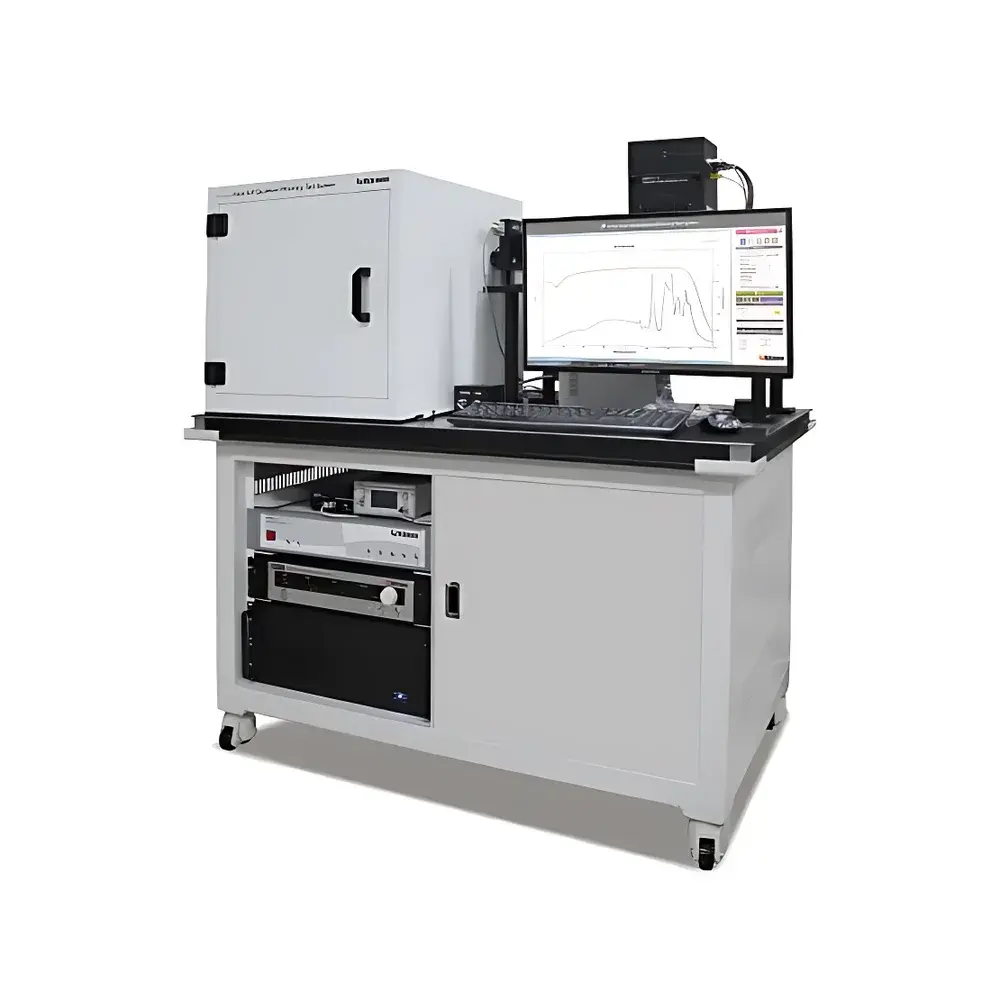
McScience K3100 Quantum Efficiency and Lifetime Test System for Organic Photodetectors (OPDs)
| Brand | McScience |
|---|---|
| Origin | South Korea |
| Model | K3100 |
| Measurement Mode | AC |
| Channel Configuration | Single- or Multi-Channel |
| Spectral Range Options | UV–VIS–NIR–IR (configurable via optional optical modules) |
| Import Status | Imported Instrument |
| Distributor Type | Authorized General Distributor |
| Pricing | Available Upon Request |
Overview
The McScience K3100 Quantum Efficiency and Lifetime Test System is an engineered platform designed specifically for the quantitative characterization of photoresponse dynamics and quantum efficiency metrics in next-generation optoelectronic detectors. It operates on the principle of synchronized AC-biased photocurrent analysis under calibrated, monochromatic illumination—enabling precise determination of external quantum efficiency (EQE), responsivity (Rλ), detectivity (D*), and operational stability under controlled bias and illumination stress conditions. Unlike generic photodiode test setups, the K3100 integrates hardware-level phase-sensitive detection (lock-in amplification), programmable light-source modulation, and environmental monitoring to support rigorous lifetime evaluation (e.g., T80, T50) per IEC 61215 and ISO 18574 standards for emerging photodetector technologies.
Key Features
- AC-coupled, lock-in amplifier-based current measurement architecture—minimizing DC drift and thermal noise for high signal-to-noise ratio (SNR) EQE mapping at low-light intensities (down to 10−4 mW/cm²)
- Modular optical engine supporting interchangeable light sources and monochromators: configurable spectral coverage from 200 nm (deep UV) to 2500 nm (short-wave IR), with ±0.5 nm wavelength accuracy and <1.5 nm FWHM resolution
- Programmable bias sweep and constant-voltage/constant-current operation modes compliant with ASTM F2629 for photodetector electrical characterization
- Multi-channel expansion capability (up to 8 parallel channels) with independent source-meter units (SMUs) and optical path switching—enabling statistical reliability testing across device arrays
- Integrated environmental chamber interface (optional) for temperature-controlled lifetime testing (−40 °C to +85 °C) with real-time humidity logging (10–90% RH, ±3% accuracy)
- Rugged, EMI-shielded enclosure with Faraday cage design and grounded optical table mounting—ensuring measurement integrity in shared lab environments
Sample Compatibility & Compliance
The K3100 accommodates planar and vertical-structure OPDs—including bulk heterojunction organic photodiodes, perovskite single-crystal and thin-film detectors, and 2D material-based devices (e.g., MoS2, BP, WSe2). Device contact configurations supported include two-terminal (anode/cathode), three-terminal (with gate bias), and microprobe-compatible layouts (≥50 µm pad spacing). All hardware and software components are designed to meet CE marking requirements and comply with IEC 61000-4 electromagnetic compatibility (EMC) standards. Data acquisition workflows adhere to ALCOA+ principles (Attributable, Legible, Contemporaneous, Original, Accurate, Complete, Consistent, Enduring, Available) and support audit-ready export for GLP/GMP-regulated R&D environments.
Software & Data Management
The system is operated via McScience’s QETStudio v3.2—a Windows-based application built on a modular .NET framework. It provides real-time visualization of EQE spectra, time-resolved photocurrent transients, and accelerated aging plots (log-log degradation curves). All raw data (including lock-in X/Y outputs, bias voltage logs, and environmental sensor timestamps) are stored in HDF5 format with embedded metadata (wavelength, intensity, bias, temperature, user ID, instrument serial number). The software supports 21 CFR Part 11-compliant user access control (role-based permissions), electronic signatures, and full audit trail generation—including modification history and session log export. Export options include CSV, MATLAB (.mat), and standardized CIE 1931 chromaticity-compatible XML.
Applications
- Quantitative EQE and responsivity mapping of solution-processed OPDs for wearable health monitors and flexible imaging arrays
- Stability benchmarking of perovskite photodetectors under ISOS-L-2 (light-only) and ISOS-L-3 (light + bias) protocols
- Wavelength-dependent gain analysis in avalanche-mode organic photodiodes (APDs)
- Interfacial trap-state evaluation via frequency-dependent photocurrent spectroscopy (FDPS)
- Batch qualification of 2D-material heterostructures for low-dark-current infrared detection
- Correlation studies between film morphology (from AFM/XRD) and EQE roll-off at high irradiance
FAQ
Does the K3100 support pulsed illumination for transient photocurrent analysis?
Yes—the system accepts TTL-synchronized external laser diodes or LED drivers (up to 10 MHz repetition rate) and records time-domain photocurrent decay with 10 ns temporal resolution using its internal digitizer.
Can I integrate my own monochromator or light source?
Yes—QETStudio includes a hardware abstraction layer (HAL) with open API documentation (C#/.NET SDK) for third-party optical component integration and custom spectral calibration routines.
Is dark current compensation automated during EQE scans?
Yes—each wavelength point executes a zero-illumination baseline measurement immediately before illumination, with adaptive averaging based on signal stability thresholds.
What level of traceability does the K3100 provide for calibration?
All optical power calibrations are NIST-traceable via McScience’s certified reference photodiodes (model PD-K3100-CAL), with calibration certificates issued annually and archived within the software’s compliance vault.
How is multi-channel synchronization achieved?
Hardware-level trigger distribution ensures sub-microsecond timing alignment across all channels; optical path switching is controlled via vacuum-actuated shutters with <5 ms settling time and position feedback verification.




