
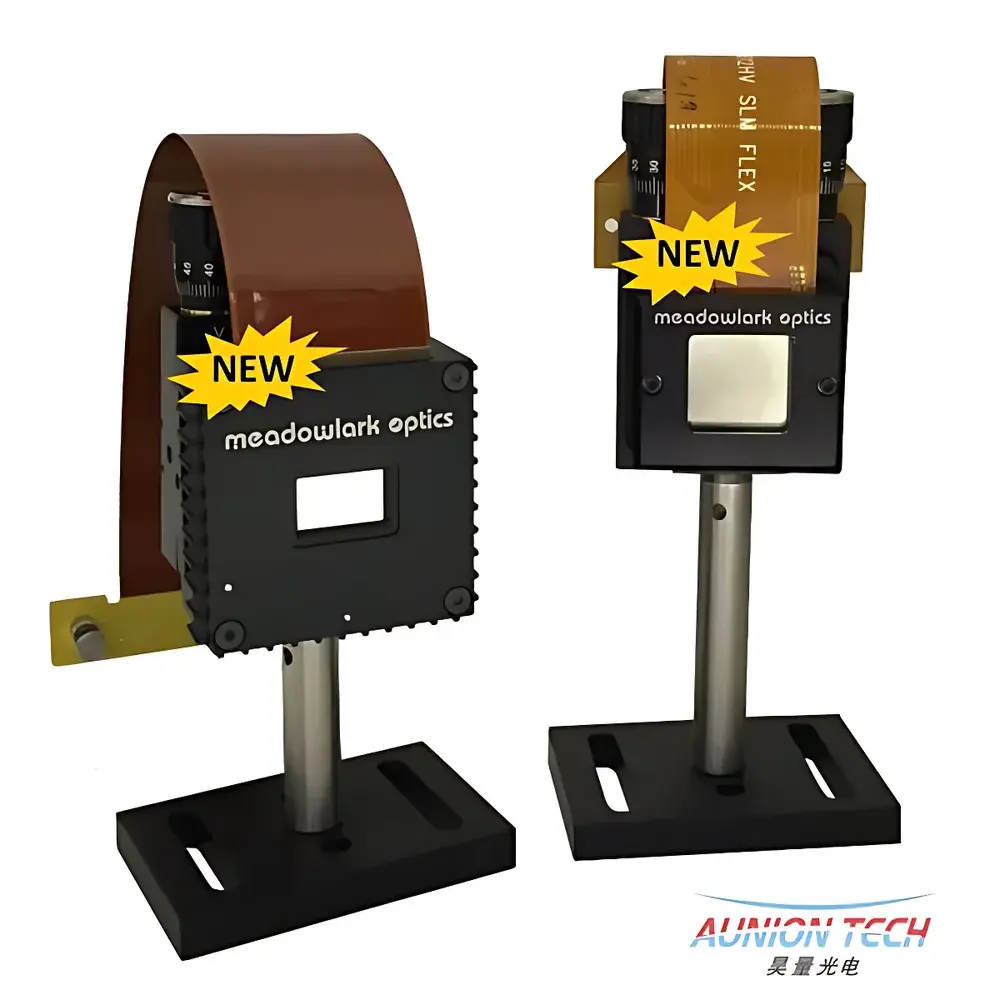
Meadowlark Optics Resolution 1920×1152 Reflective LCOS Spatial Light Modulator
| Brand | Meadowlark Optics |
|---|---|
| Model | Resolution SLM |
| Technology | Reflective LCOS (Liquid Crystal on Silicon) |
| Native Resolution | 1920 × 1152 pixels |
| Active Area | 17.7 × 10.6 mm |
| Fill Factor | 95.7% |
| Diffraction Efficiency | 88% |
| Refresh Rate | 868 Hz |
| Phase Stability | < 0.1% RMS over 1 hour |
| Wavelength Range | 400–1620 nm |
| Modulation Type | Pure-phase (configurable for phase-amplitude hybrid) |
| Pixel Pitch | 9.2 µm |
| Interface | HDMI 2.0 / DisplayPort 1.2 + Custom FPGA-triggered TTL sync |
| Compliance | RoHS, CE, ISO 9001-manufactured |
Overview
The Meadowlark Optics Resolution 1920×1152 Reflective LCOS Spatial Light Modulator is a high-fidelity, pure-phase wavefront control device engineered for precision optical manipulation in advanced research and industrial applications. Based on liquid crystal on silicon (LCOS) technology, this SLM operates in reflection mode and leverages the birefringent properties of twisted-nematic liquid crystal layers to achieve spatially resolved, voltage-controlled phase retardation across its full 1920 × 1152 pixel array. Unlike transmissive or segmented modulators, the monolithic LCOS architecture ensures sub-pixel uniformity, minimal crosstalk ( 99.2% monotonicity over 2π range). Its 17.7 × 10.6 mm active aperture supports collimated beam diameters up to 15 mm, enabling high-throughput holographic beam shaping without vignetting. Designed for integration into stable interferometric and adaptive optics platforms, the device delivers < 0.1% RMS phase drift over one-hour continuous operation—critical for long-exposure wavefront correction and quantitative holography.
Key Features
- Native resolution of 1920 × 1152 pixels with 9.2 µm pitch, optimized for diffraction-limited performance in visible to near-IR bands (400–1620 nm)
- 95.7% fill factor minimizes zero-order leakage and maximizes usable diffraction efficiency (88% typical at 1064 nm with quarter-wave retardation configuration)
- 868 Hz frame rate enables real-time closed-loop adaptive optics, dynamic holography, and high-speed optical trapping feedback
- Patented electrode architecture and alignment layer processing ensure < 0.5° pixel-to-pixel phase nonuniformity and < 1.2 nm RMS wavefront error across full field
- Configurable modulation modes: pure-phase (0–2π), phase-amplitude hybrid, and binary diffractive grating synthesis via Gerchberg-Saxton or direct Fourier encoding
- Integrated thermal stabilization and vacuum-sealed LC cell mitigate temperature-induced phase drift and response hysteresis
Sample Compatibility & Compliance
This LCOS SLM is compatible with standard optical breadboard mounting (M4 threaded holes on rear plate) and integrates seamlessly with common laser sources including DPSS (532 nm), Ti:Sapphire (700–1000 nm), and fiber-pumped OPO systems (1300–1620 nm). It meets ISO 10110-7 surface quality specifications (scratch-dig 10-5) and complies with IEC 61000-4 electromagnetic immunity standards. All firmware and calibration data are traceable to NIST-traceable interferometric verification protocols. The device is manufactured under ISO 9001-certified processes and conforms to RoHS Directive 2011/65/EU and CE marking requirements for laboratory instrumentation. While not FDA-cleared as a medical device, it supports GLP-compliant experimental workflows when paired with audit-trail-enabled control software (see Software & Data Management).
Software & Data Management
Meadowlark provides the proprietary SLM Control Studio suite (v4.3+), a cross-platform application supporting Windows, Linux, and macOS. The software includes pre-verified hologram generation algorithms (e.g., weighted Gerchberg-Saxton, direct binary search), real-time phase calibration using built-in reference interferograms, and hardware-synchronized trigger I/O (TTL input/output with < 50 ns jitter). Export formats include 16-bit TIFF, HDF5, and MATLAB .mat for offline analysis. For regulated environments, optional Compliance Mode enforces 21 CFR Part 11-compliant electronic signatures, immutable audit logs, and role-based access control—fully documented in the accompanying Validation Support Package (VSP). API support via Python (PySLM), C++, and LabVIEW enables integration into custom automation frameworks compliant with ASTM E2500-13 system validation guidelines.
Applications
- Optical Tweezers & Micromanipulation: Simultaneous trapping and dynamic reconfiguration of multiple microspheres or biological cells using multi-spot holographic patterns
- Adaptive Optics: Real-time aberration correction in confocal and multiphoton microscopy, especially for deep-tissue imaging where spherical and coma distortions dominate
- Holographic Projection: High-fidelity 3D display systems and volumetric light-field rendering with > 120 dB dynamic range in reconstructed intensity
- Structured Illumination Microscopy (SIM): Generation of precise sinusoidal fringe patterns with programmable orientation, frequency, and phase offset
- Beam Shaping & Splitting: Arbitrary Laguerre-Gaussian mode generation, Bessel beam synthesis, and multi-focal array creation for parallelized laser processing
- Quantum Optics: Spatial mode sorting in high-dimensional quantum entanglement experiments and programmable Bell-state analyzers
FAQ
What is the maximum optical power density this SLM can withstand?
The device is rated for continuous-wave irradiance up to 5 W/cm² at 1064 nm and 2 W/cm² at 532 nm, assuming proper heat sinking and collimated illumination. Pulsed operation (e.g., 100 fs pulses at 1 kHz) is supported up to 100 µJ/cm² per pulse.
Does the SLM require polarization conditioning of the incident beam?
Yes—it is optimized for linearly polarized input aligned to the designated orientation axis (marked on housing). A half-wave plate is recommended for polarization rotation prior to incidence to maximize phase modulation depth.
Can the SLM be used in vacuum or controlled atmosphere environments?
The standard unit is rated for ambient air operation only. A vacuum-compatible variant (with hermetically sealed window and outgassing-tested materials) is available under part number RES-VAC-1920-1152 upon request.
Is factory recalibration required annually?
No routine recalibration is mandated; however, Meadowlark recommends biannual verification using the included interferometric test pattern set. Full recalibration services are offered with NIST-traceable certificate (lead time: 10 business days).
How is phase nonlinearity compensated during operation?
SLM Control Studio applies pixel-wise LUT-based correction derived from factory-measured gamma curves. Users may also upload custom LUTs generated via external interferometric characterization.




