
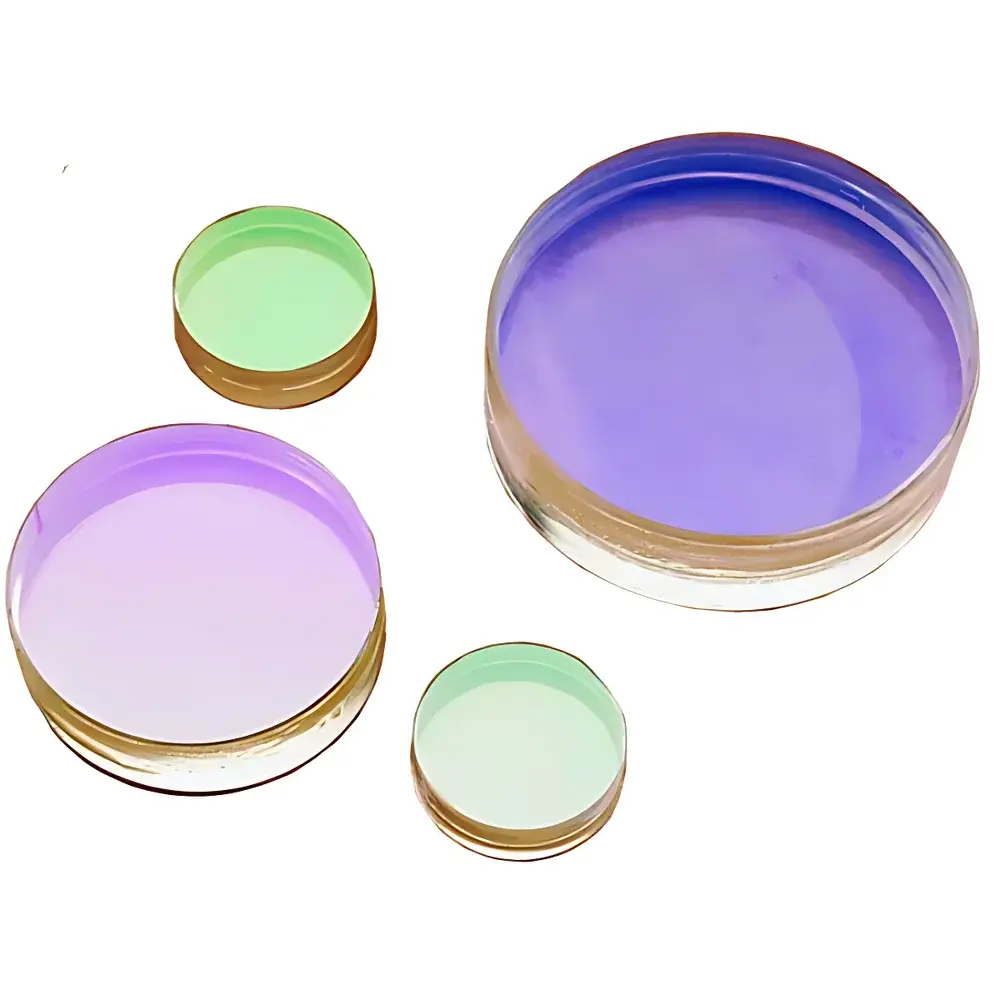
Meadowlark Optics Wide-Field Precision Retardation Plate (Broad-Angle Waveplate)
| Brand | 昊量/auniontech |
|---|---|
| Origin | USA |
| Manufacturer Type | Authorized Distributor |
| Origin Category | Imported |
| Model | Polarization Component |
| Pricing | Available Upon Request |
Overview
The Meadowlark Optics Wide-Field Precision Retardation Plate (Broad-Angle Waveplate) is an engineered optical component designed to deliver stable, wavelength-specific retardance across a broad range of incident angles—exceeding ±30° from normal incidence. Unlike conventional zero-order or multi-order waveplates, this device leverages advanced polymer-based zero-order retarder technology, enabling high-fidelity polarization state control in non-collimated, convergent, or off-axis optical systems. It operates on the principle of birefringence-induced phase delay between orthogonal polarization components, with retardance precisely tuned for λ/4 (quarter-wave) and λ/2 (half-wave) conditions at design wavelengths spanning 400–1800 nm. Its performance remains highly consistent under angular deviation—a critical requirement in applications such as wide-field imaging polarimetry, laser cavity alignment, ellipsometric sensing, and Mueller matrix instrumentation.
Key Features
- Zero-order polymer retarder architecture ensuring minimal temperature dependence and high spectral stability
- Consistent retardance performance over incident angles up to ±30° (full width), validated via calibrated polarimetric mapping
- Standard configurations available for quarter-wave (λ/4) and half-wave (λ/2) operation across visible and near-infrared bands (e.g., 532 nm, 633 nm, 780 nm, 1064 nm, 1550 nm)
- Multi-layer broadband anti-reflection (BBAR) coating applied to both surfaces; optimized for >99% transmission at design wavelength under near-normal incidence
- Clearly marked fast axis using permanent, photolithographically defined alignment indicators—compatible with automated optical assembly workflows
- Custom retardance values available across 400–1800 nm, including non-standard fractional-wave designs (e.g., λ/8, 3λ/4) upon specification
Sample Compatibility & Compliance
The Wide-Field Precision Retardation Plate is compatible with standard Ø25.4 mm and Ø50.8 mm kinematic mounts, SM1- and SM2-threaded lens tubes, and custom optomechanical interfaces. All substrates are fabricated from radiation-resistant, low-fluorescence polymer films bonded to fused silica or CaF₂ windows—ensuring compatibility with UV-VIS-NIR beam paths and high-power CW/pulsed laser exposure (tested to 5 W/cm² at 1064 nm, 10 ns pulses). Devices comply with ISO 10110-7 surface quality standards (scratch-dig 20–10), and BBAR coatings meet MIL-C-48497A spectral uniformity requirements. While not certified to specific regulatory frameworks (e.g., FDA, IEC 61000), the component supports GLP/GMP-aligned optical system validation when integrated into metrology-grade instruments.
Software & Data Management
Though inherently passive, the retardation plate is fully characterized and documented per Meadowlark Optics’ traceable calibration protocol. Each unit ships with a digital certificate containing measured retardance vs. angle data (±0.5° step resolution), spectral transmittance curves (2 nm resolution), and fast-axis orientation uncertainty (< ±0.2°). Raw datasets are provided in ASCII (.csv) and MATLAB (.mat) formats for integration into polarization modeling tools (e.g., Jones/Mueller calculus engines, Zemax OpticStudio polarization analysis modules). The calibration data supports audit-ready documentation for ISO/IEC 17025-accredited laboratories requiring instrument traceability.
Applications
- Wide-field Stokes polarimetry in astronomical instrumentation and remote sensing optics
- Polarization-resolved microscopy, especially in light-sheet and multiphoton modalities requiring angular tolerance
- Stabilized laser cavity polarization control where beam divergence exceeds ±15 mrad
- Ellipsometric thin-film characterization systems operating at variable angle-of-incidence (VAOI)
- Quantum optics experiments involving spatially encoded qubits or path-entangled photon states
- Industrial machine vision systems employing polarization contrast for defect detection on curved or textured surfaces
FAQ
What is the maximum usable field angle before retardance deviation exceeds ±5 nm?
For standard λ/4 designs at 633 nm, retardance deviation remains within ±5 nm up to ±28° incidence—verified by Mueller matrix polarimetry.
Can these plates be used in vacuum environments?
Yes—polymer-retarder variants are rated for ≤10⁻⁵ Torr; outgassing rates conform to ECSS-Q-ST-70-02C Class B specifications.
Is fast-axis alignment traceable to NIST standards?
Fast-axis orientation is referenced to mechanical fiducials aligned via interferometrically verified rotation stages; absolute uncertainty is < ±0.2° relative to primary angle standards.
Do you provide mounting adapters for C-mount or F-mount imaging systems?
Custom kinematic adapters (e.g., SM1-to-C-mount, Ø50.8 mm-to-F-mount) are available upon request with mechanical drawings and tolerance specifications.
How does BBAR coating performance degrade at 30° incidence?
At 30° AOI, average reflectance increases from <0.25% (normal) to ~0.8% across the design band; polarization-dependent loss remains below 0.05% for s- and p- components.




