
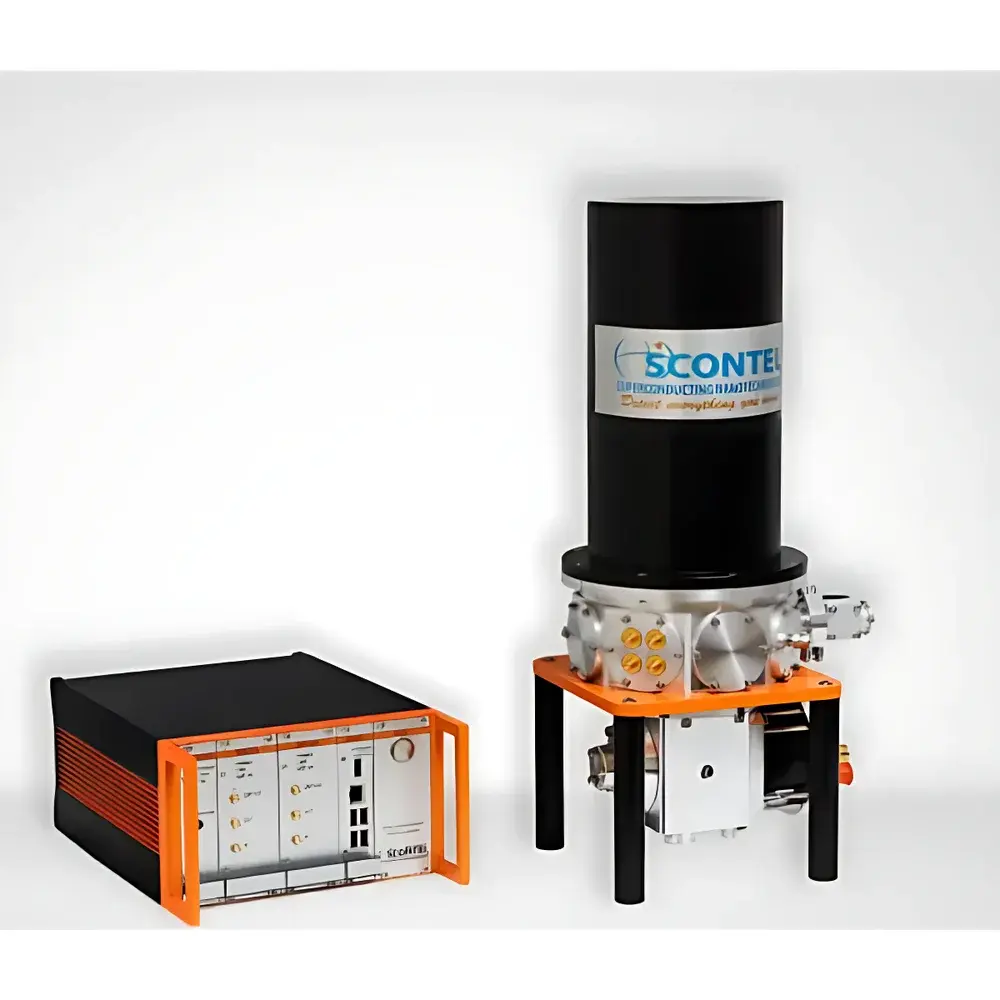
Scontel Cryogen-Free Superconducting Nanowire Single-Photon Detector (with Integrated Closed-Cycle Refrigerator)
| Brand | Scontel |
|---|---|
| Origin | Shanghai, China |
| Manufacturer Type | Authorized Distributor |
| Product Category | Domestic |
| Model | SNSPD Series |
| Counter Integration | Yes |
| Pricing | Available Upon Request |
Overview
The Scontel Cryogen-Free Superconducting Nanowire Single-Photon Detector (SNSPD) is a high-performance, turnkey quantum photodetection system engineered for ultra-low-light applications requiring single-photon sensitivity, picosecond timing resolution, and broad spectral coverage. Based on NbN or NbTiN superconducting nanowire technology, the detector operates at cryogenic temperatures (typically 0.8–2.5 K) maintained by an integrated closed-cycle pulse-tube refrigerator—eliminating the need for liquid helium refills and enabling stable, long-term operation in standard laboratory environments. Its detection principle relies on the kinetic inductance modulation of a sub-100-nm-wide superconducting nanowire upon absorption of a single photon, triggering a measurable voltage pulse with high internal gain and negligible avalanche noise. With peak system detection efficiency exceeding 95% across 300–3500 nm—including demonstrated >50% efficiency at 3.5 µm—the Scontel SNSPD series sets a benchmark for mid-infrared single-photon detection, supporting demanding applications in quantum optics, time-resolved spectroscopy, and free-space quantum communication.
Key Features
- Cryogen-free operation via integrated two-stage pulse-tube cryocooler (no liquid helium required)
- Peak system detection efficiency ≥95% (300–1000 nm), >50% up to 3500 nm
- Dark count rate <0.1 cps (configurable down to 0.01 cps with spectral filtering)
- Timing jitter <25 ps FWHM (down to 20 ps in low-jitter configuration)
- Maximum count rate >70 MHz (up to 300–500 MHz in optimized U-HED mode)
- Dead time as low as 2 ns (customizable)
- Scalable multi-channel architecture: up to 16 independent, synchronized detection channels
- Modular optical coupling options: fiber-pigtailed (SMF-28, PM, or MM), free-space input, or integrated cavity-enhanced designs
- Configurable operating modes: Low-Jitter (LJ), High-Efficiency Detection (HED), Ultra-High-Efficiency Detection (U-HED), Broadband (BB), and Low-Noise (LN) variants
Sample Compatibility & Compliance
The Scontel SNSPD is compatible with standard single-mode and polarization-maintaining optical fibers (FC/APC, FC/PC), as well as free-space collimated beams (via adjustable kinematic mounts). All systems comply with IEC 61000-6-3 (EMC emission standards) and IEC 61000-6-2 (immunity requirements). The closed-cycle refrigeration architecture meets ISO 14001 environmental operational guidelines and supports GLP-compliant lab environments through stable thermal management and traceable cooldown protocols. While not FDA-cleared (as a research-grade instrument), the system’s firmware and data acquisition architecture are designed to support 21 CFR Part 11–compliant audit trails when integrated with validated third-party software platforms for regulated applications such as TCSPC-based pharmaceutical assay development.
Software & Data Management
Each Scontel SNSPD system ships with the Scontel Control Suite—a cross-platform (Windows/Linux) application providing real-time monitoring of cryostat status (temperature, pressure, compressor current), bias current tuning, dark count characterization, and time-tagged photon stream acquisition. Raw timestamps are output in binary .tdm format (compatible with Time Tagger, MATLAB, Python-based qutip or photonstream libraries) and support histogramming with 1-ps binning resolution. For multi-channel synchronization, the system provides TTL-compatible trigger outputs and accepts external clock references (10 MHz, LVDS) to enable phase-locked operation across distributed quantum networks. Optional API access (C/C++, Python bindings) allows integration into custom LabVIEW, EPICS, or QUA-based quantum control stacks. Firmware updates and calibration logs are version-controlled and timestamped for full traceability in auditable workflows.
Applications
- Quantum key distribution (QKD) and device-independent quantum cryptography
- Time-correlated single-photon counting (TCSPC) for fluorescence lifetime imaging (FLIM) and single-molecule spectroscopy
- Optical time-domain reflectometry (OTDR) and lidar with picosecond depth resolution
- On-chip quantum photonics: Hong-Ou-Mandel interference, boson sampling, and integrated photonic circuit characterization
- Mid-infrared single-photon detection for atmospheric sensing, molecular fingerprinting, and laser heterodyne detection
- Ballistic and diffuse optical imaging in turbid media
- Single-electron and single-ion detection via scintillation readout
- Ultrafast semiconductor defect analysis using time-resolved photocurrent mapping
- Plasmonic and excitonic decay dynamics in 2D materials and quantum dots
FAQ
What cooling method does the system use, and what is the base temperature?
The system employs a two-stage closed-cycle pulse-tube cryocooler achieving a base temperature of ≤0.8 K at the detector stage without liquid cryogens.
Is multi-channel synchronization supported?
Yes—up to 16 channels can be operated with sub-10-ps inter-channel timing skew using shared reference clocks and matched signal path lengths.
Can the system be integrated into existing vacuum or UHV setups?
The detector head is available in vacuum-compatible configurations (CF-63 or CF-100 flanges) with feedthroughs for bias lines and optical fibers.
What optical interfaces are available?
Standard options include SMF-28 fiber (780/1550 nm optimized), polarization-maintaining fiber, free-space coupling with AR-coated windows, and resonant cavity-enhanced versions for narrowband applications.
Do you provide calibration certificates and traceable performance data?
Each unit is supplied with a factory calibration report including measured system detection efficiency (SDE) vs. wavelength, dark count spectrum, jitter histogram, and count-rate linearity data—traceable to NIST-traceable reference detectors where applicable.





