
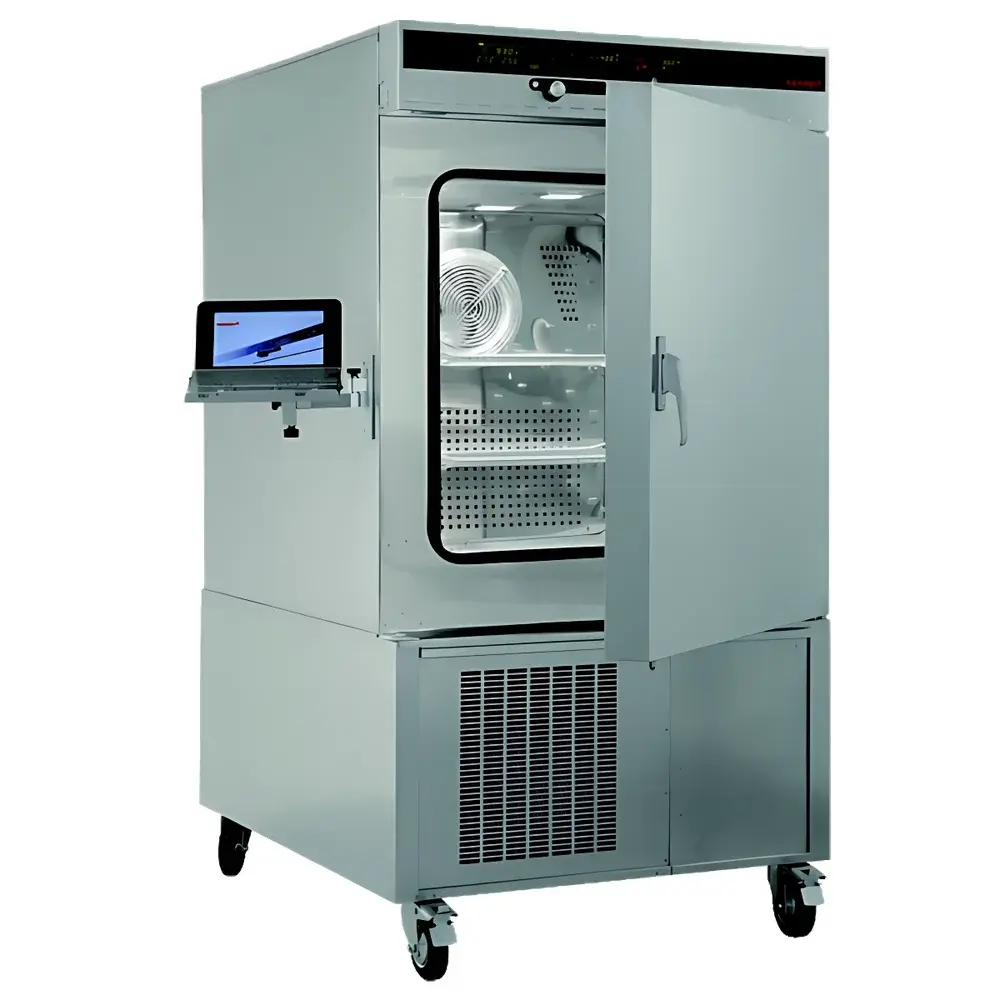
MEMMERT CTC / TTC Temperature and Humidity Controlled Environmental Test Chamber
| Brand | MEMMERT |
|---|---|
| Origin | Germany |
| Model | CTC / TTC |
| Chamber Interior | Stainless Steel 1.4301 (ASTM 304) |
| Insulation | Triple-layer aerospace-grade thermal insulation |
| Refrigeration System | Dual parallel compressors with electronically controlled refrigerant injection |
| Defrosting | Automatic cyclic defrost |
| Evaporator | Stainless steel |
| Temperature Range | –40 °C to +180 °C |
| Ramp Rate | Cooling: 80 min (180 °C → –40 °C) |
| Heating | 20 min (–40 °C → 180 °C) |
| Humidity Control | Available in TTC variant (optional integrated steam humidifier) |
| Noise Level | Low-noise operation (<62 dB(A)) |
| Interface | USB, printer port, optional Ethernet |
| Construction | Embossed stainless steel exterior, galvanized steel rear panel, double-glazed insulated door with stainless steel frame |
| Standard Accessories | 1 stainless steel grid shelf |
| Mobility | Lockable casters |
Overview
The MEMMERT CTC and TTC series are precision-engineered environmental test chambers designed for rigorous laboratory and industrial quality assurance applications. Built upon decades of German engineering expertise, these chambers employ a fundamental combination of forced-air convection, high-efficiency refrigeration architecture, and advanced humidity control (TTC variant) to deliver exceptional thermal stability, uniformity, and repeatability across wide operating ranges. The CTC model is optimized for temperature-only testing, while the TTC integrates a steam-based humidification system compliant with ISO 17025 calibration traceability requirements for relative humidity control between 10% and 98% RH at temperatures from 15 °C to 85 °C. Both models operate on the principle of dynamic thermal equilibrium—using dual parallel scroll compressors, electronically metered refrigerant flow, and a triple-layer vacuum-insulated chamber wall derived from aerospace thermal management systems—to minimize thermal lag, suppress condensation ingress, and ensure rapid, energy-efficient transitions between setpoints.
Key Features
- Aerospace-derived triple-layer insulation system reduces thermal bridging and prevents moisture penetration into insulation layers, enhancing long-term calibration stability and chamber integrity.
- Dual parallel refrigeration compressors enable variable capacity modulation—reducing energy consumption by up to 35% during partial-load operation compared to single-compressor architectures.
- Stainless steel evaporator (1.4301 / ASTM 304) resists corrosion from condensate and aggressive test atmospheres, extending service life and maintaining heat transfer efficiency over time.
- Intelligent automatic defrost cycle operates only when required—based on evaporator frost accumulation sensors—not on fixed time intervals—ensuring uninterrupted test continuity and minimizing thermal disturbance.
- Low-noise design (<62 dB(A) at 1 m) enables integration into shared laboratory environments without acoustic interference to adjacent instrumentation or personnel.
- Robust mechanical construction includes embossed stainless steel exterior panels, galvanized steel rear enclosure, and a fully insulated double-glazed stainless steel door with magnetic gasket sealing.
Sample Compatibility & Compliance
The CTC/TTC chambers accommodate a broad spectrum of sample types—including polymer specimens, electronic assemblies, pharmaceutical packaging, automotive components, and coated substrates—without risk of cross-contamination or material degradation. Internal chamber surfaces conform to FDA-recommended non-porous, cleanable finishes (1.4301 stainless steel), supporting GLP/GMP-aligned validation protocols. All standard configurations comply with IEC 60068-3-5 (environmental testing—methods for determining changes in performance), EN 60068-2-1 (cold testing), EN 60068-2-2 (dry heat), and support IQ/OQ/PQ documentation packages per ISO/IEC 17025. Optional Ethernet interface enables remote monitoring and audit-trail-capable data logging aligned with FDA 21 CFR Part 11 requirements when paired with validated software.
Software & Data Management
Chambers are equipped with MEMMERT’s proprietary Peltier-based touchscreen controller featuring multi-point temperature and humidity (TTC) calibration verification, real-time deviation alarms, and programmable ramp-soak profiles. Data export is supported via USB mass storage mode (CSV format), direct thermal printer output, and optional Ethernet connectivity for integration into centralized LIMS or MES platforms. Firmware supports configurable audit trails—including operator ID, parameter changes, alarm events, and calibration logs—with timestamping traceable to NTP-synchronized network time. All controller firmware updates are digitally signed and validated to ensure integrity during deployment.
Applications
These chambers serve critical roles in accelerated aging studies (ASTM D3045), thermal cycling reliability testing (JEDEC JESD22-A104), moisture resistance evaluation (IEC 60068-2-30), stability testing of medical devices (ISO 11607), and environmental stress screening (ESS) of printed circuit boards. In materials science labs, they support coefficient of thermal expansion (CTE) measurements, glass transition characterization, and hygrothermal aging of composites. Regulatory-driven sectors—including ISO 13485-certified medical device manufacturers and ICH Q1-compliant pharmaceutical stability programs—leverage the TTC’s humidity-controlled capability for long-term storage condition simulation.
FAQ
What is the difference between the CTC and TTC models?
The CTC is a temperature-only chamber; the TTC adds a steam humidifier and RH sensor for combined temperature/humidity testing.
Is calibration certification included with delivery?
A factory-issued calibration certificate (traceable to DAkkS-accredited standards) is available as an option—required for ISO/IEC 17025 compliance.
Can the chamber be validated for GxP environments?
Yes—full IQ/OQ documentation kits, including protocol templates and evidence checklists, are provided for GMP/GLP validation.
What maintenance intervals are recommended?
Compressor oil inspection every 24 months; evaporator cleaning every 12 months; door gasket integrity check per quarterly PM.
Is remote monitoring possible without third-party software?
Yes—the built-in web server (via optional Ethernet module) allows secure browser-based access to live readings, alarms, and historical trends.



