
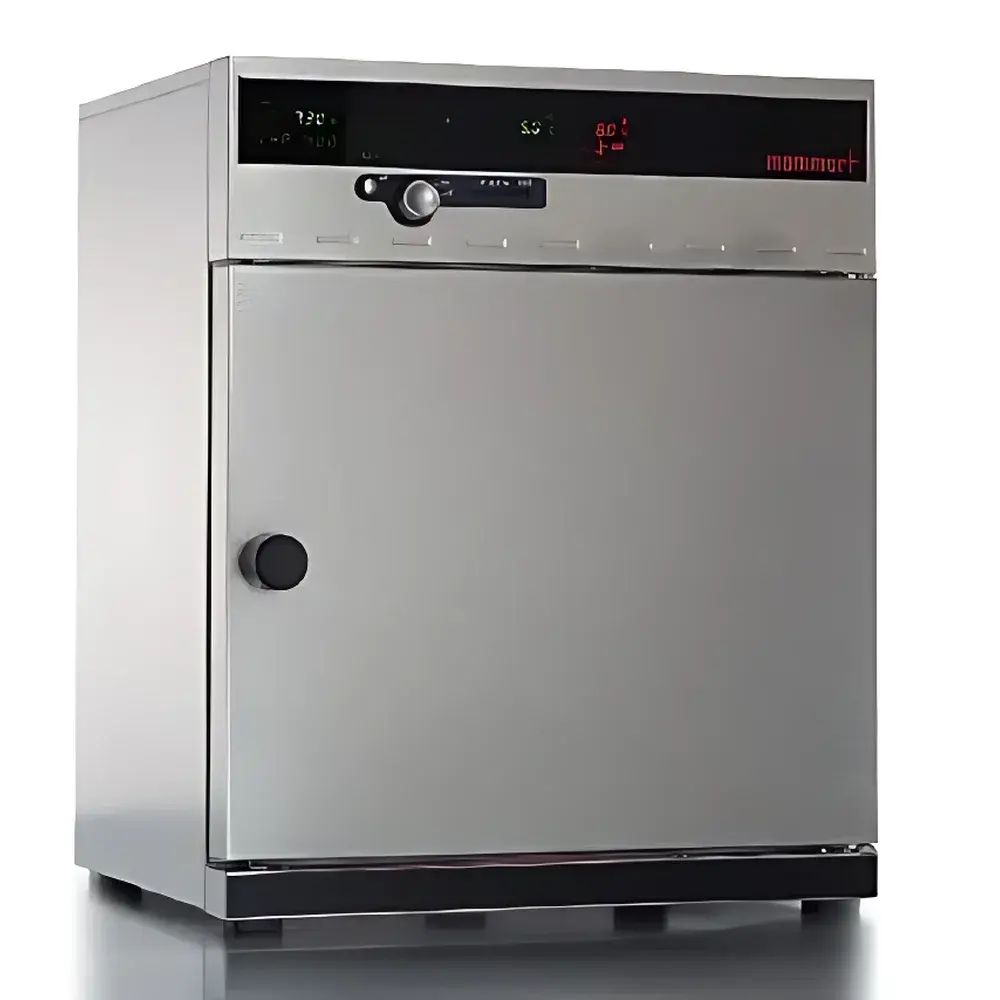
MEMMERT IPP400 Low-Temperature Biochemical Incubator
| Brand | MEMMERT |
|---|---|
| Origin | Germany |
| Model | IPP400 |
| Chamber Volume | 53 L |
| Internal Dimensions (W×H×D) | 400 × 400 × 330 mm |
| External Dimensions (W×H×D) | 550 × 680 × 570 mm |
| Shelf Quantity | 2 stainless steel shelves |
| Temperature Range | Typically 10 °C to 37 °C (with active cooling) |
| Heating/Cooling Power | 175 W |
| Temperature Sensors | Dual 4-wire PT100 probes |
| Programmability | Up to 40 segments, 9-segment control curves, time range 1 min – 999 h |
| Memory Capacity | 1024 KB internal + optional 32 MB memory card |
| Communication Interfaces | RS232 / RS485 (software-compatible), parallel printer port |
| Safety | Dual independent overtemperature protection (TWW Class 3.1 + TB Class 1), automatic thermal cutoff |
| Certifications | Calibration certificates provided for 10 °C and 37 °C |
| Lighting | Built-in digital clock with 24-h light simulation capability |
Overview
The MEMMERT IPP400 Low-Temperature Biochemical Incubator is a precision-engineered, German-manufactured environmental chamber designed for stable, reproducible temperature control in life science laboratories. Operating on a dual-mode thermoregulation principle—combining resistive heating with active Peltier-based cooling—the IPP400 maintains tight thermal uniformity across its 53 L stainless-steel chamber, enabling reliable cultivation of temperature-sensitive biological samples below ambient conditions. Its architecture adheres to IEC 61010-1 safety standards and integrates redundant thermal monitoring via two independently wired, four-wire PT100 sensors—ensuring traceable accuracy and long-term stability. Unlike conventional incubators relying solely on ambient heat exchange, the IPP400’s closed-loop microprocessor control system dynamically adjusts power delivery to sustain setpoints within ±0.3 °C under standard load conditions, making it suitable for applications requiring strict adherence to ISO/IEC 17025-compliant validation protocols.
Key Features
- Dual-layer door design: external brushed stainless-steel door and internal tempered glass door—minimizing thermal loss while enabling non-intrusive sample observation.
- Robust stainless-steel construction: fully welded inner chamber and outer casing resistant to corrosion, cleaning agents, and repeated sterilization cycles.
- Advanced programmability: supports up to 40 time-temperature segments per program; configurable delay start (delay), hold mode (hold), setpoint stabilization (sp), and fan speed modulation (fan) with loop repetition.
- Comprehensive safety architecture: primary TWW (Class 3.1) and secondary TB (Class 1) overtemperature protection systems operate independently—each with dedicated hardware logic to prevent thermal runaway even during controller failure.
- Integrated digital clock with 24-hour light simulation function—enabling circadian rhythm studies or photoperiod-controlled microbial growth without external lighting modules.
- Expandable data logging: 1024 KB internal memory stores time-stamped temperature profiles; optional 32 MB memory card enables extended unattended recording compliant with GLP audit requirements.
Sample Compatibility & Compliance
The IPP400 accommodates standard microbiological and cell culture formats—including Petri dishes, multiwell plates, flasks, and test tubes—on two adjustable stainless-steel shelves (load capacity: ≤15 kg/shelf). Its interior geometry and airflow distribution have been validated per DIN EN 12470-3 for temperature homogeneity (±0.5 °C at 37 °C, ±0.8 °C at 10 °C). The unit ships with factory-issued calibration certificates traceable to DKD (German Calibration Service) for 10 °C and 37 °C reference points, supporting initial IQ/OQ documentation. It meets CE marking requirements under the EU Machinery Directive 2006/42/EC and Electromagnetic Compatibility Directive 2014/30/EU. While not intrinsically rated for hazardous locations, its sealed electronics and non-sparking components make it appropriate for general laboratory use under GMP Annex 1 and USP analytical instrument qualification frameworks.
Software & Data Management
The IPP400 supports bidirectional communication via RS232 or RS485 interfaces using ASCII protocol, allowing integration into centralized lab management systems (LIMS) or SCADA platforms. Optional MEMMERT-specific software (e.g., “incucontrol”) provides real-time remote monitoring, alarm configuration, and export of CSV-formatted log files compatible with Excel, MATLAB, or statistical process control (SPC) tools. All logged data include timestamps, sensor IDs, and operational status flags—satisfying FDA 21 CFR Part 11 requirements when deployed with electronic signature-enabled host software and appropriate access controls. Parallel printer output enables immediate hard-copy generation of current status or event-triggered reports (e.g., door-open alerts, overtemperature events).
Applications
- Low-temperature bacterial and fungal culture (e.g., Listeria monocytogenes, Yersinia enterocolitica) per ISO 6579 and AOAC guidelines.
- Enzyme activity assays requiring precise sub-ambient incubation (e.g., cold-adapted proteases, lipases).
- Seed germination and plant tissue culture under controlled chilling regimes.
- Stability testing of biologics and diagnostic reagents per ICH Q5C recommendations.
- Environmental simulation for ecotoxicology studies involving aquatic or soil microorganisms.
- Pre-incubation conditioning of biosensors and immunoassay plates prior to detection steps.
FAQ
What is the lowest operating temperature achievable with the IPP400?
The IPP400 is engineered for stable operation from 10 °C up to 37 °C. Its Peltier-based cooling system does not support sub-zero temperatures; for cryogenic applications, MEMMERT’s HPP series is recommended.
Can the IPP400 be validated for GxP environments?
Yes—its dual PT100 sensors, calibrated certificates, audit-trail-capable logging, and deterministic control logic support full IQ/OQ/PQ execution per ASTM E2500 and EU GMP Annex 15.
Is the memory card slot compatible with industrial-grade SD cards?
The unit accepts standard SD cards formatted as FAT32; however, only MEMMERT-certified 32 MB cards are guaranteed for firmware compatibility and uninterrupted write endurance.
How is airflow managed inside the chamber?
A variable-speed centrifugal fan ensures laminar, front-to-back air circulation across both shelves—validated to maintain ≤1.5 °C vertical gradient at 37 °C with full load.
Does the IPP400 support Ethernet or USB connectivity?
No—only RS232, RS485, and parallel printer interfaces are natively supported. Network connectivity requires an external serial-to-Ethernet converter configured in transparent mode.




