
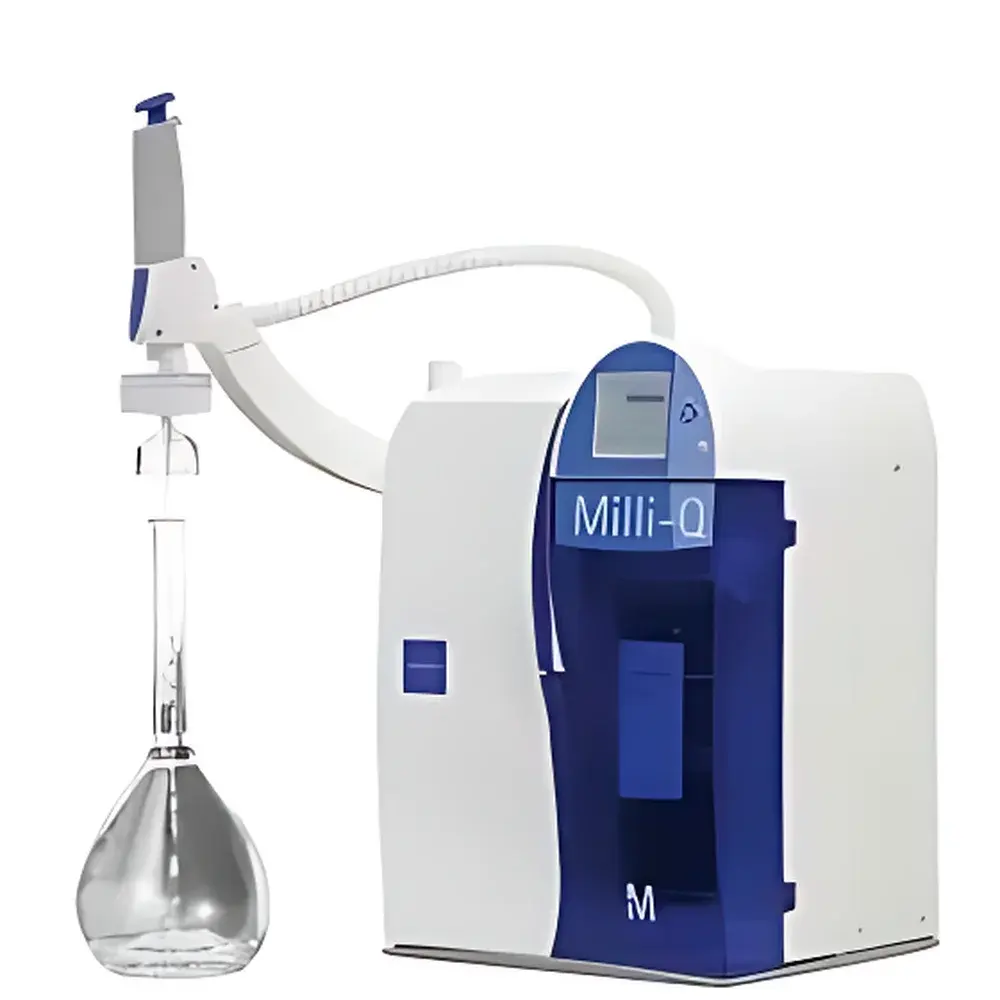
Merck Milli-Q Reference Ultra Pure Water System
| Brand | Merck |
|---|---|
| Origin | Germany |
| Manufacturer Type | Authorized Distributor |
| Product Origin | Imported |
| Model | Milli-Q Reference |
| Price Range | USD 13,500 – 40,500 (est.) |
| Water Grade | ASTM Type I / ISO 3696 Grade 1 |
| Resistivity | 18.2 MΩ·cm at 25 °C |
| Heavy Metals & Soluble Silica | < 0.1 ppb |
| Total Organic Carbon (TOC) | ≤ 5 ppb (µg/L) |
| Microbial Count | < 0.1 CFU/mL |
| Endotoxins | < 0.001 EU/mL (pyrogen-free) |
| Particles (>0.1 µm) | < 1 particle/mL |
| RNase | < 1 pg/mL (with BioPak) |
| DNase | < 5 pg/mL (with BioPak) |
Overview
The Merck Milli-Q Reference Ultra Pure Water System is a modular, high-reliability laboratory water purification platform engineered to generate Type I ultrapure water directly from pre-purified feed water (e.g., reverse osmosis or deionized water). It operates on a multi-stage purification architecture integrating dual-wavelength UV oxidation (185 nm and 254 nm), quantum-grade ion exchange, and selective terminal polishing—ensuring consistent compliance with ASTM D1193-20, ISO 3696:1987, CLSI GP30-A3, USP , EP 2.2.44, and CAP/NCCLS guidelines for critical analytical and life science applications. Unlike single-pass systems, the Milli-Q Reference employs a closed-loop recirculation circuit between the Quantum™ purification module and the selected terminal Pak cartridge, minimizing stagnation and maintaining real-time water quality stability at point-of-use.
Key Features
- Multi-Stage Purification Architecture: Feed water first passes through a Q-Gard™ pre-treatment cartridge tailored to local feed water composition, followed by dual-wavelength UV irradiation (185/254 nm) for advanced organic oxidation and microbial inactivation. Subsequent treatment via Quantum™ ion exchange and activated carbon media achieves sub-part-per-trillion ionic and organic contaminant removal.
- Modular Terminal Polishing: Interchangeable Pak cartridges—including Millipak® (0.22 µm sterile filtration), BioPak® (DNase/RNase-free, endotoxin-retentive), EDS-Pak® (endocrine disruptor screening), and VOC-Pak® (volatile organic compound–free)—enable application-specific water conditioning without system redesign.
- Ergonomic & Programmable Dispensing: A 75 cm flexible dispensing arm with integrated flow sensor supports volumetric delivery (0.1–99.9 L, ±2% accuracy), programmable volume presets, and height-adjustable ergonomic stand compatible with flasks, vials, and tall graduated cylinders.
- Intuitive Human-Machine Interface: Full-color graphical LCD display with multilingual support (including English, French, German, Chinese) provides real-time monitoring of resistivity, TOC, temperature, flow rate, and cartridge service life. Maintenance workflows—including cartridge replacement, UV lamp validation, and system sanitization—are guided step-by-step.
- Predictive Service Management: Embedded algorithm triggers proactive alerts 15 days prior to scheduled consumable replacement or service visit, ensuring uninterrupted operation and facilitating GLP/GMP-compliant maintenance logging.
- Upgradeable Architecture: The dispensing arm may be retrofitted with a POD (Point-of-Delivery) wall- or bench-mounted dispenser, reducing footprint and enabling integration into centralized lab water networks.
Sample Compatibility & Compliance
The Milli-Q Reference delivers water meeting or exceeding global regulatory benchmarks for critical laboratory use. With Millipak® installed, it yields <0.1 CFU/mL bacteria, 0.2 µm), and <0.001 EU/mL endotoxins—validated per ISO 11140-1 and USP . BioPak® configuration further guarantees RNase <1 pg/mL and DNase <5 pg/mL—essential for qPCR, CRISPR workflows, and primary cell culture. All configurations support FDA 21 CFR Part 11–compliant audit trails when paired with Milli-Q Data Manager software. System validation documentation aligns with IQ/OQ protocols per ASTM E2500-13 and ISO/IEC 17025 requirements.
Software & Data Management
Optional Milli-Q Data Manager software enables secure, role-based access control, electronic signature capture, and automated generation of calibration/maintenance reports compliant with GLP and GMP environments. All water quality parameters—including timestamped resistivity, TOC, UV transmittance, and cartridge usage metrics—are logged with tamper-proof encryption. Data export supports CSV, PDF, and XML formats for integration into LIMS or ELN platforms. Remote diagnostics and firmware updates are supported via Ethernet or optional Wi-Fi module, minimizing downtime during routine validation cycles.
Applications
- Analytical Chemistry: HPLC, LC-MS, GC-MS, ICP-MS, AAS, and ion chromatography—where low TOC and metal contamination prevent column fouling and spectral interference.
- Molecular Biology: cDNA synthesis, NGS library prep, electroporation, and stem cell culture—requiring nuclease-free, endotoxin-free water to preserve nucleic acid integrity and cellular viability.
- Pharmaceutical QA/QC: USP method development, buffer preparation, and stability testing under ICH Q5C and Q5A guidelines.
- Environmental Analysis: EPA Method 1694 (EDS screening) and ISO 21676 (trace organic analysis) using EDS-Pak® and VOC-Pak® configurations.
- Materials Science: Nanoparticle synthesis, thin-film deposition, and semiconductor cleaning—demanding ultra-low particulate and ionic residue levels.
FAQ
What feed water quality is required for optimal Milli-Q Reference performance?
The system requires pre-purified feed water with conductivity < 5 µS/cm (e.g., from RO or Elix™ systems); inlet pressure must be maintained between 1.5–6 bar, and temperature between 5–35 °C.
Can the system be validated for ISO/IEC 17025 or GMP environments?
Yes—full IQ/OQ documentation packages, including test scripts, acceptance criteria, and traceable calibration certificates, are available upon request and support 21 CFR Part 11 compliance when used with Data Manager software.
How often must consumables be replaced?
Q-Gard™ cartridges typically last 6–12 months depending on feed water quality; Quantum™ modules last 6–9 months; UV lamps require annual replacement; terminal Paks range from 3–12 months based on daily usage volume and application stringency.
Is remote monitoring supported?
Yes—via Ethernet or optional Wi-Fi, enabling real-time status dashboards, alarm notifications, and secure firmware updates through Merck’s LabManager Cloud portal.
Does the system support continuous TOC monitoring?
Integrated real-time TOC sensor (5 ppb detection limit) is standard; data is continuously logged and graphically displayed on the main interface with configurable alarm thresholds.



