
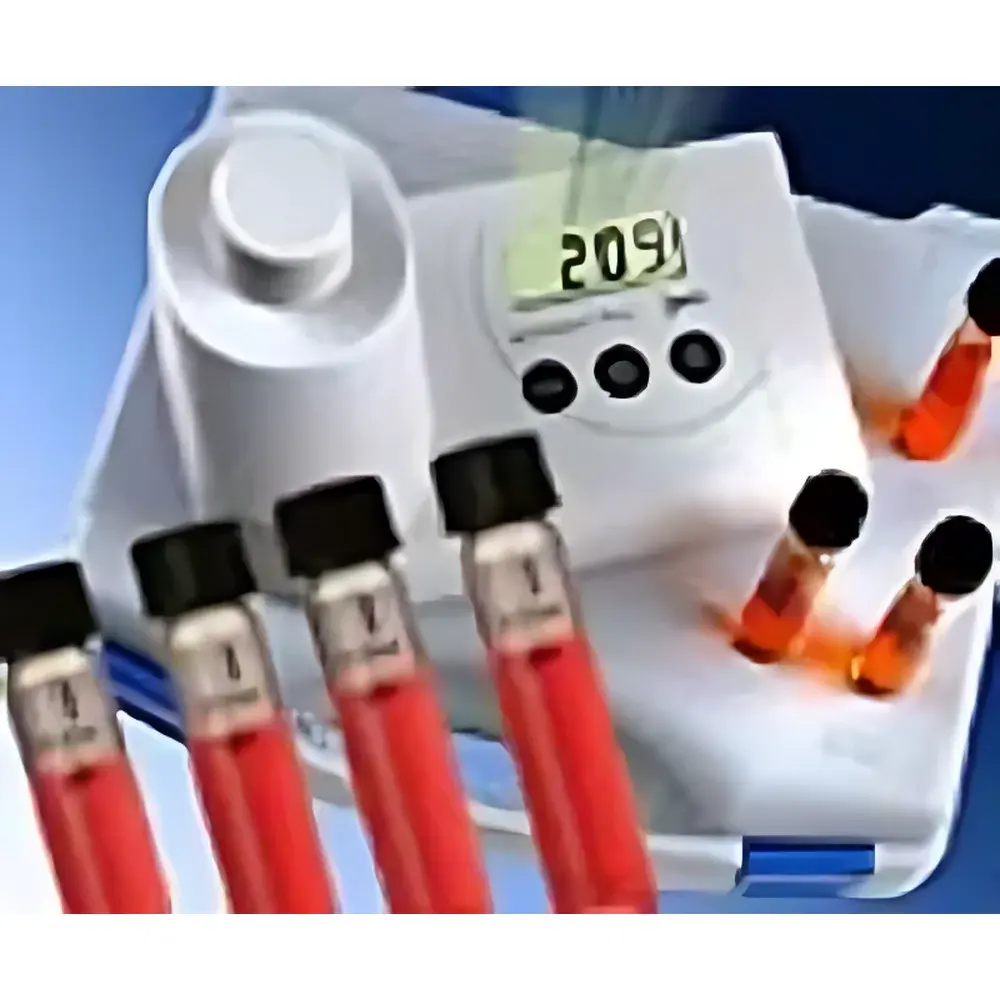
Merck Spectroquant® Picco F Fluoride Single-Parameter Colorimeter
| Brand | Merck |
|---|---|
| Origin | Germany |
| Manufacturer Type | Original Equipment Manufacturer (OEM) |
| Product Category | Imported Instrument |
| Model | Picco F |
| Pricing | Upon Request |
Overview
The Merck Spectroquant® Picco F is a dedicated single-parameter colorimeter engineered for rapid, reliable, and field-deployable fluoride (F⁻) quantification in water samples. Based on fixed-wavelength photometric absorption measurement—using a high-stability 620 nm LED light source paired with precision optical filters—the instrument applies pre-programmed calibration curves to deliver trace-level fluoride concentration results within 3–4 seconds per test. Designed for routine compliance monitoring and quality control in drinking water, wastewater effluent, industrial process streams, and environmental sampling, the Picco F operates on the principle of ion-selective colorimetric reaction: fluoride reacts with specific reagents (e.g., SPADNS or alizarin complexone derivatives) to form chromophores whose absorbance at 620 nm is directly proportional to analyte concentration. Its compact, battery-powered architecture eliminates dependency on mains power, enabling uninterrupted operation in remote locations, mobile labs, or emergency response scenarios.
Key Features
- Dedicated fluoride analysis platform with factory-calibrated, non-adjustable standard curves—ensuring method consistency and eliminating user-induced calibration drift
- Fixed-wavelength optical system (620 nm LED + interference filter) optimized for spectral specificity and long-term photometric stability
- Integrated 16 mm round cell adapter with secure cap—compatible with all Spectroquant® pre-filled reagent tubes (including 1.14598.xxxx and 1.14557.xxxx series)
- Low-power design powered by a single 9 V alkaline battery—supports up to 600 measurements per charge under typical usage conditions
- Automatic power-down after ~5 minutes of inactivity—preserves battery life without compromising operational readiness
- Robust IP-rated portable carry case containing all essential accessories: instrument host, adapter, battery, three 16 mm cuvettes, and multilingual operating manual
- Compliant with CE marking requirements per EN 55022, EN 61000-4-2, EN 61000-4-8, EN 50082-2, EN 50081-1, ENV 50140, and EN 50204—certified for electromagnetic compatibility and functional safety in laboratory and field environments
Sample Compatibility & Compliance
The Picco F is validated for use with aqueous matrices meeting standard drinking water (ISO 10523, ASTM D3370), wastewater (ISO 9963-1), and surface water (EN ISO 15587-1) sampling protocols. It supports direct analysis of filtered, non-turbid samples; turbidity >5 NTU requires prior clarification per ISO 7027. All Spectroquant® fluoride test kits referenced (e.g., 1.14598.0001, 1.14557.0001) are manufactured under Merck’s ISO 9001-certified production system and conform to DIN EN ISO/IEC 17025 traceability requirements for certified reference materials. The instrument itself does not require external validation but supports GLP-aligned documentation when used with Merck’s traceable reagent lot certificates and batch-specific calibration data sheets.
Software & Data Management
As a standalone photometer, the Picco F does not incorporate onboard data logging, USB connectivity, or PC interface capabilities. Measurement results are displayed numerically on the LCD screen and must be manually recorded. This design aligns with applications where audit trails are maintained via paper-based logbooks or integrated LIMS workflows—particularly in regulated settings where electronic records are governed by FDA 21 CFR Part 11 or EU Annex 11. For users requiring digital data capture, Merck recommends pairing the Picco F with the optional Spectroquant® LabStation software (used with compatible benchtop instruments) or third-party barcode-scanned sample tracking systems that accept manual entry of Picco F readouts.
Applications
- Drinking water utilities verifying fluoride dosing compliance per WHO guidelines (0.5–1.5 mg/L) and national standards (e.g., US EPA MCL = 4.0 mg/L, EU Directive 98/83/EC = 1.5 mg/L)
- Industrial facilities monitoring fluoride discharge in semiconductor rinse water, aluminum anodizing baths, or phosphate fertilizer production effluents
- Environmental laboratories conducting baseline surveys of groundwater near fluorite mining zones or geothermal discharge areas
- Educational institutions performing standardized APHA 4500-F B/C methods using pre-validated reagent kits
- Field technicians executing rapid-response testing during fluoride contamination incidents or post-treatment verification in rural water schemes
FAQ
What is the measurement uncertainty of the Picco F for fluoride analysis?
The instrument exhibits ±3.5% relative error across its defined working range (0.10–2.00 mg/L and 1.0–20.0 mg/L), as verified against NIST-traceable fluoride standards under controlled laboratory conditions.
Can the Picco F be used with non-Merck reagents?
No. The device relies on proprietary pre-calibrated curves matched exclusively to Spectroquant® reagent chemistry and tube geometry; third-party reagents invalidate accuracy and void regulatory acceptability.
Is temperature compensation applied during measurement?
The Picco F does not include active temperature sensing or compensation; users must perform analyses within the specified ambient range (5–40 °C) and equilibrate samples to room temperature prior to testing to maintain stated precision.
How often does the optical system require recalibration?
None. The fixed-wavelength LED/filter assembly is factory-aligned and sealed; no field recalibration or user maintenance is permitted or required under normal operating conditions.
Does the Picco F meet ISO/IEC 17025 method validation requirements?
While the instrument itself is not accredited, its performance when used with certified Spectroquant® test kits satisfies ISO/IEC 17025 clause 5.4.2 for “use of standard methods” — provided laboratories establish and document their own verification of trueness, precision, and detection capability per ISO/IEC 17025:2017 Annex A.3.
Related Products







