
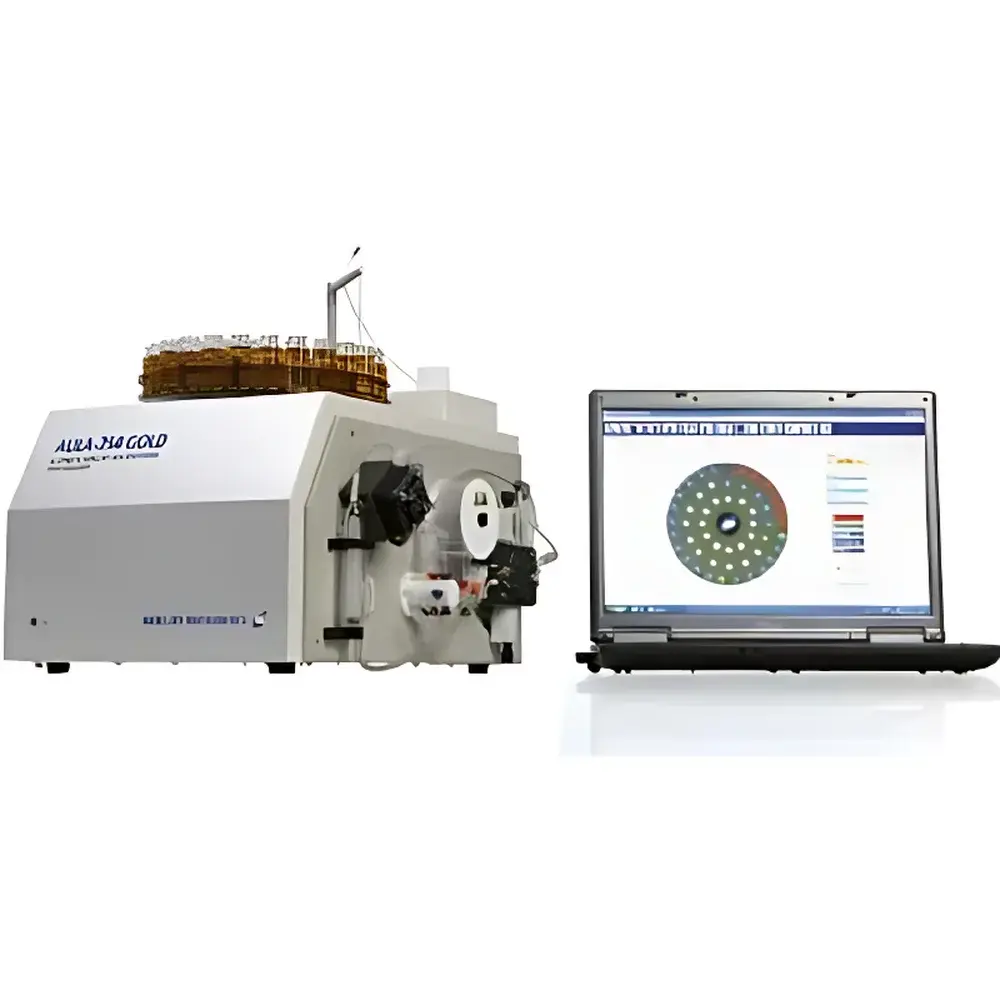
Mercury Instruments AULA-254 Gold Automated Laboratory Mercury Analyzer
| Brand | Mercury Instruments |
|---|---|
| Origin | Germany |
| Model | AULA-254 Gold |
| Instrument Type | Benchtop Laboratory Analyzer |
| Measurement Principle | Cold Vapor Atomic Absorption Spectrometry (CVAAS) |
| Detection Limit | < 1 ng/L (with gold amalgamation trap) |
| Repeatability | ≤ 1.0% RSD |
| Linearity Error | ±1% |
| Optical Wavelength | 253.7 nm |
| UV Source | Electrodeless Low-Pressure Mercury Discharge Lamp |
| Sample Introduction | 53-position rotary autosampler |
| Sample Vial | 10 mL glass vials with optional aluminum foil caps |
| Carrier Gas | Argon (4–6 L/h), mass flow controlled |
| Digestion Heater Temperature | 98 °C |
| Optical Cell | Fused silica, 230 mm path length |
| Optical Cell Temperature | 50 °C |
| Measurement Cycle | 60–280 s |
| Software | AULA-WIN (Windows®-based) |
| Power Supply | 115/230 V~, 50–60 Hz, 100 W (120 W with ASD module) |
| Dimensions (W×H×D) | 37 × 38 × 44 cm |
| Footprint Requirement | 50 × 70 cm (W × D) |
| Weight | ~14 kg (without PC) |
| Compliance | EPA Methods 245.1, 245.7, 1631, 7470, 7471A |
| Optional Module | Automated Sample Digestion (ASD) |
Overview
The Mercury Instruments AULA-254 Gold is a benchtop, fully automated mercury analyzer engineered for ultra-trace quantification of total mercury in liquid and digested solid matrices. It employs Cold Vapor Atomic Absorption Spectrometry (CVAAS) — a reference-grade technique standardized by the U.S. Environmental Protection Agency (EPA) and widely accepted under ISO 17294-2 and ASTM D3223. The system integrates a high-efficiency gold amalgamation trap to preconcentrate mercury vapor prior to detection, enabling sub-part-per-trillion (sub-ppt) sensitivity without compromising analytical speed or robustness. Unlike conventional CVAAS systems requiring lengthy thermal desorption cycles, the AULA-254 Gold utilizes an ultra-thin ceramic substrate-based gold trap, minimizing thermal inertia and enabling rapid heating/cooling kinetics — reducing cycle time to as low as 60 seconds while maintaining full compliance with EPA Method 1631 validation criteria. The instrument operates at a fixed absorption wavelength of 253.7 nm using a stable, electrodeless low-pressure mercury discharge lamp, coupled with a dual-beam optical architecture featuring a fused silica absorption cell (230 mm path length) maintained at a constant 50 °C to ensure baseline stability and minimize condensation artifacts.
Key Features
- Fully automated analysis workflow: integrated 53-position rotary autosampler with programmable sequence control and optional aluminum foil sealing for volatile sample integrity.
- Gold amalgamation trap with proprietary low-thermal-mass ceramic substrate — delivers <1 ng/L detection limit (as Hg) and enables dynamic range extension from 1 ng/L to 5 µg/L.
- Dual-beam CVAAS optics with temperature-stabilized fused silica absorption cell (230 mm path length) and real-time background correction.
- Onboard carrier gas regulation: precision mass-flow-controlled argon delivery (4–6 L/h); nitrogen compatibility available upon configuration.
- Modular design supports seamless integration of the optional Automated Sample Digestion (ASD) module — a PTFE-lined, temperature-controlled (98 °C) digestion station compliant with EPA 7470/7471A protocols.
- Zero-point calibration executed automatically after each measurement cycle, ensuring long-term baseline fidelity and eliminating manual drift correction.
Sample Compatibility & Compliance
The AULA-254 Gold is validated for direct analysis of aqueous samples (e.g., drinking water, wastewater, leachates) and acid-digested matrices including soils, sediments, biological tissues (urine, blood, hair), pharmaceutical formulations, petrochemical distillates, and metallurgical extracts. Its performance meets or exceeds requirements of EPA Methods 245.1, 245.7, 1631, 7470, and 7471A; it also aligns with ISO 17294-2 for trace metal analysis in water and ASTM D3223 for mercury in petroleum products. When operated with ultra-high-purity reagents and certified reference materials (CRMs), the system achieves ≤1.0% RSD for repeatability and ±1% linearity error across its calibrated range. All measurement data are timestamped, user-logged, and stored with full audit trail capability — supporting GLP/GMP environments and FDA 21 CFR Part 11-compliant workflows when deployed with appropriate IT infrastructure.
Software & Data Management
AULA-WIN is a Windows®-based control and data processing platform designed specifically for trace mercury analytics. It provides intuitive method setup, real-time spectral visualization, automatic peak integration, and multi-point calibration curve generation with weighting options (e.g., 1/x, 1/x²). Raw absorbance signals, trap temperature profiles, gas flow logs, and autosampler status are archived in a relational database structure with configurable export (CSV, PDF, XML). The software supports user-level access control, electronic signatures, and full audit trail logging — essential for laboratories undergoing ISO/IEC 17025 accreditation or regulatory inspections. Data integrity safeguards include write-protected archives, automatic backup scheduling, and tamper-evident file hashing.
Applications
The AULA-254 Gold serves as a primary tool in environmental monitoring labs performing routine compliance testing of surface water, groundwater, and effluent discharges per national discharge permits. In clinical and toxicology laboratories, it supports biomonitoring studies via quantification of mercury in urine and whole blood at occupational exposure limits (OELs). Pharmaceutical QA/QC teams use it for residual mercury screening in active pharmaceutical ingredients (APIs) and excipients per ICH Q3D guidelines. Geochemical and mining laboratories apply it to assess mercury mobility in ore leachates and tailings pore waters. Additionally, it is routinely deployed in petrochemical QC for catalyst poisoning assessment and in semiconductor manufacturing for ultrapure water certification.
FAQ
Does the AULA-254 Gold require external cooling or ventilation?
No — the system is air-cooled and designed for standard laboratory benchtop operation without dedicated exhaust or chilled water connections.
Can the gold trap be regenerated in situ?
Yes — the trap undergoes full thermal regeneration within each analytical cycle; no manual replacement or chemical cleaning is required during normal operation.
Is method validation support provided?
Mercury Instruments supplies comprehensive validation documentation packages, including IQ/OQ protocols, linearity verification reports, and EPA 1631-compliant performance checklists.
What sample preparation is needed for solid matrices?
Soil, sediment, or tissue samples require acid digestion (e.g., HNO₃/H₂SO₄/KMnO₄ or EPA SW-846 Method 3050B/3052); the optional ASD module automates this step with programmable ramp-hold profiles.
How is data security ensured in regulated environments?
AULA-WIN supports role-based user authentication, electronic signatures, immutable audit trails, and encrypted database backups — meeting core technical requirements of 21 CFR Part 11 when paired with validated network storage and domain policies.





