
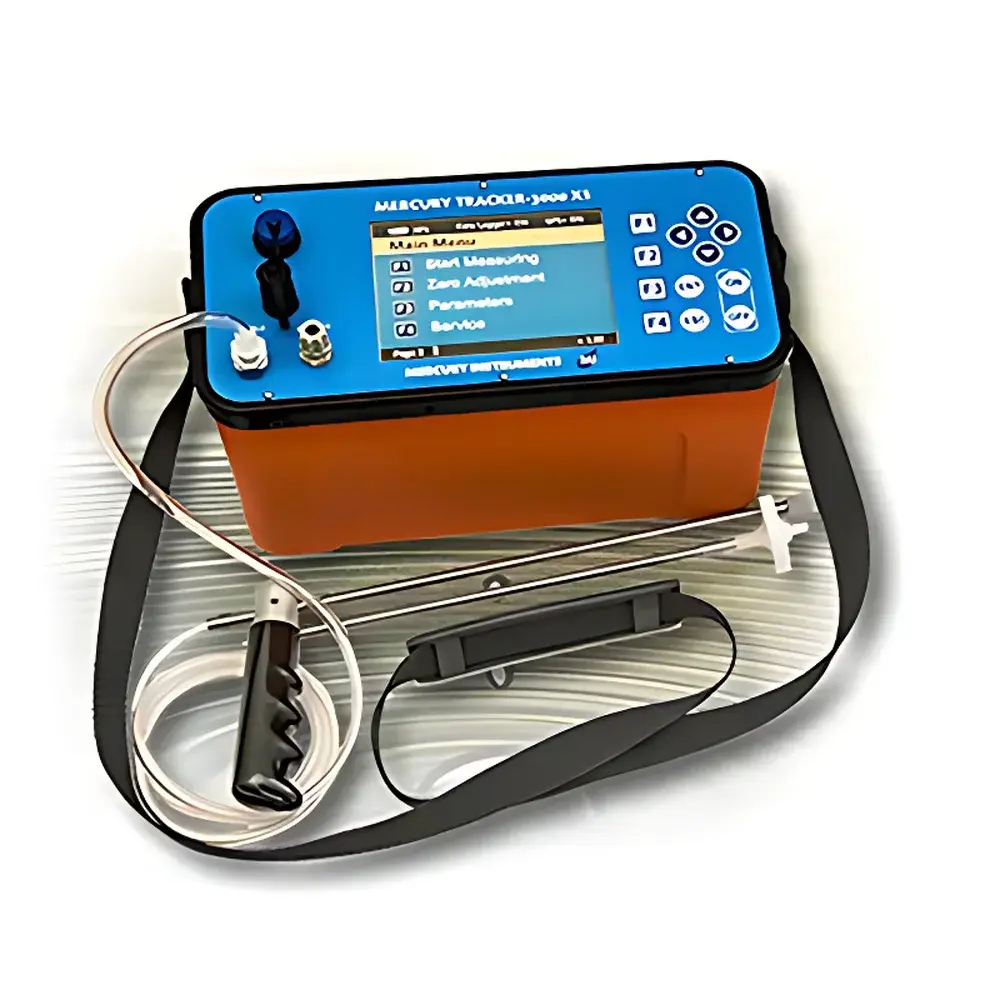
Mercury Instruments Tracker 3000XS Portable Mercury Analyzer
| Brand | Mercury Instruments |
|---|---|
| Origin | Germany |
| Model | 3000XS |
| Instrument Type | Portable |
| Measurement Principle | Cold Vapor Atomic Absorption Spectrometry (CVAAS) |
| Detection Limit | 0.1 µg/m³ |
| Repeatability | ≤3.0% |
| Linearity Error | ±10% |
| Measurement Ranges | 0–100 / 0–1000 / 0–2000 µg/m³ |
| Resolution | 0.1 µg/m³ |
| UV Source | Electrodeless Low-Pressure Mercury Lamp (253.7 nm) |
| Optical Cell | High-Purity Fused Silica |
| Pump Type | Maintenance-Free Diaphragm Pump |
| Battery Life | Up to 6 Hours |
| Data Logging | Integrated Recorder |
| Compliance | Designed for ISO 15202, ASTM D6784, and EPA Method 29–compliant field deployment |
Overview
The Mercury Instruments Tracker 3000XS is a field-deployable, battery-powered mercury vapor analyzer engineered for real-time, quantitative measurement of elemental mercury (Hg⁰) in ambient air, workplace atmospheres, and contaminated site emissions. It operates on the principle of Cold Vapor Atomic Absorption Spectrometry (CVAAS), a well-established, reference-grade technique standardized in ISO 15202:2019, ASTM D6784-22 (Standard Test Method for Elemental, Oxidized, Particle-Bound, and Total Mercury in Flue Gas), and U.S. EPA Method 29. In this method, gaseous mercury atoms in the sample stream absorb ultraviolet radiation at the resonant wavelength of 253.7 nm. The degree of absorption—measured via a dual-beam optical path through a high-purity fused silica absorption cell—is directly proportional to mercury concentration. The Tracker 3000XS employs a frequency-stabilized, electrodeless low-pressure mercury lamp as its primary UV source, delivering narrow spectral bandwidth (<0.05 nm) precisely matched to the Hg atomic absorption line. A reference beam continuously monitors lamp intensity drift, enabling real-time photometric compensation and ensuring long-term baseline stability. Background noise is maintained below 0.1 µg/m³, supporting reliable quantification at sub-ppqv levels.
Key Features
- True portable architecture: Weighing under 4.2 kg with ergonomic shoulder strap and detachable probe for unrestricted access to ducts, confined spaces, and outdoor survey points.
- Three user-selectable measurement ranges (0–100, 0–1000, and 0–2000 µg/m³) with automatic range switching and 0.1 µg/m³ digital resolution.
- Maintenance-free diaphragm sampling pump with flow-controlled inlet (1.2 L/min nominal), integrated particulate filter, and chemical scrubber compatibility for H₂S or Cl₂ interference mitigation.
- Onboard calibration verification function: Users can perform zero and span checks using certified Hg permeation sources or dynamic dilution systems without external software.
- Ruggedized housing rated IP54 for dust and splash resistance; corrosion-resistant internal wetted path (PTFE, fused silica, stainless steel 316); shock-absorbing elastomer mounting for optics and lamp assembly.
- Integrated rechargeable Li-ion battery pack supporting ≥6 hours of continuous operation at 25°C, with hot-swap capability and external DC input (12–24 V).
Sample Compatibility & Compliance
The Tracker 3000XS is validated for direct analysis of undiluted ambient air, stack effluent (with optional heated probe up to 180°C), soil gas (via stainless steel probe and Tedlar® tubing), and indoor workplace air. It meets functional requirements for occupational exposure monitoring per OSHA 29 CFR 1910.1000 and EU Directive 2017/2398. Its CVAAS methodology aligns with the performance criteria specified in ISO 15202 for portable mercury analyzers—including detection limit verification, linearity assessment across three decades, and repeatability testing under variable humidity (20–80% RH) and temperature (5–40°C). Each unit ships with factory calibration traceable to NIST-traceable Hg vapor standards and includes full uncertainty budget documentation compliant with ISO/IEC 17025:2017 Annex A.5.
Software & Data Management
Data acquisition and instrument control are managed via the embedded TrackerControl firmware (v3.2+), accessible through a 4.3-inch capacitive touchscreen interface. All measurements—including raw absorbance, calculated concentration, flow rate, battery status, lamp hours, and temperature/pressure compensation values—are time-stamped and stored internally (≥100,000 records). Export is supported via USB-C or Bluetooth 5.0 to PC-based MercuryView Suite (Windows/macOS), which provides GLP-compliant audit trails, electronic signature support, and 21 CFR Part 11–ready configuration controls (user roles, password policies, change logs). Raw spectral data and calibration history files are exportable in CSV and XML formats for third-party validation or regulatory submission.
Applications
- Occupational health monitoring in chlor-alkali plants, dental clinics, fluorescent lamp recycling facilities, and gold mining operations.
- Rapid screening of mercury-contaminated brownfields, former industrial sites, and landfill perimeter zones per ASTM D6828–22 protocols.
- Real-time leak detection during mercury-containing equipment maintenance (e.g., transformers, switches, thermometers) and decommissioning activities.
- Compliance verification for EU Minamata Convention reporting, U.S. Clean Air Act Section 112 compliance audits, and WHO air quality guideline assessments (1 µg/m³ annual mean).
- Field validation of fixed-site continuous emission monitoring systems (CEMS) and sorbent trap sampling programs.
FAQ
What regulatory standards does the Tracker 3000XS meet for field mercury monitoring?
It conforms to ISO 15202:2019, ASTM D6784-22, and EPA Method 29 for measurement performance, and supports documentation workflows aligned with ISO/IEC 17025 and 21 CFR Part 11.
Can the instrument measure mercury in soil gas or flue gas?
Yes—when paired with an optional heated sampling probe (up to 180°C) and inert tubing, it quantifies Hg⁰ in soil gas and cooled, filtered flue gas streams; high-temperature applications require external conditioning.
How often does the instrument require recalibration?
Factory calibration remains stable for ≥12 months under normal use; users are advised to verify zero and span before each critical survey using traceable standards per ISO 15202 Annex B.
Is the optical cell susceptible to contamination from particulates or condensate?
No—the fused silica cell is housed upstream of the particulate filter and features hydrophobic surface treatment; optional heated inlet accessories prevent dew point-related deposition.
Does the Tracker 3000XS support remote data transmission?
Not natively—but Bluetooth 5.0 enables local wireless transfer to mobile devices running MercuryView Mobile (iOS/Android), with scheduled cloud upload via companion gateway hardware (sold separately).





