
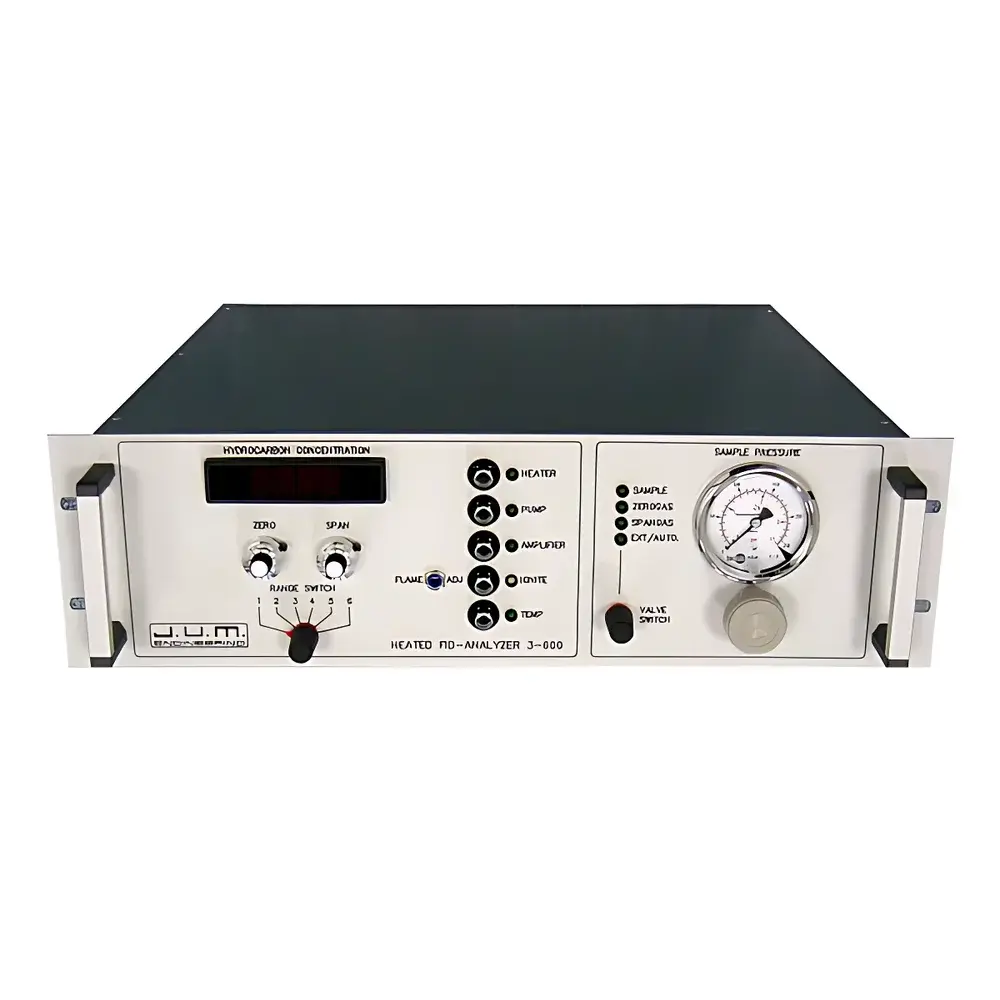
J.U.M. 3-600-1 Online Non-Methane Hydrocarbons (NMHC) Monitoring System with FID Detector
| Brand | J.U.M. |
|---|---|
| Origin | Germany |
| Model | 3-600-1 |
| Detection Principle | Flame Ionization Detection (FID) |
| Instrument Type | Online Analyzer |
| Configuration | Total VOC Analyzer |
| Measurement Range | 0–1000 ppm |
| Resolution | 0.1 ppm |
| Accuracy | ±5% of reading |
| Response Time | <60 s |
| Sensitivity | ≤1 ppm (CH₄ full scale) |
| Heater Chamber Temperature | 190 °C |
| Carrier/Air Supply | Integrated zero-air generator |
Overview
The J.U.M. 3-600-1 Online Non-Methane Hydrocarbons (NMHC) Monitoring System is a high-stability, laboratory-grade continuous emission monitoring solution engineered for precise quantification of total volatile organic compounds (TVOC) and non-methane hydrocarbons in gaseous streams. Built upon flame ionization detection (FID) technology—a universally accepted reference method for hydrocarbon measurement—the system delivers robust, linear response across wide dynamic ranges without chemical specificity bias. Unlike photoionization (PID) or metal oxide semiconductor (MOS) sensors, FID provides stoichiometric response to virtually all organic compounds containing C–H bonds, making it the preferred technique for regulatory-compliant NMHC reporting under statutory frameworks including German BImSchV ordinances (2nd, 13th, and 17th Ordinances), European EN 12619 and EN 13526, and U.S. EPA Methods 25A and 503. The instrument features a thermally stabilized combustion chamber operating at 190 °C to ensure complete oxidation of complex hydrocarbons—including aromatic, aliphatic, and oxygenated VOCs—while minimizing condensation artifacts and catalytic memory effects.
Key Features
- FID detector with inherent linearity over six decades (0–100,000 ppm CH₄ equivalent), calibrated traceably to NIST-traceable standards
- Integrated zero-air supply system eliminating external compressed air dependency and reducing background interference
- Heated sample path and reaction chamber maintained at 190 °C to prevent adsorption losses of semi-volatile compounds (e.g., C₁₀–C₁₆ alkanes, PAH precursors)
- Real-time digital signal processing with 0.1 ppm resolution and ±5% full-scale accuracy verified per ISO 17025-accredited procedures
- Modular architecture supporting optional methane slip correction, catalytic methanizer integration, and dual-range auto-ranging
- IP65-rated enclosure suitable for industrial environments with ambient temperature operation from 5 °C to 40 °C
Sample Compatibility & Compliance
The 3-600-1 is validated for direct analysis of hot, humid, and particulate-laden gas streams typical of automotive exhaust, engine test cell ducts, catalytic converter effluents, and thermal oxidizer stacks. It complies with GLP and GMP-aligned data integrity requirements, including audit-trail-enabled configuration logging and user-access-controlled parameter modification. Regulatory alignment includes compliance-ready reporting templates for EN 14181 QAL1/QAL2 validation, EPA PS-8 performance specifications, and VDI 2440/VDI 3870 for mobile source emissions testing. All calibration and maintenance records adhere to ISO 17025 documentation standards, facilitating third-party verification and regulatory audits.
Software & Data Management
The embedded firmware supports Modbus TCP, RS-485, and analog 4–20 mA outputs for seamless integration into SCADA, DCS, and LIMS platforms. Optional J.U.M. Analytical Suite software provides real-time chromatogram-free concentration trending, alarm thresholding (pre-set or user-defined), automatic zero/span validation scheduling, and CSV/Excel export compliant with FDA 21 CFR Part 11 requirements—including electronic signatures, change history, and role-based access control. Data retention supports ≥12 months of second-resolution time-series storage onboard, with optional cloud synchronization via TLS 1.2–encrypted MQTT.
Applications
- Regulatory NMHC monitoring from light-duty and heavy-duty vehicle exhaust during WLTP/RDE testing cycles
- Continuous emission monitoring (CEM) of thermal incinerators, regenerative thermal oxidizers (RTOs), and catalytic oxidation units
- In-line process control of solvent recovery systems with lower explosive limit (LEL) safety interlock capability
- Hydrocarbon purity verification in ultra-high-purity (UHP) nitrogen, argon, and hydrogen used in semiconductor fabrication
- Dynamic catalyst evaluation during accelerated aging tests, including Pd/Rh/Pt washcoat deactivation profiling
- Source apportionment studies in automotive component off-gassing chambers (e.g., dashboards, seat foams, adhesives)
FAQ
Does the 3-600-1 require external zero-air or calibration gas cylinders?
No—it incorporates an integrated catalytic purifier and pressure-regulated zero-air generator, eliminating dependency on bottled gases for routine operation.
Can the system distinguish between methane and non-methane hydrocarbons without a methanizer?
The base configuration measures total hydrocarbons; NMHC quantification requires either upstream methane removal (via selective scrubber) or post-detection subtraction using a parallel methane-specific analyzer (e.g., GC-FID or NDIR). Optional methanizer integration is available.
Is the instrument certified for use in explosion-hazardous areas (ATEX/IECEx)?
The standard 3-600-1 is rated for Zone 2/Class I Div 2 environments; ATEX-certified variants (II 2G Ex db IIB T4 Gb) are available upon request with modified housing and intrinsically safe signal conditioning.
What maintenance intervals are recommended for long-term operational stability?
FID jet cleaning and electrode inspection every 3 months; ceramic igniter replacement every 12 months; annual full system verification including linearity, zero drift, and response time per EN 14181 Annex B.
How is data integrity ensured during power interruptions or network outages?
Onboard non-volatile memory retains all measurement data and event logs during brownouts; internal clock maintains timestamp accuracy within ±2 seconds/month, and unsent data buffers automatically transmit upon network recovery.
Related Products







