
Meridion Continuous Spray Freeze-Drying System
| Brand | Meridion |
|---|---|
| Origin | Germany |
| Model | Continuous Spray Freeze-Drying System |
| Application | Laboratory-scale R&D to Pilot/Pharmaceutical Production (up to 20 kg/batch) |
| Vacuum Level | < 10 Pa (typical operating range for primary drying) |
| Condenser Capacity | ≥ 5 kg/24 h (standard configuration) |
| Overall Dimensions (L×W×H) | 2200 × 1800 × 2600 mm |
| Cooling Medium | Liquid nitrogen or closed-loop cryogenic refrigerant system |
| Particle Size Range | 200–800 µm (narrow distribution, CV < 15%) |
| Drying Time Reduction | Up to 50% vs. conventional shelf-based lyophilization |
Overview
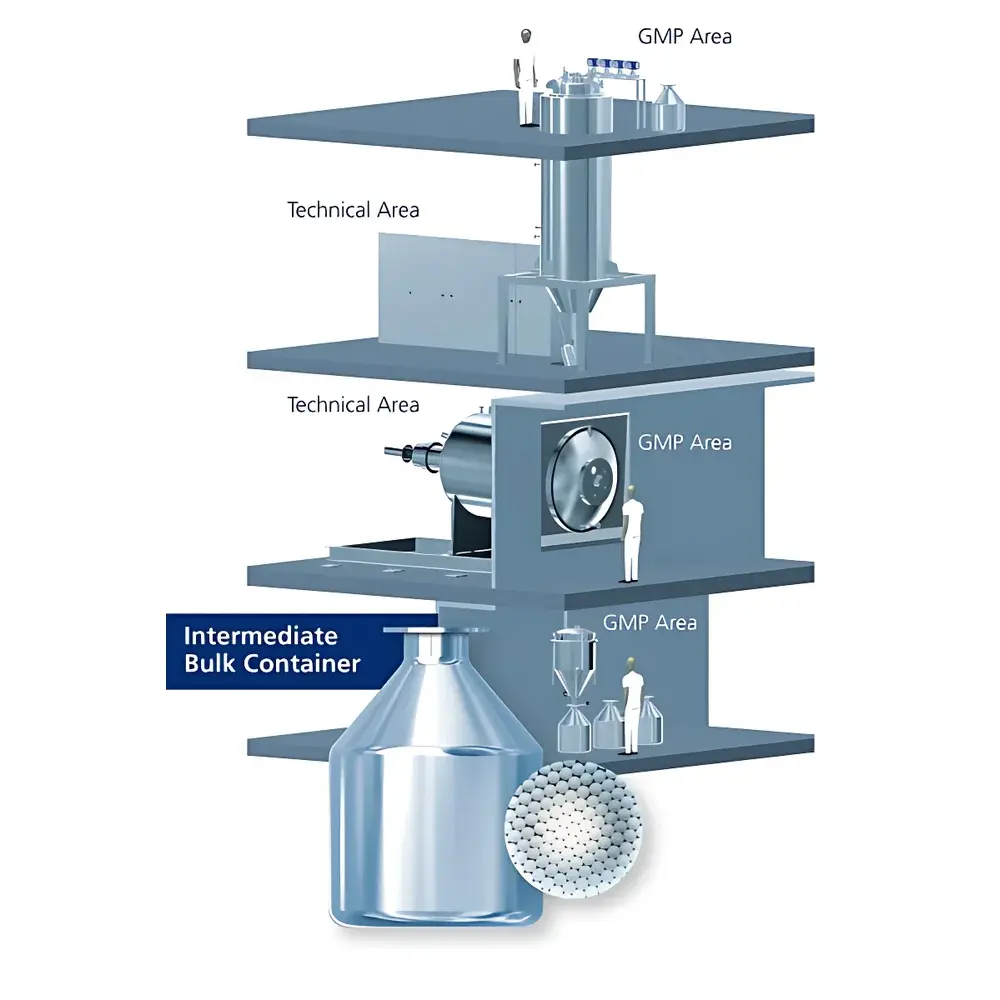
The Meridion Continuous Spray Freeze-Drying System is a purpose-engineered platform for the integrated production of uniform, free-flowing freeze-dried microspheres under continuous or semi-continuous operation. Unlike conventional batch lyophilizers relying on static shelf loading and conductive heat transfer, this system combines high-precision pneumatic or ultrasonic spray atomization with dynamic cryogenic freezing and radiation-heated rotational drying—enabling direct control over nucleation kinetics, ice morphology, and mass transfer pathways. Developed in Basel-region Germany by a multidisciplinary team of pharmaceutical process engineers, cryo-process specialists, and automation experts, the system implements a true continuous solid dosage form manufacturing paradigm: liquid feed → atomized droplets → rapid cryo-solidification → controlled sublimation in rotating cylindrical chambers → dry powder collection. Its architecture supports both laboratory-scale formulation development (gram-to-kilogram output) and scalable process validation aligned with ICH Q5, Q8, and Q9 frameworks.
Key Features
- Continuous spray-freeze-drying workflow eliminating manual vial loading/unloading and shelf-based thermal bottlenecks
- High-resolution nozzle systems enabling narrow particle size distribution (200–800 µm; coefficient of variation < 15%)
- Rotational drying chamber with radiative heating and real-time surface temperature monitoring (±0.5 °C accuracy)
- Cryogenic freezing zone utilizing liquid nitrogen or closed-loop refrigerant for instantaneous solidification (< 100 ms droplet residence time)
- Integrated process analytical technology (PAT) suite: in-line NIR spectroscopy, product temperature probes, vacuum pressure profiling, and condenser load tracking
- Modular design compliant with ISO 14644-1 Class 7 cleanroom integration and GMP-compliant material contact surfaces (316L stainless steel, electropolished)
- No shelf dependency—drying efficiency enhanced by full-surface heat exchange and unrestricted vapor flow paths
Sample Compatibility & Compliance
The system accommodates aqueous, organic, and co-solvent-based formulations containing APIs, biologics (e.g., peptides, mAbs), vaccines, and excipients such as trehalose, mannitol, and HPMC. It supports freeze-drying of thermolabile compounds requiring low-temperature stabilization and enables formulation strategies for orally disintegrating tablets (ODTs), inhalable powders, and combination products where component incompatibility necessitates spatially separated drying or sequential deposition. Regulatory alignment includes support for FDA 21 CFR Part 11-compliant electronic records, audit trail generation, and IQ/OQ/PQ documentation packages. All mechanical and control systems conform to EN 61000 (EMC), EN 61010-1 (safety), and ISO 13485:2016 for medical device manufacturing environments.
Software & Data Management
The Meridion Control Suite (v4.2+) provides deterministic real-time process supervision via a validated Siemens SIMATIC S7-1500 PLC backbone and WinCC SCADA interface. Operators configure atomization parameters (flow rate, gas pressure, nozzle frequency), freezing profiles (cryogen flow, residence time), and drying ramps (radiation intensity, rotation speed, chamber pressure) through a role-based GUI with configurable user permissions. All critical process parameters (CPPs) are logged at ≤1 Hz resolution with timestamped metadata. Data export complies with ASTM E2500-13 and USP guidelines, supporting CSV, PDF, and ASAM ODS formats. Electronic signatures, deviation logging, and alarm management modules meet ALCOA+ principles for data integrity in GLP/GMP audits.
Applications
- Rapid screening of lyoprotectant matrices and crystallinity-modulating excipients
- Development of amorphous solid dispersions with improved dissolution kinetics
- Manufacturing of spherical freeze-dried particles for direct compression or capsule filling
- Production of sterile, low-bioburden powders without terminal sterilization
- Process intensification studies targeting reduction of cycle time, energy consumption, and facility footprint
- Supporting Quality-by-Design (QbD) initiatives through Design of Experiments (DoE)-driven parameter space mapping
FAQ
What distinguishes spray freeze-drying from conventional lyophilization?
Spray freeze-drying eliminates the need for pre-freezing and shelf-based primary drying by atomizing solution into cryogenic gas, forming spherical frozen particles with uniform ice crystal structure—resulting in faster reconstitution, higher surface area, and reduced collapse risk.
Can the system be integrated into an existing cleanroom HVAC infrastructure?
Yes—the unit is designed for Class 7 (ISO 14644-1) compatibility with optional HEPA-filtered air handling and segregated utility interfaces (N₂, compressed air, chilled water, electrical).
Is remote monitoring and troubleshooting supported?
The system includes secure OPC UA server functionality and optional TLS-encrypted cloud telemetry for authorized remote diagnostics and performance benchmarking.
Does it support regulatory filing submissions?
Full validation documentation—including URS, FDS, SDS, FAT/SAT reports, and traceability matrices—is provided per client requirements for IND, IMPD, or MAA dossiers.
What maintenance intervals are recommended for the cryogenic delivery system?
Liquid nitrogen supply lines require quarterly inspection; closed-loop refrigerant systems follow OEM-specified oil analysis and filter replacement schedules (typically every 2,000 operating hours).



