
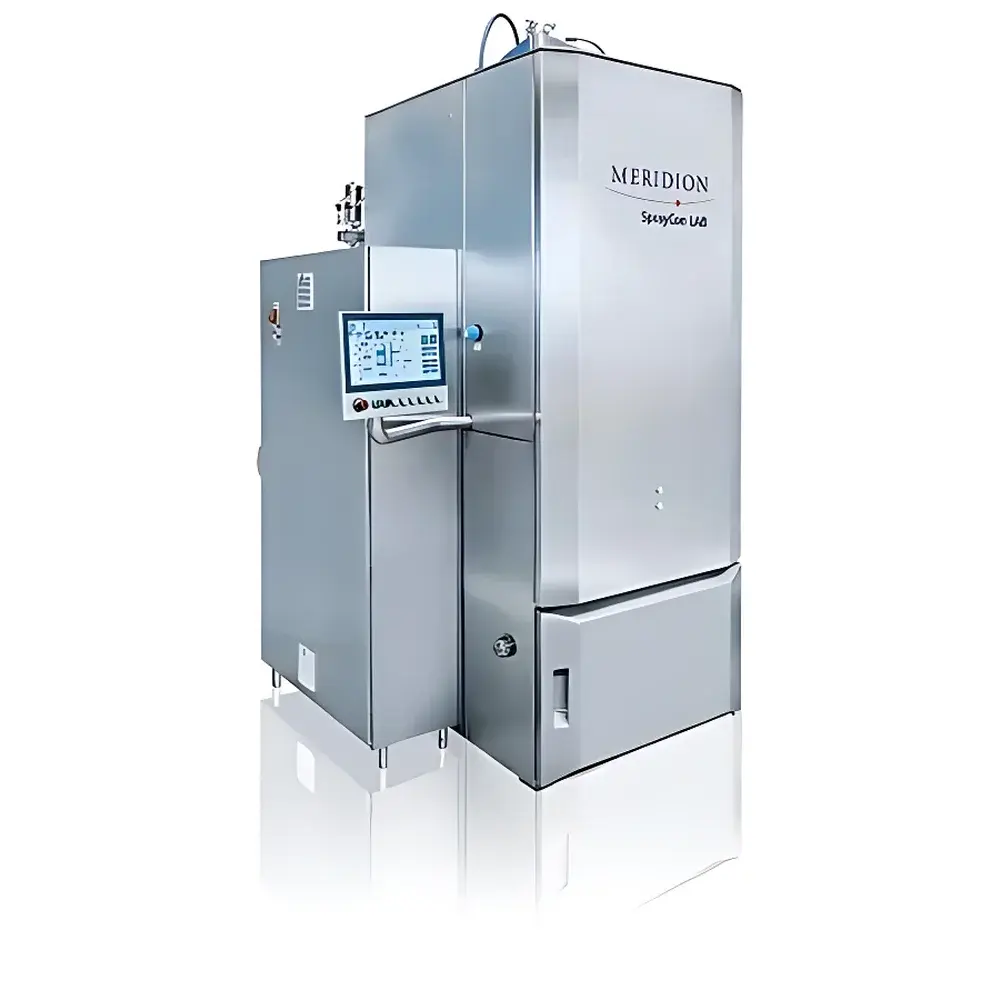
Meridion SprayCon LAB Spray Freeze Dryer
| Brand | Meridion |
|---|---|
| Origin | Germany |
| Model | SprayCon LAB |
| Type | Spray-based Cryogenic Freeze Dryer |
| Application | Laboratory-scale Microsphere Production |
| Droplet Size Range | 200–800 µm |
| Spray Feed Rate | 300–1500 mL/h |
| Cooling Medium | Liquid Nitrogen (LN₂) |
| LN₂ Consumption | 40–60 L/h |
| Compressed Air | 20–30 m³/h at 6 bar |
| Power Supply | 230 V, 3 kW |
| Dimensions | 1100 × 1200 × 2650 mm |
| Weight | 1150 kg |
Overview
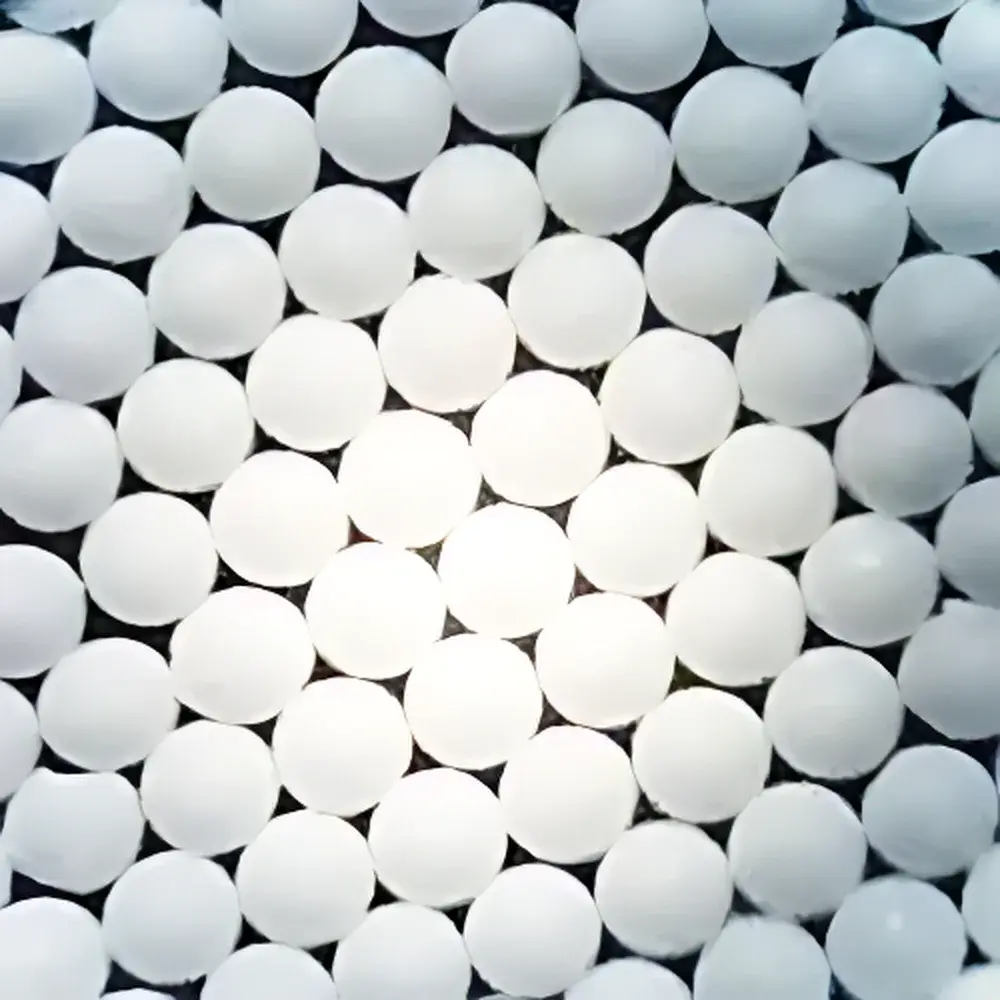
The Meridion SprayCon LAB is a laboratory-scale spray freeze dryer engineered for the reproducible production of uniform, cryogenically frozen microspheres—designed specifically for pharmaceutical formulation development, excipient compatibility screening, and advanced solid dosage form research. Unlike conventional lyophilization systems that rely on batch freezing followed by primary and secondary drying under vacuum, the SprayCon LAB employs a continuous, single-step cryogenic atomization process: liquid feedstock is precisely atomized via high-accuracy nozzles into fine droplets, which undergo instantaneous solidification while traversing a controlled, insulated nitrogen-cooled chamber. This principle—based on rapid conductive/convective heat transfer in a cryogenic environment—enables formation of spherical, low-porosity ice particles with narrow size distribution (200–800 µm), minimal solute migration, and exceptional morphological homogeneity. The system operates without shelves, stoppering mechanisms, or vacuum chambers typical of standard freeze dryers; instead, it delivers direct cryo-solidification under atmospheric or optionally inert (N₂-purged) conditions—making it especially suited for oxygen-sensitive actives, thermolabile biologics, and multi-component formulations requiring spatially resolved co-processing.
Key Features
- High-precision pneumatic or ultrasonic spray nozzles enabling consistent droplet generation across defined size ranges (200–800 µm)
- Integrated liquid nitrogen cooling circuit with dual-wall thermal management for rapid, uniform droplet vitrification
- PLC-based control architecture with industrial-grade HMI touchscreen interface supporting recipe storage, parameter logging, and real-time temperature profiling of the spray chamber
- Modular conical collection vessel housed within an insulated cryogenic lower compartment—facilitating rapid, contamination-minimized product recovery
- Gravity-driven powder handling architecture eliminating need for shelf loading/unloading, tray transfer, or mechanical agitation—reducing shear stress and cross-contamination risk
- Optional SCADA-integrated control system (15″ touchscreen) with audit trail capability compliant with FDA 21 CFR Part 11 requirements
- Available add-ons include WIP/CIP nozzle cleaning module, optical droplet sizing sensor (laser diffraction), GN₂ inerting kit, and extended spray chamber configuration for residence time optimization
Sample Compatibility & Compliance
The SprayCon LAB accommodates aqueous, organic, and mixed-solvent formulations—including protein solutions, peptide suspensions, lipid nanoparticles, and polymer dispersions—provided viscosity remains compatible with peristaltic feed pumping (up to ~1500 mPa·s). Its open-chamber design supports sterile processing when integrated with ISO Class 5 laminar flow hoods or gloveboxes. All wetted materials comply with USP Class VI and EU Pharmacopoeia 3.1.9 standards for extractables and leachables. The system’s architecture aligns with ICH Q5C (stability of biotechnological products), Q8 (pharmaceutical development), and Q9 (quality risk management) frameworks. When configured with electronic signature-capable SCADA and full audit trail functionality, it meets GLP and GMP documentation requirements for preclinical formulation studies and early-phase process characterization.
Software & Data Management
Control logic resides in a CE-certified industrial PLC with deterministic scan cycles and non-volatile memory for up to 100 user-defined protocols. The embedded HMI provides live visualization of critical parameters: feed rate, chamber wall temperature, LN₂ flow pressure, ambient dew point, and nozzle backpressure. All operational data—including timestamps, setpoints, deviations, and alarm events—are logged in CSV format and exportable via USB or Ethernet. Optional SCADA integration enables centralized monitoring across multiple instruments, role-based access control, electronic batch records (EBR), and automated report generation aligned with ALCOA+ principles (Attributable, Legible, Contemporaneous, Original, Accurate, Complete, Consistent, Enduring, Available).
Applications
- Rapid generation of freeze-dried microspheres for oral disintegrating tablets (ODTs), inhalable powders, and implantable depots
- Formulation screening of incompatible APIs via spatial segregation in multi-layered or core-shell microspheres
- Stabilization of labile biologics (e.g., mRNA-LNPs, enzymes) without annealing or prolonged freezing steps
- Process analytical technology (PAT) development—coupled with inline Raman or NIR for real-time crystallinity assessment
- Accelerated stability studies requiring morphologically consistent starting material batches
- Development of combination products where physical separation of components prevents degradation during storage
FAQ
How does spray freeze drying differ from conventional lyophilization?
Spray freeze drying eliminates the slow, heterogeneous bulk freezing step—replacing it with millisecond-scale droplet vitrification. This yields spherical particles with higher density, lower residual moisture heterogeneity, and improved reconstitution kinetics compared to shelf-frozen cakes.
Can the SprayCon LAB be used under sterile conditions?
Yes—when operated inside a certified ISO Class 5 environment and equipped with aseptic-compatible nozzles and collection vessels, it supports sterile microsphere manufacturing per EU Annex 1 guidelines.
What is the typical throughput for R&D-scale batches?
At 500 µm target diameter and 800 mL/h feed rate, users achieve ~150–250 g/h of frozen microspheres—scalable to pilot production using Meridion’s industrial SprayCon series.
Is method transfer to commercial-scale equipment feasible?
Yes—the underlying atomization physics, heat transfer coefficients, and nucleation kinetics are directly scalable. Meridion provides technical documentation packages supporting regulatory filing for process validation and comparability studies.
Does the system support DOE-based formulation optimization?
Absolutely—the HMI allows parametric sweeps across nozzle pressure, feed rate, LN₂ flow, and chamber insulation settings, with automatic data capture enabling multivariate analysis of particle size, morphology, and residual solvent content.



