
Mesa Photonics IDOL & IMPACTIDOL Series Diode-Pumped Q-Switched Solid-State Lasers
| Brand | Mesa Photonics |
|---|---|
| Origin | USA |
| Manufacturer Type | Authorized Distributor |
| Product Category | Imported Optical Instrument |
| Model | IDOL / IMPACTIDOL Series |
| Core Configuration | Diode-Pumped, Q-Switched, Solid-State Laser System |
| Fundamental Wavelengths | 1342 nm (IDOL), 1064 nm (IMPACTIDOL) |
| Pulse Width | <12 ns (IDOL), <10 ns (IMPACTIDOL) |
| Beam Quality (M²) | <1.2 |
| Repetition Rate | Up to 100 kHz (IDOL), Up to 200 kHz (IMPACTIDOL) |
| Output Modes | TEM₀₀ |
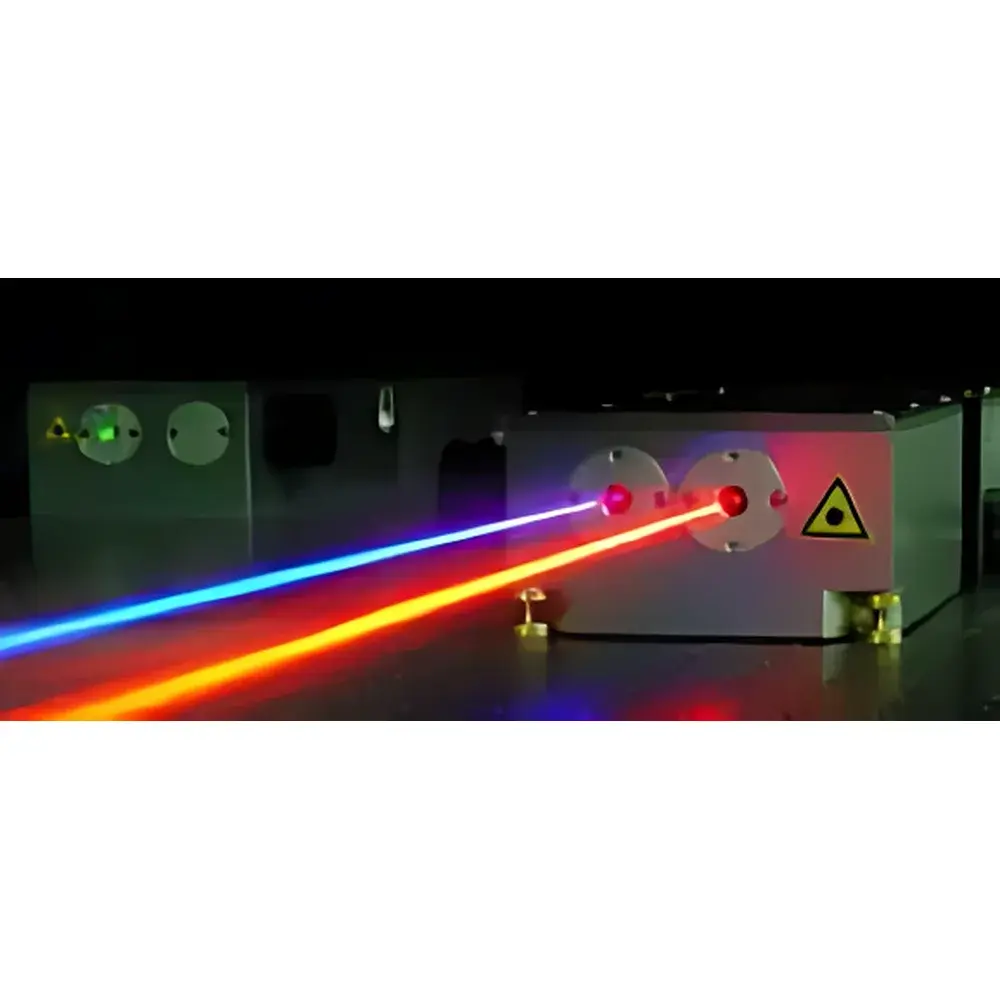
| Frequency Conversion | Second Harmonic Generation (SHG) to red/blue (IDOL), SHG and fourth-harmonic generation (FHG) to green/UV (IMPACTIDOL) |
| Compliance | CE, RoHS, FDA 21 CFR Part 1040.10 (Laser Product Safety) |
Overview
The Mesa Photonics IDOL and IMPACTIDOL series represent a class of high-repetition-rate, diode-pumped, actively Q-switched solid-state lasers engineered for precision pulsed laser applications requiring exceptional beam quality, temporal stability, and wavelength flexibility. These lasers operate on the principle of stimulated emission in Nd-doped vanadate (Nd:YVO₄) or Nd:YAG gain media, with end-pumping architecture enabling efficient thermal management and low-noise pulse generation. The IDOL platform is fundamentally configured at 1342 nm—enabling direct access to high-brightness infrared output—and supports intracavity or external second-harmonic generation (SHG) to produce stable, diffraction-limited red (671 nm) and blue (447 nm) radiation. The IMPACTIDOL variant operates at the industry-standard 1064 nm fundamental wavelength and integrates a master oscillator–power amplifier (MOPA) architecture to decouple pulse shaping from energy scaling, thereby achieving sub-10 ns pulses with peak powers exceeding several kilowatts while maintaining M² < 1.2. Both platforms are designed for integration into OEM instrumentation and laboratory systems where deterministic pulse timing, shot-to-shot amplitude stability (<1.5% RMS), and long-term operational reliability are prerequisites.
Key Features
- Diode-pumped solid-state (DPSS) architecture with thermally optimized Nd:YVO₄/Nd:YAG crystals for high wall-plug efficiency and minimal thermal lensing
- Actively Q-switched operation using acousto-optic (AO) or electro-optic (EO) modulators, enabling precise control over pulse timing and repetition rate (adjustable from single-shot to 200 kHz)
- TEM₀₀ Gaussian beam profile with M² < 1.2, ensuring optimal focusability for microfabrication, nonlinear frequency conversion, and interferometric alignment
- Sub-12 ns pulse duration (IDOL) and sub-10 ns (IMPACTIDOL) with rise times < 5 ns—critical for time-resolved fluorescence lifetime imaging (FLIM), pump-probe spectroscopy, and ablation threshold studies
- Integrated harmonic generation modules supporting SHG (532 nm, 671 nm, 447 nm) and FHG (266 nm, 223 nm) with >40% conversion efficiency under optimized conditions
- RS-232 and USB 2.0 interfaces for remote triggering, parameter adjustment, and real-time monitoring of laser diode current, cavity temperature, and pulse energy feedback
Sample Compatibility & Compliance
These lasers are compatible with standard optical tables, kinematic mounts, and commercial beam delivery systems—including fiber coupling via aspheric collimators (FC/APC or SMA905 interfaces) and free-space propagation through UV-grade fused silica optics. All models comply with IEC 60825-1:2014 and FDA 21 CFR Part 1040.10 for Class IV laser product safety, including interlock-ready connectors and key-controlled enable circuits. The mechanical housing meets IP52 environmental rating for dust resistance and limited drip protection. For regulated environments, firmware supports audit-trail logging and user-access-level configuration (admin/operator modes), aligning with GLP/GMP documentation requirements when integrated into analytical or manufacturing workflows.
Software & Data Management
Mesa Photonics provides the LaserControl Suite—a cross-platform application (Windows/macOS/Linux) supporting full parameter scripting, pulse train synchronization (TTL/PECL trigger outputs), and real-time pulse energy logging. The SDK includes C/C++, Python, and LabVIEW APIs compliant with NI-VISA and Modbus TCP protocols. All devices generate timestamped metadata (pulse count, internal temperature, diode drive current) embedded in HDF5-formatted data files, facilitating traceability in ISO/IEC 17025-accredited laboratories. Optional firmware upgrades support IEEE 1588 Precision Time Protocol (PTP) for sub-microsecond synchronization across multi-laser arrays in ultrafast metrology setups.
Applications
- Time-resolved photoluminescence spectroscopy and carrier dynamics analysis in semiconductor thin films and perovskite materials
- Micro-scale laser-induced forward transfer (LIFT) for printed electronics and bioactive ink deposition
- High-resolution laser marking of polymer substrates with grayscale modulation via pulse-on-demand (POD) control
- Pump source for optical parametric oscillators (OPOs) and broadband supercontinuum generation in mid-IR spectroscopy
- Calibration reference for streak cameras, SPAD arrays, and TCSPC systems requiring known pulse width and jitter characteristics
- Nonlinear microscopy excitation (e.g., two-photon absorption at 1342 nm, SHG imaging at 671 nm) in biological tissue sections
FAQ
What is the typical pulse-to-pulse energy stability over 8 hours of continuous operation?
Measured stability is ≤1.2% RMS under constant ambient temperature (23 ± 0.5°C) and stabilized line voltage (±1%), verified per ISO 11554 Annex B.
Can the IMPACTIDOL series be configured for burst-mode operation?
Yes—firmware v3.2+ supports programmable burst sequences (up to 16 pulses per burst) with inter-pulse delays adjustable from 100 ns to 10 ms.
Is vacuum-compatible packaging available for ultra-high-vacuum chamber integration?
Standard units are not UHV-rated; however, custom versions with CF-40 flange mounting, non-outgassing elastomers, and bakeable housings are available upon request (lead time: 14 weeks).
Do these lasers meet FDA 21 CFR Part 11 requirements for electronic records in pharmaceutical QC labs?
When deployed with validated LaserControl Suite configurations and network-attached storage with write-once/read-many (WORM) policy enforcement, full Part 11 compliance—including electronic signatures, audit trails, and role-based access—is achievable.
What cooling method is required for sustained 200 kHz operation?
Active water cooling (chiller setpoint: 18–22°C, flow rate ≥1.2 L/min) is mandatory for IMPACTIDOL at full repetition rate; IDOL models support conduction-cooled operation up to 50 kHz.




