
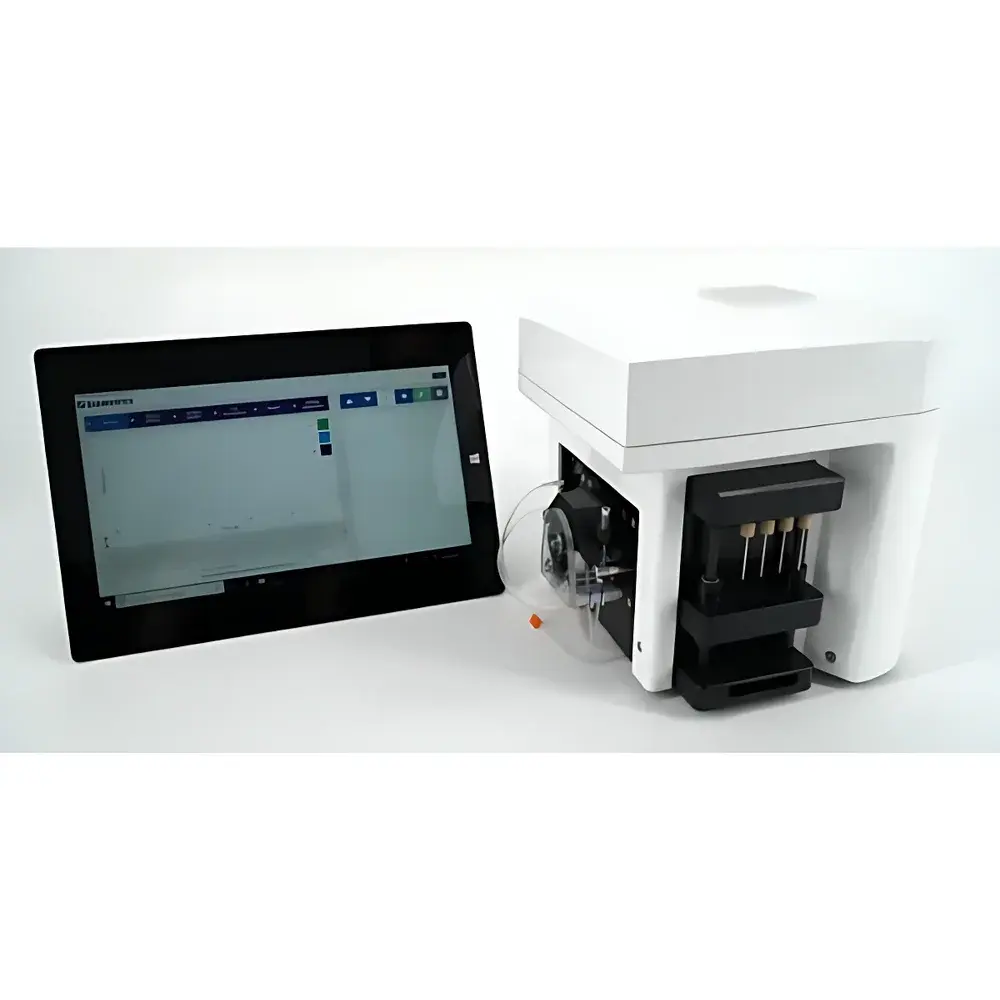
Biametrics b-portable Molecular Interaction Analyzer
| Brand | Biametrics |
|---|---|
| Origin | Germany |
| Model | b-portable |
| Detection Principle | Single-Colour Reflectometry (SCORE) based on optical interference |
| Sensitivity | 1 pg/mm² |
| Kinetic Range | Association rate constant (kₐ): 10³–10⁷ M⁻¹s⁻¹ |
| Dissociation rate constant (k_d) | 10⁻⁶–0.5 s⁻¹ |
| Sample Types | Proteins, antibodies, peptides, DNA/RNA, polysaccharides, lipids, small molecules, cells, viruses, nanoparticles |
| Sample Matrix Compatibility | DMSO-containing buffers, cell culture media, urine, plasma, serum, whole blood |
| Injection Mode | Automated flow-based injection |
| Throughput | 1–4 samples per run (sequential multi-run capability) |
| Consumables | Disposable sensor chips |
| Channel Configuration | Multi-channel |
| Instrument Type | Label-free molecular interaction analyzer |
| Regulatory Context | Designed for GLP-compliant workflows |
Overview
The Biametrics b-portable Molecular Interaction Analyzer is a compact, benchtop-grade label-free biosensor system engineered for quantitative real-time analysis of biomolecular interactions. It operates on the patented Single-Colour Reflectometry (SCORE) principle—a solid-phase optical interference technology that detects minute changes in the refractive index at the sensor surface upon binding events. Unlike surface plasmon resonance (SPR) or quartz crystal microbalance (QCM), SCORE employs monochromatic light and a high-resolution reflectance detection scheme, eliminating the need for complex wavelength scanning or angle tuning. This architecture delivers robust signal stability, low instrument drift, and exceptional reproducibility across diverse biological matrices—including viscous or optically heterogeneous samples such as whole blood, serum, and cell culture supernatants. The b-portable is purpose-built for academic and industrial research laboratories requiring rigorous kinetic characterization without the operational overhead or capital investment associated with high-throughput platforms.
Key Features
- Label-free, real-time monitoring of association and dissociation phases without fluorescent or enzymatic tagging
- Multi-channel fluidic architecture enabling simultaneous or sequential analysis of up to four independent samples per run
- Integrated automated fluid handling with precise flow control (±2% volumetric accuracy) and programmable injection sequences
- Disposable sensor chips functionalized with standard chemistries (e.g., carboxymethyl dextran, streptavidin, Ni-NTA, or custom ligand coupling surfaces)
- Optimized optical path design minimizing bulk refractive index artifacts—enabling reliable measurements in complex biological fluids
- Low sample consumption: typical binding assays require ≤50 µL per analyte injection at concentrations ranging from pM to µM
- Modular software interface supporting method scripting, kinetic model fitting (1:1 Langmuir, bivalent analyte, heterogeneous ligand), and global parameter refinement
Sample Compatibility & Compliance
The b-portable demonstrates broad compatibility with structurally and functionally diverse analytes: recombinant proteins, monoclonal antibodies, synthetic peptides, nucleic acids (ss/dsDNA, RNA aptamers), glycoconjugates, lipid vesicles, intact mammalian cells, enveloped viruses (e.g., influenza, SARS-CoV-2 pseudovirions), and polymeric nanoparticles. Its optical detection scheme tolerates turbidity and absorbance common in crude lysates or clinical specimens—eliminating the need for extensive sample purification prior to analysis. The system complies with core quality assurance frameworks: raw sensorgrams and processed kinetics are timestamped, user-authenticated, and stored with full metadata (chip lot ID, buffer composition, temperature log, flow rate history). Audit trails meet FDA 21 CFR Part 11 criteria when deployed on validated Windows OS environments; optional IQ/OQ documentation packages support GxP lab implementation.
Software & Data Management
Acquisition and analysis are managed through Biametrics’ proprietary bControl™ software, built on a .NET framework with deterministic real-time data streaming (≥10 Hz sampling rate). The software provides integrated tools for baseline subtraction, mass transport correction, reference channel subtraction, and numerical integration of response units into RU (resonance units) or pg/mm² equivalents. Kinetic fitting uses Levenberg–Marquardt nonlinear regression with confidence interval estimation for kₐ, k_d, and K_D. Export formats include CSV, Excel (.xlsx), and XML (for LIMS integration). All datasets are stored in an encrypted local database with role-based access control; raw files adhere to MIAME-compliant metadata standards for structural proteomics repositories.
Applications
- Characterization of protein–protein binding affinities and on/off rates during antibody–antigen validation
- Epitope binning and paratope mapping using competition assay configurations
- Concentration determination of unlabeled analytes via steady-state response calibration curves
- Cell-surface receptor engagement studies using adherent or suspended cells captured directly on chip surfaces
- Binding thermodynamics profiling across temperature gradients (15–40 °C range with ±0.1 °C stability)
- Diagnostic biomarker screening in minimally processed biofluids—supporting translational assay development under CLIA-like protocols
- Quality-by-Design (QbD) assessment of biosimilar comparability in early-stage development
FAQ
What detection principle does the b-portable use, and how does it differ from SPR?
The b-portable employs Single-Colour Reflectometry (SCORE), an optical interference technique measuring phase shifts in reflected monochromatic light. Unlike SPR, it requires no prism coupling, gold films, or angular/wavelength scanning—reducing sensitivity to temperature fluctuations and enabling stable operation in high-salt or serum-rich matrices.
Can I reuse sensor chips?
No—sensor chips are single-use disposables designed to ensure batch-to-batch consistency and eliminate carryover risk. Surface regeneration protocols are not supported.
Is the system compatible with GMP/GLP-regulated environments?
Yes. When configured with electronic signatures, audit trails, and validated software versions, the b-portable meets foundational requirements for GLP compliance and supports inspection-readiness for FDA or EMA audits.
What is the minimum analyte concentration detectable for a typical IgG–antigen interaction?
Under optimized immobilization and flow conditions, sub-nanomolar (0.1–1 nM) analyte concentrations yield robust kinetic signals for high-affinity interactions (K_D < 10 nM).
Does the system support custom surface chemistry development?
Yes—Biametrics offers OEM chip fabrication services and provides technical documentation for covalent amine coupling, thiol-based immobilization, and biotin–streptavidin capture strategies.





