
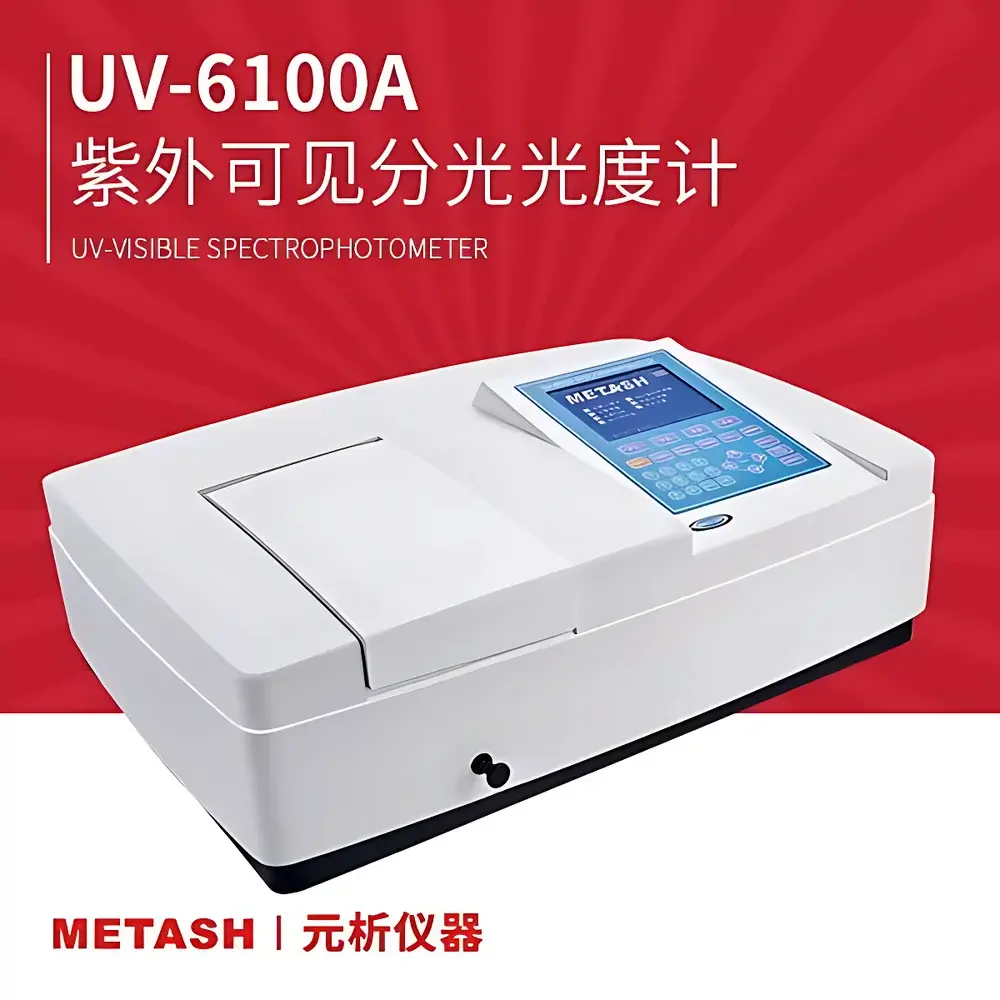
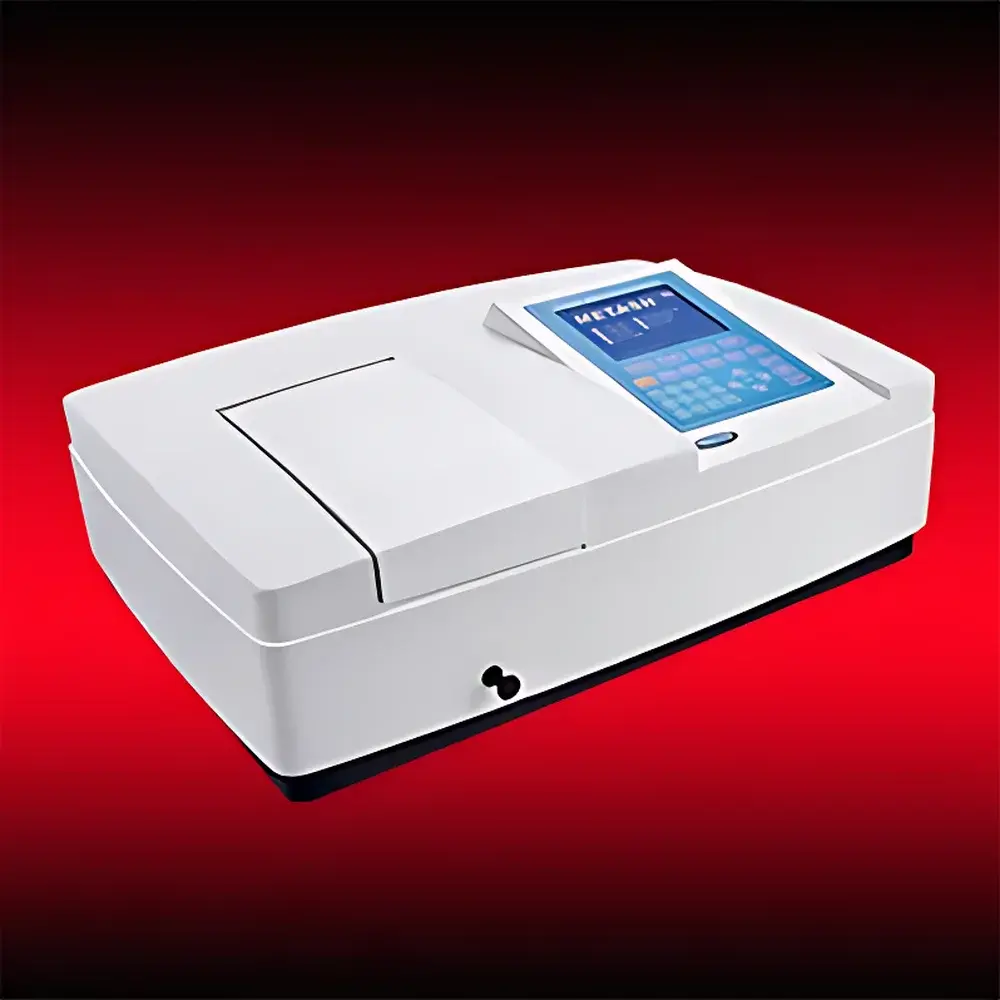
Metash UV-6100A Dual-Beam UV-Vis Spectrophotometer
| Brand | Metash Instruments |
|---|---|
| Origin | Shanghai, China |
| Manufacturer Type | Original Equipment Manufacturer (OEM) |
| Product Category | Domestic |
| Model | UV-6100A |
| Optical System | Dual-Beam Ratio-Monitoring |
| Detector Type | Silicon Photocell |
| Wavelength Range | 190–1100 nm |
| Wavelength Accuracy | ±0.1 nm @ 656.1 nm, ±0.3 nm across full range |
| Wavelength Repeatability | ≤0.1 nm |
| Spectral Bandwidth | 1 nm |
| Stray Light | ≤0.05% T |
| Automation Level | Automatic Wavelength Scanning |
| Display | 6-inch Full-Color LED LCD |
| Data Interface | USB port for PC connectivity |
| Software | GLP/GMP-compliant analytical software with audit trail, user management, and report generation |
| Structural Design | Suspended optical assembly mounted on 16-mm thick aerospace-grade aluminum optical base |
Overview
The Metash UV-6100A is a high-performance dual-beam ratio-monitoring ultraviolet-visible spectrophotometer engineered for precision absorbance, transmittance, and reflectance measurements across a broad spectral range (190–1100 nm). Its optical architecture employs a dynamic reference beam path that continuously monitors source intensity fluctuations—primarily from the imported deuterium and tungsten lamps—and mathematically compensates in real time, thereby minimizing baseline drift and enhancing photometric stability over extended acquisition periods. Unlike single-beam systems requiring manual recalibration, the UV-6100A’s ratio-monitoring design ensures consistent signal-to-noise performance without interrupting sample analysis. The instrument utilizes a fixed 1-nm spectral bandwidth, optimized for resolution-sensitive applications such as quantitative assay validation, spectral identification of conjugated organic compounds, and nucleic acid/protein quantification where peak shape fidelity is critical.
Key Features
- Dual-beam ratio-monitoring optical system with real-time source compensation for enhanced photometric stability and long-term reproducibility
- Suspended optical assembly rigidly anchored to a 16-mm-thick aerospace-grade aluminum optical base, isolating the light path from mechanical vibration and thermal-induced chassis deformation
- 6-inch full-color LED LCD display enabling intuitive local operation—no external PC required for routine photometric, quantitative, kinetic, or multi-wavelength measurements
- Imported UV and visible light sources (deuterium lamp for UV; tungsten-halogen lamp for visible/NIR) coupled with high-purity optical components to achieve ≤0.05% T stray light—critical for low-absorbance accuracy in trace analysis
- Integrated firmware supporting standalone operation of spectral scanning, time-based kinetics, DNA/protein A260/A280 ratio calculation, and multi-point calibration workflows
- USB interface and bundled PC software compliant with GLP/GMP data integrity requirements—including electronic signatures, user-level access control, immutable audit trails, and timestamped data archiving
Sample Compatibility & Compliance
The UV-6100A accommodates standard 10-mm pathlength quartz or glass cuvettes and supports optional accessories including an automated 8-cell turret, micro-volume cuvette holders (down to 50 µL), Peltier-controlled temperature-regulated cell changers, and diffuse reflectance attachments for solid-sample analysis. All optical paths adhere to ISO 9001-certified manufacturing protocols, and spectral performance complies with ASTM E275 and ISO 6223 standards for spectrophotometer verification. The software platform satisfies FDA 21 CFR Part 11 requirements for electronic records and signatures when configured with role-based authentication and audit logging enabled.
Software & Data Management
The included analytical software provides a validated, modular environment for method development, instrument control, and regulatory-compliant reporting. It supports method templates for pharmacopeial assays (e.g., USP , EP 2.2.25), custom calibration curve fitting (linear, quadratic, cubic, or non-linear regression), and export of raw spectral data in CSV, XML, or JCAMP-DX formats. All user actions—including parameter changes, measurement execution, and report generation—are logged with operator ID, timestamp, and contextual metadata. Data files are stored with cryptographic hash integrity checks to prevent tampering, and backup archives can be exported to network drives or LIMS-integrated storage systems.
Applications
The UV-6100A serves core analytical functions in QC laboratories across pharmaceuticals, environmental testing, food safety, and academic research. Typical use cases include: quantification of active pharmaceutical ingredients (APIs) per ICH Q2(R2) guidelines; determination of protein concentration via Bradford or BCA assays; monitoring enzymatic reaction kinetics at defined wavelengths; verification of solvent purity using UV cutoff criteria; characterization of nanomaterial extinction spectra; and validation of cleaning procedures through residual contaminant detection. Its low stray light and tight wavelength repeatability (<0.1 nm) make it suitable for high-fidelity spectral library matching in forensic or polymer identification workflows.
FAQ
Is the UV-6100A compliant with 21 CFR Part 11 for regulated environments?
Yes—the software includes configurable electronic signature workflows, audit trail logging, and data integrity safeguards aligned with FDA requirements for electronic records.
Can the instrument perform kinetic measurements over extended timeframes?
Yes—it supports time-scan mode with user-defined intervals (100 ms to 60 s), automatic baseline correction, and derivative analysis for reaction rate determination.
What is the minimum sample volume supported with optional accessories?
With the micro-cuvette adapter, the system accommodates volumes as low as 50 µL using 10-mm pathlength quartz cells.
Does the optical base require periodic recalibration?
No—the suspended optical architecture and thermally stable aluminum base eliminate mechanical drift; wavelength calibration is verified annually using NIST-traceable holmium oxide and didymium filters.
Is remote instrument control possible via LAN or Ethernet?
The standard configuration supports only USB-to-PC communication; optional Ethernet module integration is available upon request for centralized lab network deployment.





