
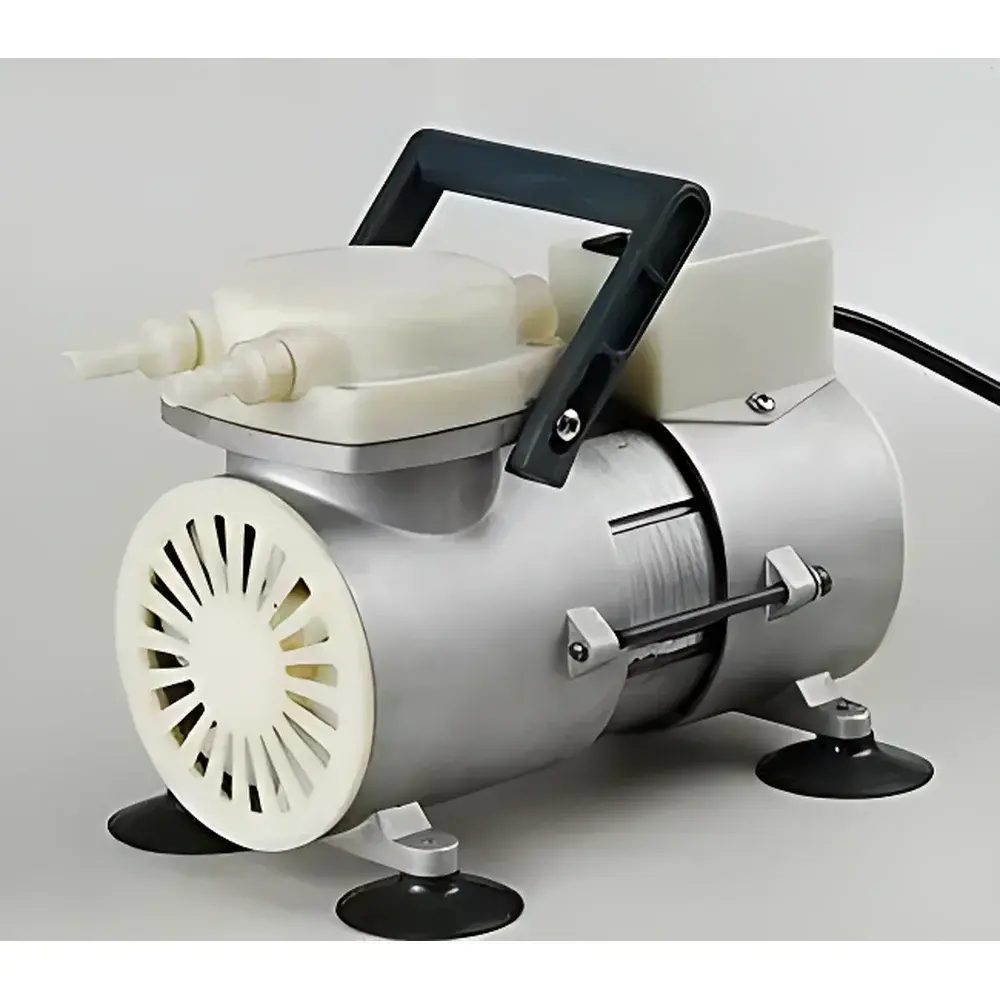
JINTENG GM-0.20 Diaphragm Vacuum Pump
| Brand | JINTENG |
|---|---|
| Origin | Tianjin, China |
| Model | GM-0.20 |
| Ultimate Vacuum Pressure | 300 mbar (abs) |
| Maximum Flow Rate | 12 L/min |
| Motor Power | 75 W |
| Noise Level | <50 dB(A) |
| Operating Temperature Range | 7–40 °C |
| Weight | 4 kg |
| Dimensions (L×W×H) | 195 × 98 × 156 mm |
| Inlet Port Diameter | φ6 mm |
| Positive Pressure Output | 0.07 MPa (≈10 psi) |
| Diaphragm Material | Nylon |
| Housing Material | Anodized Aluminum Alloy |
| Ambient Humidity | ≤80% RH (non-condensing) |
Overview
The JINTENG GM-0.20 Diaphragm Vacuum Pump is a compact, oil-free vacuum source engineered for precision laboratory applications requiring clean, dry, and chemically inert evacuation. Based on positive displacement principle, it utilizes a reciprocating elastomeric diaphragm driven by an eccentric cam mechanism to alternately expand and compress the sealed gas chamber—enabling continuous suction and exhaust without lubricating oil contamination. This architecture eliminates hydrocarbon vapor backstreaming, making it compatible with sensitive analytical instrumentation such as gas chromatographs (GC), liquid chromatography–mass spectrometers (LC-MS), and headspace samplers where sample integrity and baseline stability are critical. Designed and manufactured in Tianjin, China, the GM-0.20 meets fundamental requirements for ISO/IEC 17025-compliant laboratories performing routine QC/QA testing in pharmaceutical, food safety, forensic toxicology, and biochemical research environments.
Key Features
- Oil-free operation ensures zero risk of sample contamination or instrument fouling—critical for GC carrier gas supply, vacuum manifold systems, and solvent evaporation under reduced pressure.
- Corrosion-resistant nylon diaphragm and anodized aluminum alloy housing provide long-term durability against mild organic solvents, aqueous vapors, and ambient laboratory chemicals.
- Low-noise design (<50 dB[A] at 1 m distance) enables quiet operation in shared lab spaces, including analytical instrument rooms and teaching laboratories.
- Thermally optimized motor and airflow path maintain pump body temperature below 55 °C during continuous duty—reducing thermal drift and extending component service life.
- Integrated thermal protection circuit automatically interrupts power if internal temperature exceeds safe thresholds, complying with IEC 61000-6-3 EMC emission standards.
- Compact footprint (195 × 98 × 156 mm) and lightweight construction (4 kg) facilitate benchtop integration, mobile cart mounting, or use in confined fume hood installations.
Sample Compatibility & Compliance
The GM-0.20 is suitable for non-aggressive gases and vapors generated during standard laboratory procedures—including nitrogen purging, rotary evaporation support, filtration under vacuum, and vacuum desiccation. It is not rated for explosive, highly reactive, or condensable vapors (e.g., concentrated HCl, HF, or high-boiling-point solvents above 150 °C). While not certified to UL/CSA or ATEX standards, its construction aligns with general-purpose laboratory equipment safety expectations per IEC 61010-1. The pump supports GLP/GMP workflows when used as a supporting utility device; however, it does not include built-in audit trail or electronic signature functionality required for 21 CFR Part 11 compliance.
Software & Data Management
This is a standalone, manually operated vacuum pump with no embedded microcontroller, digital interface, or software connectivity. All operational parameters—including flow rate, ultimate vacuum, and pressure output—are fixed by mechanical design and cannot be adjusted or monitored in real time. No proprietary drivers, firmware updates, or data logging capabilities are provided. Users rely on external vacuum gauges (e.g., Pirani or capacitance manometers) for process verification. For automated systems, optional analog pressure feedback signals may be integrated via third-party controllers using standard 0–5 V or 4–20 mA transducers.
Applications
- Supporting gas chromatography systems as a vacuum source for detector exhaust or purge gas lines.
- Vacuum-assisted filtration in microbiological assays and particulate analysis (e.g., membrane filtration for water quality testing).
- Rotary evaporator auxiliary vacuum control for low-temperature solvent removal in natural product isolation.
- Forensic sample preparation—including solid-phase extraction (SPE) cartridge conditioning and elution under controlled vacuum.
- Pharmaceutical stability studies requiring inert atmosphere maintenance during accelerated degradation testing.
- Academic teaching labs for demonstrating vacuum physics principles, gas laws, and separation techniques without oil-maintenance overhead.
FAQ
Is the GM-0.20 suitable for use with mass spectrometry systems?
No—it lacks the ultimate vacuum performance (<10⁻³ mbar) and ultra-low hydrocarbon emission profile required for MS ion sources. It is appropriate only for front-end GC auxiliary functions.
Can this pump handle acidic or halogenated vapors?
Not recommended. While the nylon diaphragm offers moderate resistance to weak acids, prolonged exposure to HCl, Cl₂, or brominated compounds may cause swelling or embrittlement.
What maintenance is required?
Annual inspection of diaphragm integrity and valve seating is advised. No oil changes or lubrication are needed. Replace diaphragm and inlet/outlet valves every 6,000–8,000 operating hours under typical lab conditions.
Does it include a vacuum gauge?
No. A separate vacuum measurement device must be installed downstream for process monitoring.
Is the pump CE-marked?
It carries no CE marking; users must perform their own risk assessment per Machinery Directive 2006/42/EC if integrating into custom equipment.



