
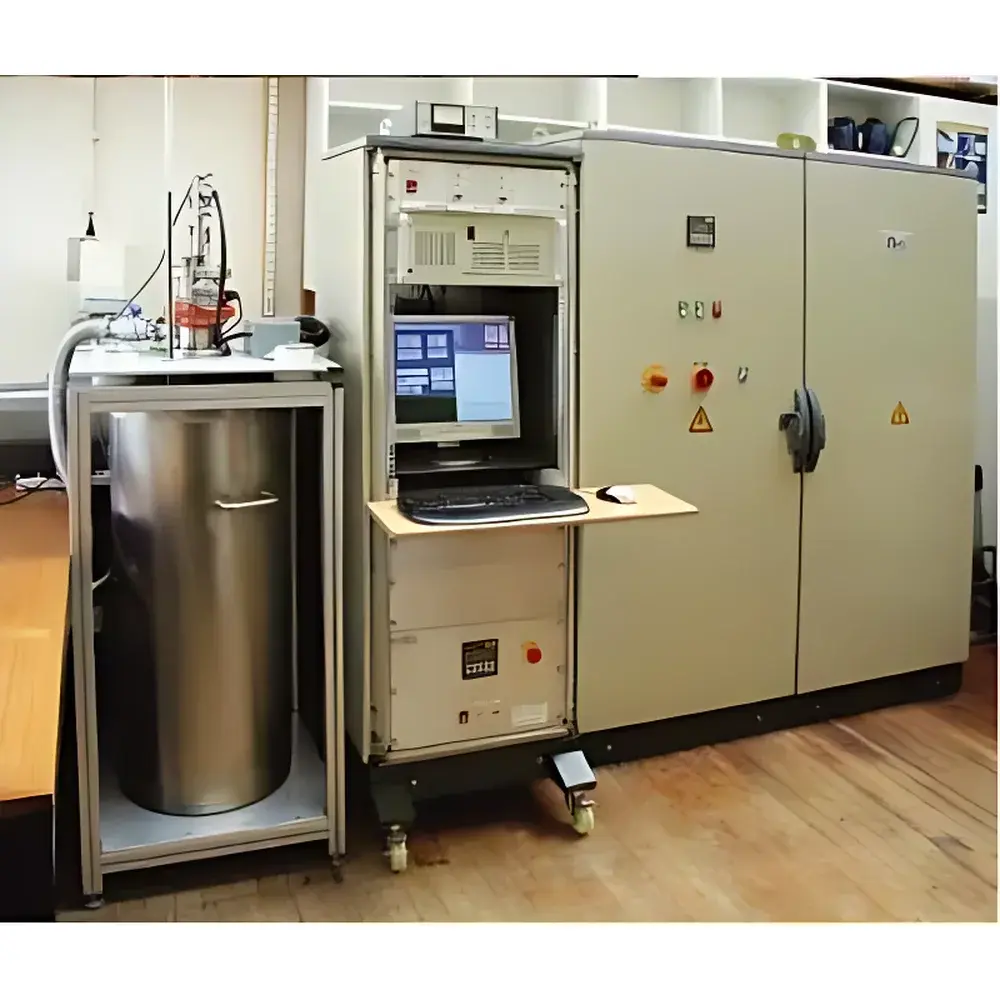
Metis CryoPulse Advanced Pulsed High-Field Low-Temperature Experimental Platform
| Brand | Metis |
|---|---|
| Origin | Imported |
| Manufacturer Type | Authorized Distributor |
| Model | CryoPulse |
| Operating Temperature Range | 4 K to 300 K |
| Maximum Pulsed Magnetic Field | ≥ 80 T |
| Pulse Duration | Up to 20 ms (configurable) |
| Magnet Bore Diameter | 20–54 mm |
| Field Rise Time (dB/dt) | As low as 6.2 ms |
| Energy Storage Capacity | ≥ 32 kJ (modular CDM-X capacitor bank, 4 kJ/module) |
| Voltage Rating | 3000 V |
| Data Acquisition | 16-bit, 1 MS/s, synchronized multi-channel (B-field, time, current, sample signal) |
| Cryogenic Compatibility | Liquid nitrogen (77 K) and liquid helium (4.2 K) Dewars |
| Sample Access | Replaceable cold finger (17 mm ID, 15 mm clear bore) |
| Compliance | Designed for GLP-compliant operation |
Overview
The Metis CryoPulse Advanced Pulsed High-Field Low-Temperature Experimental Platform is an integrated scientific infrastructure system engineered for precision condensed matter physics research under extreme conditions. It combines transient high-intensity magnetic fields—generated via controlled capacitor discharge—with cryogenic thermal stabilization across a continuous 4 K to 300 K range. The platform operates on the principle of pulsed magnetometry: rapid electromagnetic energy release through optimized solenoidal coils produces short-duration (sub-millisecond to tens-of-milliseconds), high-amplitude magnetic transients (up to 80 T), while simultaneously maintaining sample thermal equilibrium within a vibration-isolated, multi-stage cryostat. Unlike steady-state superconducting or resistive magnets, CryoPulse enables access to field regimes where quantum phase transitions, non-equilibrium spin dynamics, and high-field electronic band reconstruction become experimentally resolvable—without the thermal load and operational constraints inherent in DC high-field systems.
Key Features
- Modular CDM-X capacitor discharge power supply: scalable architecture with ≥32 kJ total storage (eight 4 kJ modules), programmable voltage up to 3000 V, and real-time graphical interface for pulse shaping and dB/dt control.
- Optimized pulsed magnet family: including high-field (32 T, 6.2 ms rise time), high-uniformity (±0.3% over 10 mm), and wide-bore (54 mm) configurations—each thermally coupled to liquid nitrogen pre-cooling circuits.
- Dual-cryogen experimental Dewar: supports both liquid nitrogen (77 K) and liquid helium (4.2 K) operation; equipped with calibrated Cernox™ and RuO₂ temperature sensors, proportional heating elements, and needle-valve-controlled boil-off regulation.
- Multi-probe cold finger design: 17 mm internal diameter with 15 mm unobstructed sample space; compatible with interchangeable measurement probes for four dedicated configurations—CryoPulse-BI (current-biased transport), CryoPulse-MO (magneto-optical spectroscopy), CryoPulse-MT (magnetotransport), and CryoPulse-BM (field- and temperature-dependent magnetization).
- Synchronized 16-bit, 1 MS/s data acquisition system: hardware-triggered capture of simultaneous B-field, time, excitation current, and sample response signals; fully isolated analog inputs with anti-aliasing filtering and onboard timestamping.
- Vibration-damped mechanical integration: custom-engineered support structure decouples magnet recoil forces from the Dewar and optical path, ensuring sub-micron positional stability during pulse events.
Sample Compatibility & Compliance
CryoPulse accommodates diverse solid-state samples—including single crystals, thin films, polycrystalline pellets, and nanostructured heterostructures—mounted on standardized probe carriers with gold-plated CuNi leads and fiber-optic feedthroughs for photoluminescence excitation and collection. All electrical and optical interfaces comply with IEC 61000-4 immunity standards for electromagnetic pulse environments. The platform’s modular architecture allows configuration for ISO/IEC 17025-accredited laboratories: temperature calibration traceable to NIST SRM® 1960, magnetic field calibration verified using NMR-based field mapping protocols (ASTM E1088), and data integrity maintained via deterministic trigger synchronization and hardware-enforced write-once logging. When deployed with validated third-party control software, the system meets documentation requirements for GLP audits and FDA 21 CFR Part 11 electronic records compliance—including user authentication, audit trails, and electronic signatures.
Software & Data Management
System operation is coordinated through a Windows-based Visual Basic application that provides real-time monitoring of capacitor bank charge status, magnet temperature, Dewar pressure, and active probe configuration. Pulse sequencing, parameter ramping (e.g., field sweep rate, temperature step size), and acquisition triggering are scriptable via ASCII command protocol, enabling integration into Python- or LabVIEW-driven experimental workflows. Raw data files are stored in HDF5 format with embedded metadata (timestamp, field amplitude, temperature setpoint, probe ID, calibration coefficients), ensuring FAIR (Findable, Accessible, Interoperable, Reusable) principles. Optional MATLAB and Python SDKs provide direct API access to acquisition buffers and instrument control registers, facilitating automated batch measurements and in-situ analysis pipelines.
Applications
- Superconductivity characterization: critical current density (Jc) and upper critical field (Hc2) mapping in high-Tc cuprates and iron-based superconductors under simultaneous pulsed field and DC bias (CryoPulse-BI mode).
- Magnetic phase diagram exploration: field- and temperature-dependent magnetization hysteresis, metamagnetic transitions, and spin-flop behavior in spin-Peierls compounds, manganites, and rare-earth ferrites (CryoPulse-BM).
- Quantum transport phenomena: Shubnikov–de Haas oscillations, quantum Hall effect, and Berry curvature mapping in 2D electron gases and topological insulators (CryoPulse-MT).
- Magneto-optical spectroscopy: Zeeman splitting, Faraday rotation, and cyclotron resonance in self-assembled quantum dots and III–V heterostructures under pulsed fields >30 T (CryoPulse-MO).
- Nonlinear magnetostriction and dynamic magnetization relaxation studies requiring sub-millisecond field rise times and millikelvin thermal stability.
FAQ
What is the maximum achievable pulsed field in CryoPulse, and how is field homogeneity ensured?
Standard configurations deliver up to 32 T with ±0.3% spatial uniformity over a 10 mm diameter sphere; optional high-field magnets reach 80 T at reduced uniformity (±5% over 2 mm). Homogeneity is optimized via finite-element coil geometry modeling and validated by NMR field mapping.
Can CryoPulse operate continuously across the full 4 K–300 K range without refilling cryogens?
No—operation below 77 K requires periodic liquid helium refills. For extended 4 K runs, integration with a closed-cycle cryocooler (e.g., GM or pulse-tube) is supported via optional cold-head adapter kits.
Are optical access ports available for in-situ spectroscopy?
Yes—standard Dewar configurations include two orthogonal 25 mm clear-aperture optical windows (CaF₂ or sapphire, AR-coated for UV–NIR), aligned to the sample position with <10 µrad angular tolerance.
How is electrical noise minimized during high-dB/dt pulsing?
Through galvanic isolation of all low-level signal paths, twisted-pair shielded cabling with ferrite suppression, and synchronous sampling triggered precisely at field peak to avoid eddy-current-induced transients.
Does Metis provide application-specific probe development support?
Yes—custom probe design (e.g., RF/microwave transport, AC susceptibility, time-resolved PL) is available under NDA-supported engineering collaboration, including mechanical CAD, thermal simulation, and EM interference testing.



