
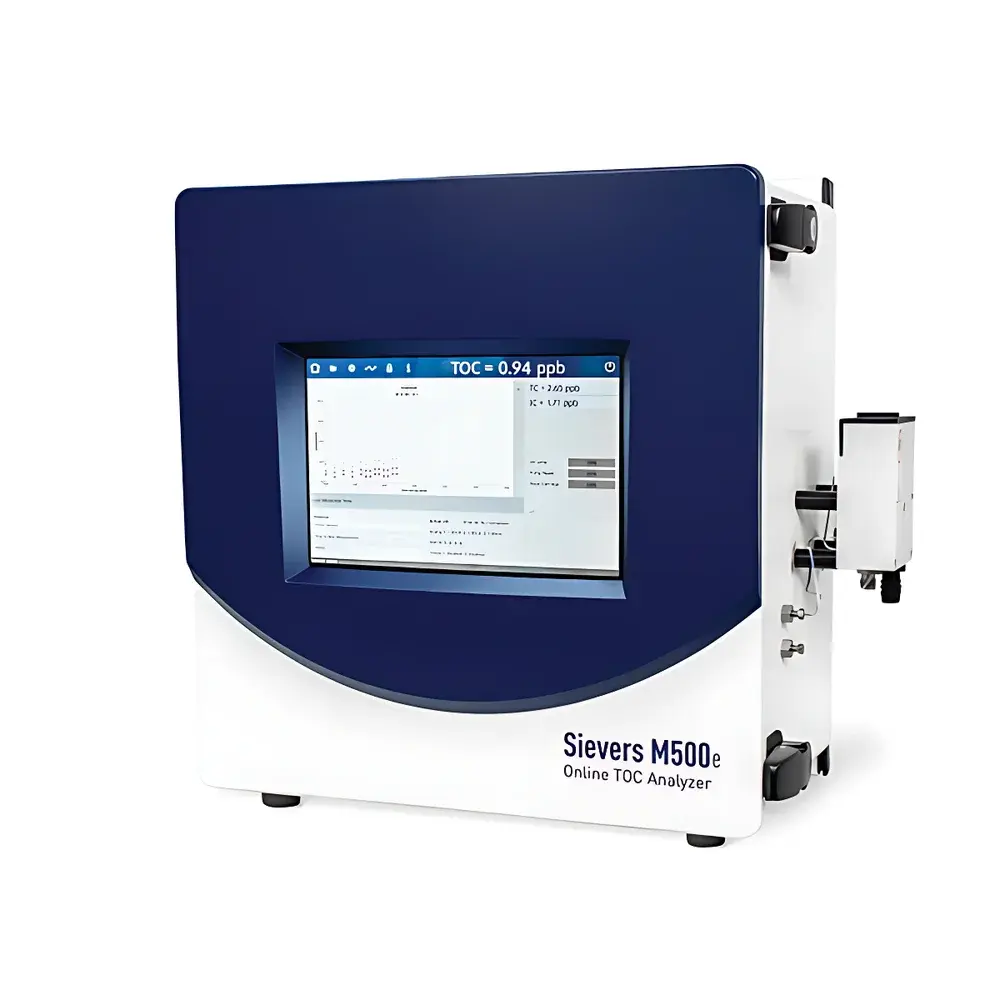
Sievers M500 Online Total Organic Carbon (TOC) Analyzer
| Brand | Sievers (Veolia) |
|---|---|
| Origin | USA |
| Model | Sievers M500 |
| Instrument Type | Online TOC Analyzer |
| Detection Principle | Membrane Conductivity Detection |
| Oxidation Method | UV Oxidation |
| Measurement Range | 0.03–2500 ppb |
| Accuracy | ±5% of reading or ±0.01 ppb (whichever is greater) |
| Resolution | 0.03 ppb |
| Detection Limit | 0.03 ppb |
| Repeatability | ±5% of reading or ±0.01 ppb (whichever is greater) |
| Analysis Time (Continuous Mode) | 6 minutes |
| Sample Flow Rate | 0.25 mL/min |
| External Flow Rate | 50 mL/min |
| Sample Temperature Range | 1–95 °C (steam-tolerant for short-term exposure) |
| Max. Inlet Pressure | 100 psi |
| Conductivity Tolerance | 0.01–800 µS/cm |
| Calibration Stability | Up to 12 months without recalibration |
| Display | 10-inch color touchscreen |
| Enclosure Rating | IP55 |
| Power Supply | 100–240 VAC (+10%), 50/60 Hz, 50 W |
| Operating Environment | Indoor use only |
| Safety Certifications | ETL, CE |
| Dimensions (H×W×D) | 43.4 × 55.9 × 28.7 cm |
| Weight | 16.3 kg |
Overview
The Sievers M500 Online Total Organic Carbon (TOC) Analyzer is an industrial-grade, real-time water quality monitoring system engineered for continuous, unattended operation in regulated pharmaceutical, biotechnology, and semiconductor manufacturing environments. It employs ultraviolet (UV) photocatalytic oxidation combined with membrane-conductivity detection—a proven, non-selective method compliant with USP , EP 2.2.44, and JP 2.59—ensuring accurate quantification of oxidizable carbon species across ultra-pure water (UPW), purified water (PW), and water-for-injection (WFI) systems. Unlike combustion-based analyzers, the M500’s low-temperature UV oxidation process minimizes chloride interference and eliminates the need for high-pressure gas supplies or catalyst maintenance. Its robust architecture supports integration into existing clean utility networks with minimal footprint and no requirement for external sample conditioning.
Key Features
- Real-time continuous monitoring with 6-minute analysis cycle time—enabling rapid detection of organic contamination events during production or cleaning validation cycles.
- UV oxidation at 185/254 nm wavelength ensures complete mineralization of refractory organics—including ethanol, isopropanol, and residual sanitants—without generating volatile by-products.
- Patented hydrophobic membrane conductivity cell provides immunity to ionic interferences (e.g., Cl⁻, SO₄²⁻, Na⁺) across a wide conductivity range (0.01–800 µS/cm), eliminating the need for dilution or pretreatment in most UPW applications.
- Self-contained calibration stability: factory-calibrated slope and zero remain valid for up to 12 months under routine operating conditions—reducing operational overhead and audit documentation burden.
- IP55-rated enclosure with integrated 10-inch color touchscreen interface enables intuitive local configuration, alarm management, and trend visualization without external PCs.
- Comprehensive I/O suite includes three isolated 4–20 mA analog outputs, four programmable relay alarms, RS-232 serial port, USB host port, and Ethernet (TCP/IP) for seamless integration with DCS, SCADA, or MES platforms.
- Steam-tolerant fluidic path rated for intermittent exposure to 121 °C saturated steam—supporting SIP (steam-in-place) compatibility in GMP-critical water loops.
Sample Compatibility & Compliance
The M500 is validated for direct online measurement of pharmaceutical water streams meeting USP Purified Water, Water for Injection, and EP Purified Water monographs. Its design conforms to FDA 21 CFR Part 11 requirements for electronic records and signatures when operated with compliant data management software. The analyzer supports ALCOA+ data integrity principles through automated audit trails, user access control, and immutable event logging. It meets ISO 9001 and ISO/IEC 17025 traceability standards via NIST-traceable calibration protocols. Regulatory alignment extends to ASTM D5903 (standard test method for TOC in water) and EU GMP Annex 1 guidance on water system monitoring.
Software & Data Management
When paired with Sievers Insight™ software (optional), the M500 delivers full lifecycle data governance: automated report generation (PDF/CSV), configurable alarm escalation workflows, and secure role-based access. All measurement events—including calibration, maintenance, and fault logs—are timestamped and digitally signed. Data export supports CSV, XML, and OPC UA protocols for integration into LIMS or compliance dashboards. Firmware updates are delivered via encrypted USB or over-the-air (OTA) through authenticated HTTPS connections—ensuring cybersecurity posture aligns with IEC 62443-3-3 Level 2 requirements.
Applications
- Pharmaceutical water system surveillance: continuous TOC trending at point-of-use (POU), storage tank outlets, and distribution loop returns.
- Cleaning validation support: quantitative verification of organic residue removal following CIP/SIP cycles in bioreactors, piping, and filtration skids.
- Water-for-injection (WFI) quality assurance: real-time release testing per USP and EU GMP Annex 1 §5.62.
- Ultra-pure water monitoring in semiconductor fab utilities: detection of trace organics from photoresist strippers or cleaning agents that impact wafer yield.
- Environmental compliance reporting: continuous discharge monitoring for wastewater treatment plants subject to EPA NPDES permit limits.
FAQ
What is the minimum detectable TOC concentration?
The instrument has a method detection limit (MDL) of 0.03 ppb, verified per EPA Method 415.3 protocols.
Can the M500 operate in ozone-rich environments?
Yes—it tolerates continuous ozone exposure up to 50 ppb and intermittent exposure (≤2 hours/day) up to 200 ppb without sensor degradation.
Does the analyzer require daily calibration?
No. Factory calibration remains stable for 12 months under normal operating conditions; verification checks are recommended quarterly per USP .
Is the M500 compatible with high-conductivity feedwater?
Yes—the membrane conductivity detector accommodates samples from 0.01 to 800 µS/cm without dilution or neutralization.
How is data integrity ensured during power interruptions?
Internal non-volatile memory retains all critical parameters, calibration history, and recent measurements for ≥72 hours without external power.







