
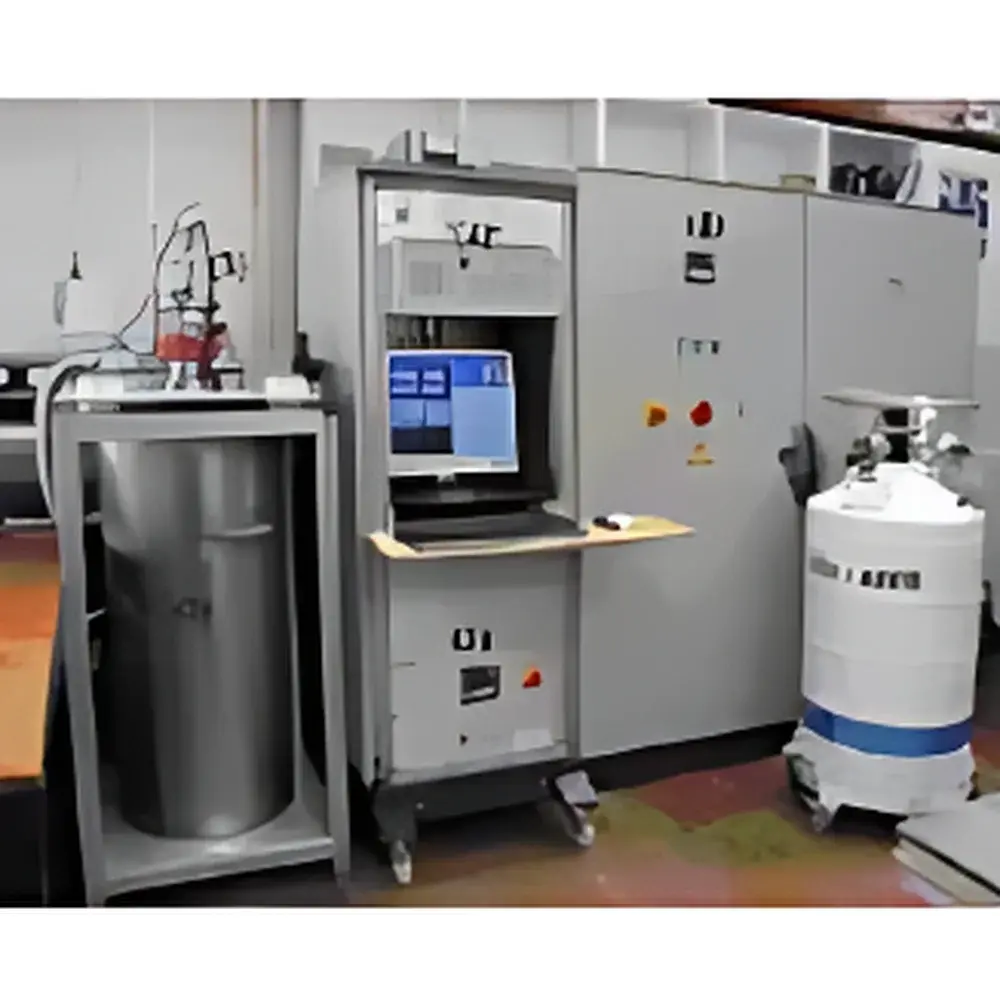
Metis CryoPulse-BI Pulsed-Field Critical Current Measurement System
| Brand | Metis |
|---|---|
| Origin | Belgium |
| Manufacturer Type | Authorized Distributor |
| Origin Category | Imported |
| Model | CryoPulse-BI |
| Pricing | Upon Request |
Overview
The Metis CryoPulse-BI Pulsed-Field Critical Current Measurement System is an engineered solution for direct, high-precision determination of the critical current (Ic) of superconducting materials under transient high magnetic fields—up to 30 T—and high current densities—up to 7 kA. Based on synchronized pulsed-field and pulsed-current excitation, the system operates on the principle of resistive transition detection during short-duration (ms-scale), controlled magnetic and electrical transients. Unlike conventional DC magnet-based Ic measurement systems—which require persistent-mode magnets, cryogenic current leads, and extended thermal stabilization—the CryoPulse-BI leverages capacitor discharge technology to generate precisely timed, high-energy pulses in both field (B) and transport current (I), enabling rapid B–I parameter space mapping at cryogenic temperatures (4 K or 77 K). Developed in collaboration with the Applied Superconductivity and Cryogenics Group at the University of Cambridge, the system delivers metrologically traceable Ic data aligned with international standards for superconductor characterization, including ASTM C257, IEC 61788-12, and ISO/IEC 17025-accredited testing protocols.
Key Features
- Synchronized dual-pulse architecture: Independent, time-coordinated magnetic field (0–30 T) and transport current (0–7 kA) pulses generated via modular capacitor discharge modules (CDM-M and CDM-C)
- Cryogenic compatibility: Integrated 4 K or 77 K variable-temperature system with low-boil-off helium consumption; liquid nitrogen-cooled pulse magnet housed within the cryostat
- Modular scalability: Field strength, pulse duration, and spatial homogeneity can be upgraded by replacing pulse magnet coils and expanding capacitor bank capacity—no structural retrofitting required
- Flexible sample geometry support: Configurable for both perpendicular (B ⊥ I) and parallel (B ∥ I) field-current orientations, enabling anisotropy studies of HTS tapes (e.g., Bi-2223, REBCO) and LTS wires (e.g., NbTi, Nb3Sn)
- Quasi-steady-state operation option: Compatible with flat-top pulse magnets (dB/dt ≈ 0), permitting static-like Ic(B) acquisition while retaining pulsed-system efficiency
- High reproducibility: <±0.5% relative standard deviation in repeated Ic measurements across identical sample batches under identical pulse profiles
- Intuitive GUI-driven workflow: All operational parameters—including pulse timing, amplitude ramping, voltage tap configuration, and trigger delay—are configured via point-and-click interface with real-time preview
Sample Compatibility & Compliance
The CryoPulse-BI accommodates a broad range of superconducting formats: multifilamentary wires, tape-shaped conductors (e.g., Ag-sheathed Bi-2223, stainless-steel-reinforced REBCO), thin films, and bulk ceramics. Sample mounting uses a standardized, vacuum-tight insertion probe (sample rod), enabling sub-5-minute exchange without cryostat warm-up. Electrical contacts are made via spring-loaded, low-thermal-conductance Pt–Rh voltage taps with four-wire sensing, minimizing Joule heating artifacts. The system meets mechanical and electromagnetic safety requirements per IEC 61000-4 series and complies with EU Machinery Directive 2006/42/EC. Data acquisition adheres to GLP principles, supporting audit-ready metadata logging (timestamp, pulse waveform, temperature, vacuum level) required for FDA 21 CFR Part 11–compliant laboratories.
Software & Data Management
The embedded control software (CryoPulse Control Suite v3.x) provides full experimental automation, including programmable sweep sequences (e.g., B-step-I-scan, I-ramp-at-fixed-B), real-time V–I curve reconstruction, and automatic Ic extraction using the 1 µV/cm criterion per IEC 61788-12. Raw digitized waveforms (voltage, current, field) are saved in HDF5 format with embedded calibration coefficients and SI-unit metadata. Export options include CSV, MATLAB .mat, and ASCII-compatible formats compatible with third-party analysis tools (OriginLab, Python SciPy, MATLAB Curve Fitting Toolbox). Audit trail functionality records all user actions, parameter changes, and system state transitions—essential for ISO/IEC 17025 accreditation and internal QA documentation.
Applications
- Quality assurance of industrial superconducting tapes and wires for fusion magnets (ITER, SPARC), MRI systems, and particle accelerator applications
- Fundamental research on flux pinning mechanisms, irreversibility line mapping, and anisotropic critical surface modeling
- Accelerated screening of novel superconductors (e.g., iron-based, MgB2, hydride phases) under high-field transient conditions
- Development and validation of electromagnetic simulation models (e.g., H-formulation, E–J power law) against experimentally derived Ic(B,T,θ) datasets
- Interlaboratory comparison studies supporting round-robin certification programs coordinated by CERN, NIST, or the International Electrotechnical Commission
FAQ
What is the maximum achievable pulse duration for quasi-steady-state measurements?
Flat-top pulses up to 100 ms are attainable with custom-designed low-dB/dt magnets; typical operational range is 20–50 ms depending on field amplitude and coil inductance.
Can the system measure critical current at temperatures above 77 K?
Yes—when equipped with a variable-temperature insert (VTI), the system supports continuous operation from 4 K to 300 K, enabling Ic(T) characterization across the full superconducting transition.
Is remote operation supported for unattended overnight scans?
Fully supported via secure SSH or TLS-encrypted web interface; scheduled experiments include auto-recovery after minor thermal drift or vacuum fluctuation events.
How does the system ensure voltage measurement accuracy during high-di/dt transients?
Differential voltage inputs use coaxial, twisted-pair wiring with active guarding and bandwidth-limited filtering (1 MHz cutoff) to suppress electromagnetic interference from pulsed-field coupling.
Are calibration certificates provided for the current and field sensors?
Yes—NIST-traceable calibration reports for Rogowski coils (current) and Hall probes (field) are included with each system delivery and updated annually per ISO/IEC 17025 requirements.



