
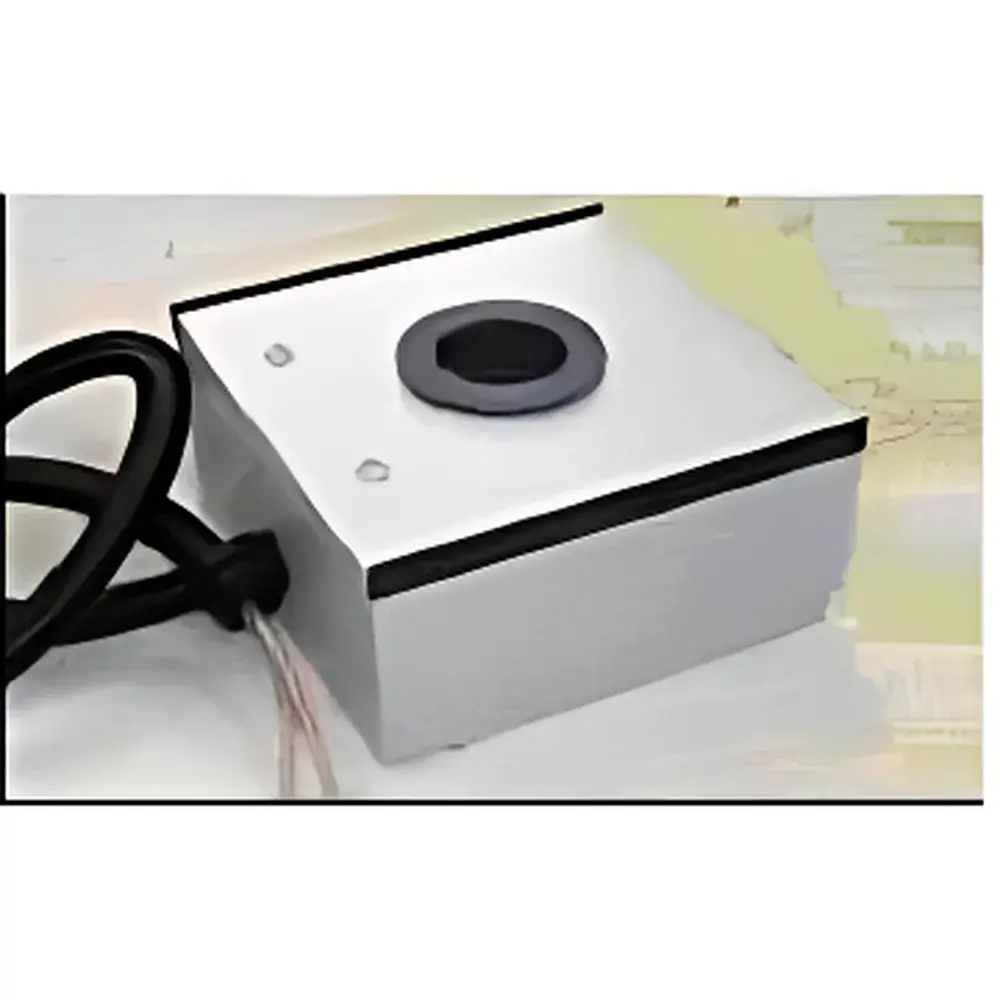
Metis Magnetic Magnetization Fixture
| Brand | Metis |
|---|---|
| Origin | Belgium |
| Distributor Type | General Distributor |
| Import Status | Imported |
| Cooling Options | Natural Convection, Forced Air, Liquid Cooling |
| Design Methodology | CAD-Based Mechanical Design & Finite Element Analysis (FEA) for Magnetic Flux and Structural Optimization |
| Compliance Framework | Designed for integration with industrial magnetizing power supplies compliant with IEC 61000-4 series EMC standards and ISO 9001-certified manufacturing processes |
| Packaging | Custom Protective Enclosure for Transit and Storage |
| Reusability | High-cycle mechanical durability with precision-machined ferromagnetic pole pieces and non-magnetic structural housing |
Overview
The Metis Magnetic Magnetization Fixture is an engineered electromechanical interface system designed to deliver controlled, repeatable, and spatially optimized magnetic fields to ferromagnetic or hard magnetic components during industrial magnetization processes. It operates on the principle of transient high-current pulse magnetization—where a brief, high-amplitude current pulse (typically 1–50 kA, depending on fixture geometry and material saturation requirements) is applied through low-inductance coil windings integrated into the fixture structure. The resulting magnetic flux path is precisely shaped by custom-designed pole pieces, yokes, and flux concentrators, enabling targeted magnetization of complex geometries—including multi-pole rotors, sensor rings, sintered NdFeB blocks, and bonded ferrite assemblies. Unlike generic solenoid-based systems, Metis fixtures are application-specific: each unit is modeled using 3D finite element magnetics (FEMM) simulation to predict flux density distribution (B-field), saturation behavior, eddy current losses, and thermal transient response—ensuring alignment with both material coercivity thresholds and production cycle time targets.
Key Features
- Application-specific electromagnetic topology: Pole geometry, air gap dimensions, and winding configuration are derived from FEA-driven optimization—not empirical templates—ensuring minimal flux leakage and maximal field utilization efficiency.
- CAD-integrated mechanical architecture: All structural components—including non-magnetic stainless steel frames, hardened alloy pole inserts, and insulated busbar interfaces—are dimensionally validated in SolidWorks prior to CNC machining; design files are submitted for customer technical sign-off before fabrication.
- Modular cooling compatibility: Fixtures support three thermal management configurations—passive natural convection (for low-duty-cycle lab use), forced-air convection via integrated axial fans (for medium-frequency production lines), and closed-loop liquid cooling (for high-repetition-rate automated magnetizing cells requiring <5°C thermal drift stability).
- High-cycle mechanical integrity: Pole surfaces are ground to ≤0.8 µm Ra finish and coated with wear-resistant Ni-P electroless plating to maintain dimensional repeatability over ≥100,000 actuation cycles without flux-path degradation.
- Ergonomic handling integration: Fixture mounting interfaces comply with ISO 9409-1-50-4-M6 standard kinematic coupling patterns; weight distribution and lifting lug placement adhere to EN 1005-2 human factors guidelines for manual loading into press-type magnetizers.
Sample Compatibility & Compliance
Metis magnetization fixtures accommodate parts ranging from Ø3 mm miniature sensor elements to Ø280 mm rotor laminations, with axial lengths up to 180 mm. Compatibility extends across sintered NdFeB (N35–N55, EH/SH/UH grades), SmCo, AlNiCo, and anisotropic ferrite materials. Each fixture is supplied with traceable calibration documentation per ISO/IEC 17025:2017 (clause 6.5.2), including simulated B-field maps at 10%, 50%, and 100% nominal current, as well as thermal imaging reports under rated duty cycle. Units conform to CE marking requirements under the Machinery Directive 2006/42/EC and Low Voltage Directive 2014/35/EU. Optional documentation packages include FDA 21 CFR Part 11–compliant audit trails for fixtures deployed in medical device magnet assembly lines subject to GMP validation.
Software & Data Management
While the fixture itself is a passive electromagnetic interface, it is fully interoperable with industry-standard magnetizing control platforms—including Magnet-Physik MPD series, Brockhaus MMS controllers, and custom LabVIEW-based pulse sequencers. Metis provides native XML configuration files mapping fixture-specific parameters (inductance, resistance, saturation current threshold, safe operating area limits) into controller firmware. All FEA models are archived in Ansys Maxwell binary format (.aedt) and delivered upon request for customer internal verification or process simulation reuse. Firmware update logs, thermal sensor calibration certificates, and mechanical inspection reports are stored in a secure, password-protected portal accessible via unique serial-number authentication.
Applications
- Automotive EPS motor rotor magnetization with precise 4-, 6-, or 8-pole angular orientation tolerance ≤±0.3°
- Medical MRI shimming ring magnetization requiring uniform ±1.2% flux density variation across 360° arc segments
- Aerospace actuator position sensor ring magnetization under MIL-STD-883H Method 3015.8 environmental stress screening
- Industrial BLDC fan motor stator segment magnetization with simultaneous radial + axial field vector superposition
- Research-grade rare-earth magnet characterization where remanence (Br) and intrinsic coercivity (Hcj) must be evaluated under controlled pulse waveform fidelity (di/dt > 500 A/µs)
FAQ
What data is required to initiate a custom fixture design?
Part geometry (STEP or IGES), material grade and orientation direction, target magnetization pattern (dipole, multipole, Halbach array), required surface field strength (kG or T), and pulse generator specifications (voltage, peak current, rise time, energy capacity).
Can existing fixtures be retrofitted for higher current operation?
Yes—provided the original mechanical envelope and thermal interface allow for upgraded busbar cross-sections and enhanced cooling integration; full re-simulation and safety certification are mandatory.
Is electromagnetic compatibility (EMC) testing included?
Fixture-level radiated emissions testing per CISPR 11 Group 2 Class A is performed during qualification; conducted emissions compliance depends on the host pulse generator’s filtering architecture.
How is mechanical alignment verified before shipment?
Each unit undergoes coordinate measuring machine (CMM) verification against nominal CAD datums, with positional tolerance reporting per ASME Y14.5-2018 GD&T standards.
What warranty and service support is provided?
Standard 24-month limited warranty covering material and workmanship defects; extended calibration and FEA revalidation services available under annual maintenance contracts.
Related Products



