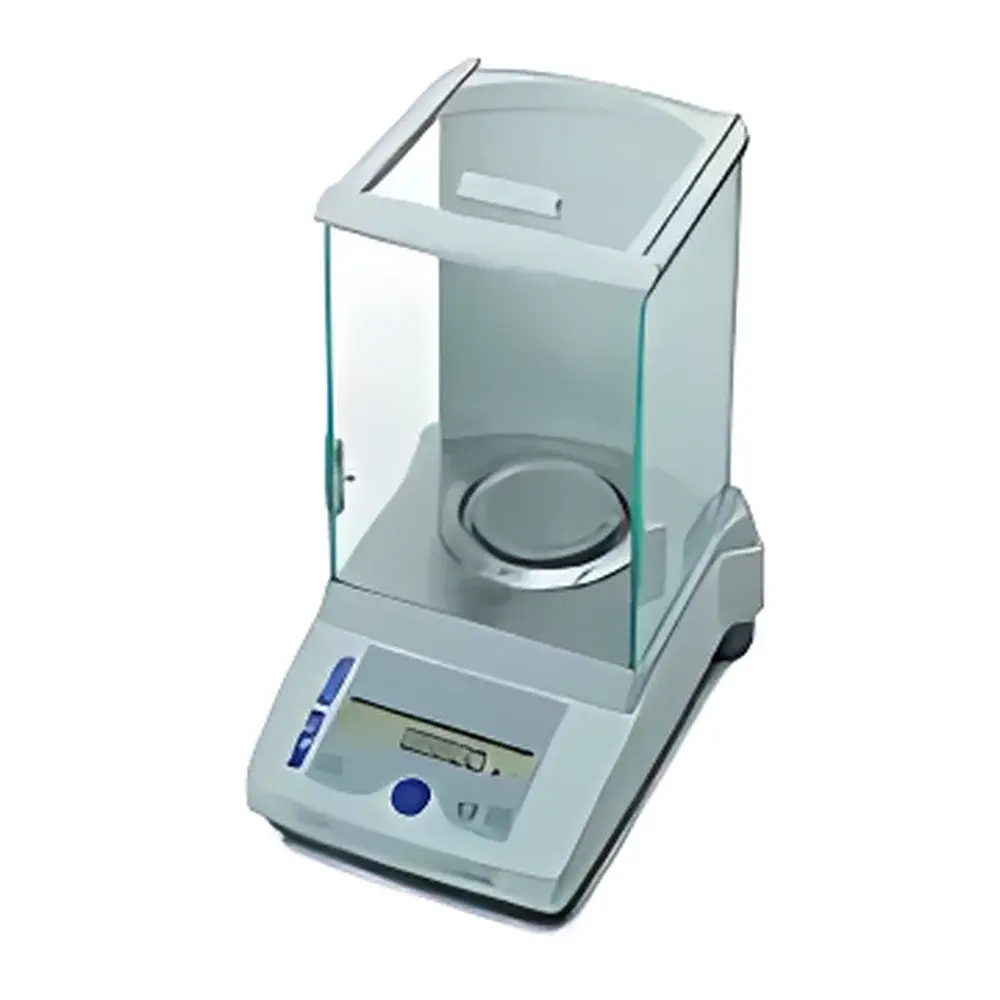
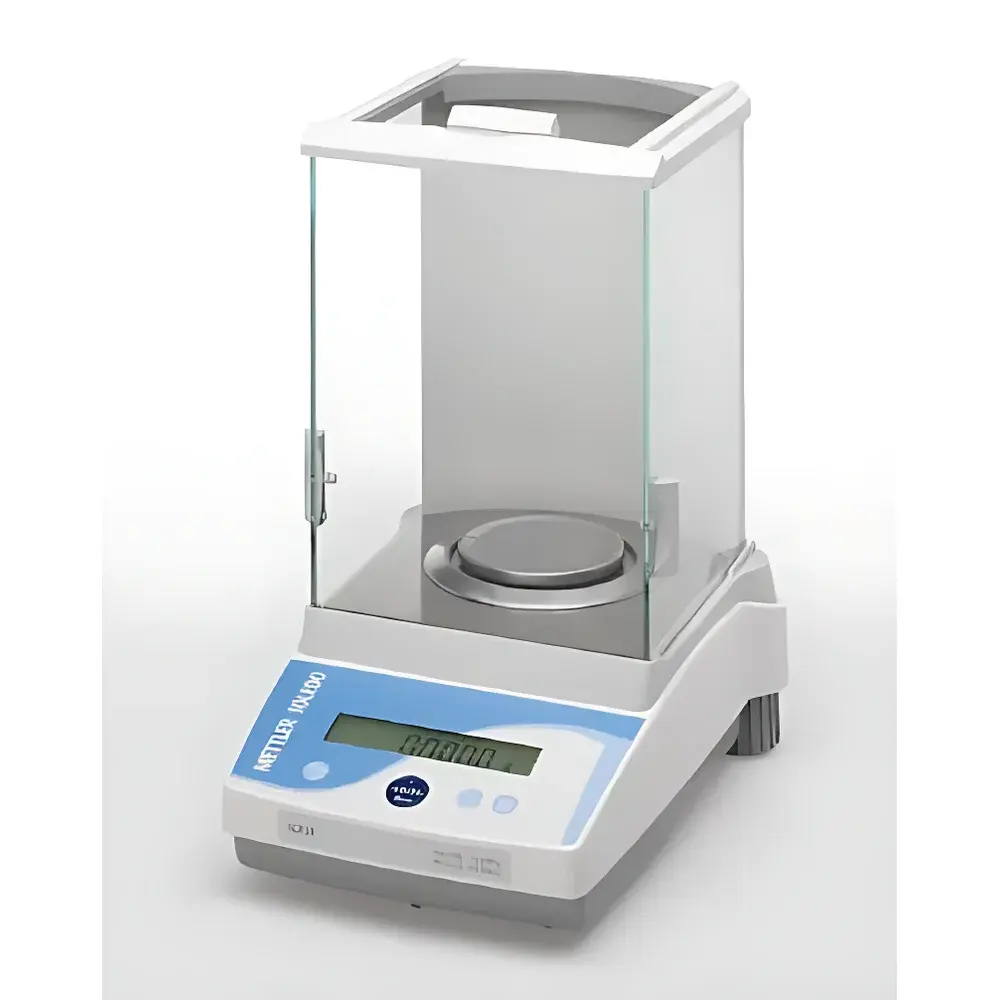
Metler Toledo AL104 Analytical Balance
| Key | Readability: 0.1 mg |
|---|---|
| Max Capacity | 110 g |
| Repeatability | 0.1 mg |
| Linearity | ±0.2 mg |
| Pan Diameter | Ø90 mm |
| Draft Shield Height | 220 mm |
| Dimensions (W×D×H) | 238 × 335 × 364 mm |
| External Calibration | 100 g weight (optional) |
| Interface | RS232 |
| Housing Material | Corrosion-resistant ABS engineering plastic |
| Built-in Applications | Weighing, Percentage Weighing, Piece Counting, Dynamic Weighing, Net/Gross/Tare Addition/Subtraction |
| Compliance | Designed for GLP/GMP environments with audit-ready data handling capabilities |
Overview
The Mettler Toledo AL104 Analytical Balance is a high-precision mass measurement instrument engineered for routine laboratory applications requiring reliable sub-milligram resolution. Based on electromagnetic force compensation (EMFC) technology, the AL104 delivers stable and reproducible results under standard ambient conditions (20 ±5 °C, <70 % RH, non-condensing). Its 0.1 mg readability and 110 g maximum capacity make it suitable for quantitative sample preparation, reagent dispensing, quality control checks, and educational demonstrations where trace-level accuracy is essential but ultra-high-end metrology is not required. The balance features a robust monolithic sensor architecture, thermally stabilized weighing cell, and integrated draft shield—ensuring minimal drift and high short-term stability. Designed and assembled in Shanghai under Mettler Toledo’s global manufacturing standards, the AL104 complies with international regulatory expectations for analytical instrumentation used in ISO/IEC 17025-accredited laboratories.
Key Features
- Electromagnetic force compensation (EMFC) transducer ensures long-term calibration stability and low maintenance requirements.
- Corrosion-resistant ABS engineering plastic housing provides mechanical durability while minimizing thermal mass and electrostatic interference.
- Large, backlit LCD display with intuitive icon-based menu navigation enables rapid operation without training overhead.
- Dedicated In-Use plastic cover protects internal components from particulate contamination and chemical splashes during active weighing sessions.
- External calibration via optional 100 g Class M2 or better certified weight supports traceable verification per ISO 9001 and ISO/IEC 17025 requirements.
- RS232 serial interface enables direct connection to label printers, PCs, or LIMS systems for automated data capture—supporting 21 CFR Part 11–compliant electronic record workflows when paired with validated software.
- Preloaded application modes—including percentage weighing, piece counting, dynamic (moving object) weighing, and net/gross/tare arithmetic—reduce manual calculation errors and improve throughput.
Sample Compatibility & Compliance
The AL104 accommodates a wide range of solid and powdered samples within its Ø90 mm stainless steel pan and 220 mm effective draft shield height. Its design meets fundamental mechanical and environmental robustness criteria outlined in OIML R 76-1 and EN 12334 for non-automatic weighing instruments. While not certified for hazardous area use (ATEX/IECEx), the unit operates safely in general-purpose laboratory zones. For regulated environments, the balance supports GLP-compliant documentation through timestamped printouts and ASCII-formatted RS232 output. When integrated with e-Loader II firmware update utility and third-party validated data acquisition platforms, it fulfills audit trail, user access control, and electronic signature prerequisites aligned with FDA 21 CFR Part 11 Annex 11 and EU GMP Annex 11 frameworks.
Software & Data Management
The AL104 does not include embedded Wi-Fi or Ethernet connectivity; however, its native RS232 interface allows seamless integration with PC-based data management tools such as LabX Lite (via optional USB-to-serial adapter) or custom-developed SCADA interfaces. All weighing events—including tare, gross, net, and application-mode outputs—are transmitted in ASCII format with configurable delimiters and prefix/suffix tags. Firmware updates are performed offline using Mettler Toledo’s e-Loader II utility, ensuring version control and integrity verification prior to deployment. Audit logs (if enabled via host software) can record operator ID, timestamp, measured value, unit, and application context—critical for method validation and regulatory submissions.
Applications
- Pharmaceutical QC testing: active pharmaceutical ingredient (API) weighing for dissolution testing and tablet content uniformity assays.
- Chemical synthesis: precise stoichiometric reagent dosing in organic and inorganic reaction setups.
- Materials science: gravimetric analysis of catalyst loading, polymer additives, or nanomaterial dispersions.
- Food & beverage labs: moisture content determination via loss-on-drying protocols (when paired with compatible drying ovens).
- Academic teaching labs: foundational instruction in metrology principles, uncertainty propagation, and statistical process control using built-in statistics mode.
- Environmental testing: filter weighing for total suspended solids (TSS) and particulate matter (PM10/PM2.5) analysis per EPA Method 160.1 and ISO 1171.
FAQ
What is the recommended calibration frequency for the AL104 in a GLP environment?
Calibration should be performed at startup, after relocation, following significant temperature fluctuations, and at defined intervals (e.g., daily or per batch) as specified in your SOP—typically verified using a 100 g external weight traceable to NIST or equivalent national metrology institute.
Does the AL104 support internal calibration?
No—the AL104 requires external calibration with a certified weight; internal motorized calibration is available only on higher-tier models such as the ME or XSE series.
Can the AL104 be connected to modern LIMS or ELN systems?
Yes—via RS232 with appropriate protocol configuration (e.g., Mettler Toledo Standard or Modbus ASCII); middleware or driver-based integration may be required for cloud-native platforms.
Is the plastic protective cover included as standard equipment?
Yes—the In-Use cover is supplied as standard with every AL104 unit to prevent dust ingress and accidental spill damage during operation.
What environmental conditions must be maintained for optimal performance?
Ambient temperature between 15–30 °C (ideally 20 ±2 °C), relative humidity below 70 % RH (non-condensing), and placement on a vibration-isolated, level surface away from air currents and electromagnetic sources.