Metrolux ML 2100 VariLux Continuous Variable Laser Beam Attenuator
| Brand | Metrolux |
|---|---|
| Origin | Germany |
| Model | ML 2100 VariLux |
| Dimensions (ML2100/ML2150) | ~40×40×60 mm³ |
| Max. Avg. Power | 5 W |
| Available Wavelengths | 157–1064 nm |
| Max. Transmission | >70% (157 nm) to >90% (248–1064 nm) |
| Min. Transmission | <2% (157 nm) to <1% (≥248 nm) |
| Damage Threshold (1 Hz) | 0.2–15.0 J/cm² (wavelength-dependent) |
| Mounting | C-mount |
| Spectral Range (ML2300 PolarLux) | 185–2000 nm |
| Max. Input Power (ML2300) | <1000 W |
| Max. Avg. Power Density (ML2300) | <10,000 W/cm² |
| Max. Pulse Power Density (ML2300) | 2 GW/cm² |
| Beam Deviation | 90° (non-polarizing), 0° (polarizing) |
| Free Aperture (ML2300) | ~15×15 mm² |
| Wedge Material | Fused Silica |
| Neutral Density Filters | OD 0.9–4.0, absorbing & metallic types, 200–700 nm range |
Overview
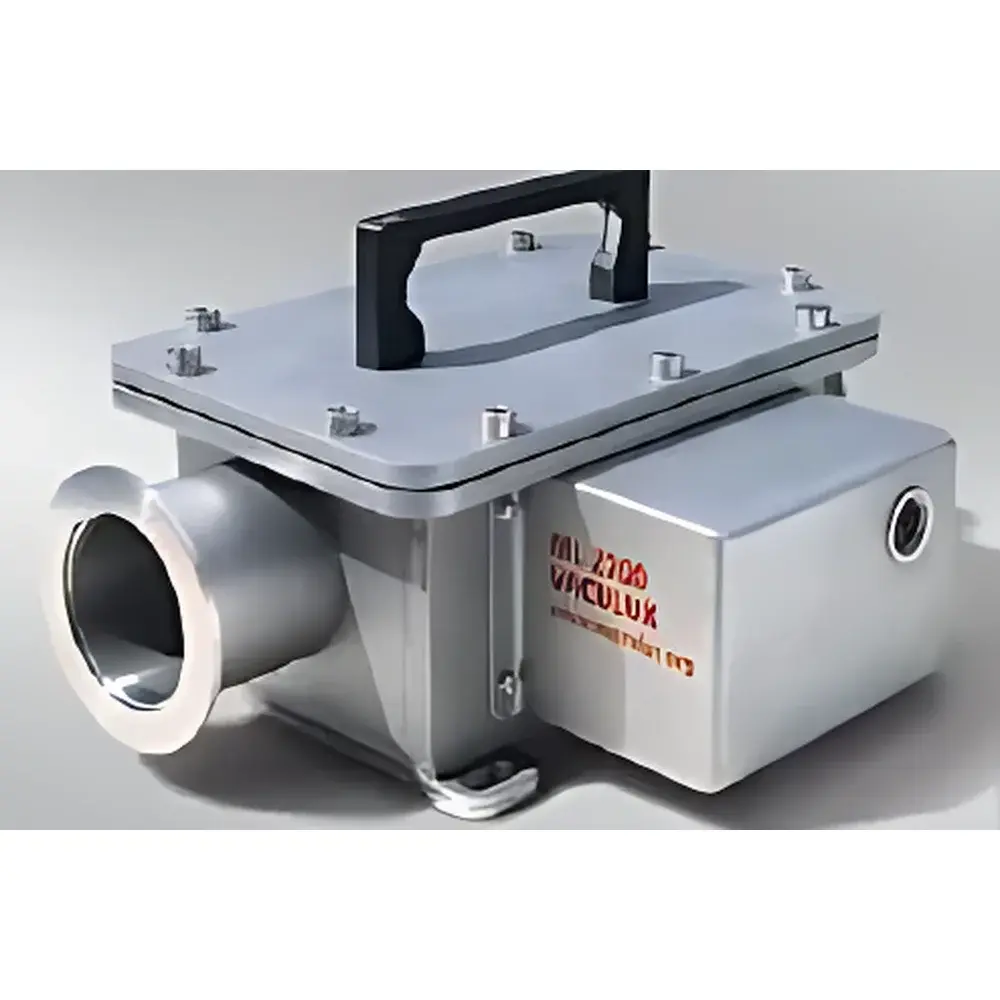
The Metrolux ML 2100 VariLux is a precision-engineered continuous variable laser beam attenuator designed for stable, repeatable control of high-peak-power and high-average-power laser radiation across deep UV to near-IR spectral regions. Based on rotating wedge-based attenuation architecture, it operates on the principle of variable beam displacement through fused silica wedges — enabling smooth, stepless transmission adjustment without introducing polarization bias (in non-polarizing configuration) or beam walk-off artifacts typical of fixed ND filter stacks. Its compact footprint (~40×40×60 mm³), C-mount compatibility, and vacuum/gas-purged housing options (e.g., ML2200 VacuLux variant) make it suitable for integration into excimer laser systems (157–308 nm), solid-state Q-switched lasers (266–1064 nm), and ultrafast amplifier chains requiring deterministic pulse energy management prior to diagnostics or material interaction stages.
Key Features
- Continuous, analog attenuation control with no discrete steps — ideal for real-time feedback loops and closed-loop power stabilization
- Fused silica optical train ensuring high laser-induced damage threshold (LIDT) from 157 nm (0.2 J/cm² @ 1 Hz) to 1064 nm (15 J/cm² @ 1 Hz)
- Dual-beam-path design: non-polarizing mode (90° beam deviation) for alignment-insensitive setups; polarizing mode (0° deviation, 50 mm lateral displacement) for polarization-preserving applications
- Modular platform supporting interchangeable wedge assemblies and ND filter modules (absorbing and metallic types) for hybrid attenuation strategies
- C-mount mechanical interface compliant with standard optomechanical breadboards and OEM laser enclosures
- Vacuum-compatible variants (ML2200 VacuLux) rated for operation under ≤10⁻⁶ mbar environments, eliminating outgassing-related contamination in lithography or photochemistry chambers
Sample Compatibility & Compliance
The ML 2100 series accommodates collimated, spatially filtered input beams up to 15 mm × 15 mm (ML2300 PolarLux) with minimal wavefront distortion (<λ/10 PV over full aperture). It maintains spectral neutrality within specified bands — critical for multi-wavelength experiments and broadband pump-probe configurations. All models comply with ISO 11146-1 (laser beam parameters) and EN 60825-1 (laser product safety) requirements. The fused silica substrates meet ASTM F795 specifications for optical-grade synthetic quartz. For regulated environments, the system supports traceable calibration documentation aligned with ISO/IEC 17025-accredited laboratories, and optional audit-ready firmware logs (with timestamped attenuation settings) satisfy GLP/GMP data integrity expectations per FDA 21 CFR Part 11 when integrated with validated control software.
Software & Data Management
While the ML 2100 operates as a manually actuated optical component, its C-mount form factor enables seamless integration with motorized rotation stages (e.g., Thorlabs K10CR1, Newport URS100CC) controlled via LabVIEW™, Python (PyVISA), or MATLAB® instrument drivers. Metrolux provides ASCII-based command protocols for third-party automation, including position-to-transmission lookup tables calibrated per wavelength and pulse regime. All ND filter modules include individual serial-numbered calibration certificates reporting measured optical density (OD), transmission (%T), and damage threshold verification at specified wavelengths and pulse durations. Raw attenuation data can be exported in CSV format for inclusion in electronic lab notebooks (ELN) or LIMS systems supporting ASTM E2500-21 metadata standards.
Applications
- Excimer laser energy regulation in photolithography mask aligners and UV ablation systems (157–308 nm)
- Pulse energy balancing in multi-channel Ti:sapphire amplifier systems and OPCPA front-ends
- Reference beam conditioning in interferometric metrology (e.g., LIGO-style cavity locking, heterodyne detection)
- Calibration source attenuation for radiometric sensors (NIST-traceable power meters, photodiode linearity verification)
- In-situ laser fluence control during laser-induced breakdown spectroscopy (LIBS) and time-resolved fluorescence decay measurements
- Vacuum-integrated optical pumping in atomic vapor cells and cold atom traps (via ML2200 VacuLux)
FAQ
Is the ML 2100 compatible with femtosecond laser pulses?
Yes — provided pulse duration exceeds 10 ps and repetition rate remains below 1 kHz, the fused silica wedge design avoids nonlinear effects and thermal lensing. For sub-100 fs pulses, consult Metrolux for custom anti-reflection coating options optimized for group delay dispersion (GDD) minimization.
Can I combine ML 2100 attenuation with neutral density filters?
Absolutely. The ML 2100’s free aperture and modular filter slot support cascaded attenuation schemes. Use wedge-based coarse control (OD 0–3) and metallic ND filters (OD 3–4) for fine-tuning, ensuring total transmission uncertainty remains below ±1.5% (k=2) across the operating band.
Does Metrolux provide NIST-traceable calibration for transmission values?
Yes — each unit ships with a certificate of conformance referencing measurements performed at a DAkkS-accredited calibration laboratory (D-K-12345-0001), covering transmission vs. rotation angle at five wavelengths (193, 248, 355, 532, 1064 nm) and certified LIDT validation per ISO 21254-2.
What maintenance is required for long-term stability?
No periodic recalibration is needed. Fused silica wedges exhibit negligible aging under normal operating conditions. Recommend quarterly inspection of C-mount fasteners and wipe-down of entrance/exit windows using spectroscopic-grade methanol and lint-free wipes — per ISO 10110-7 surface cleanliness guidelines.