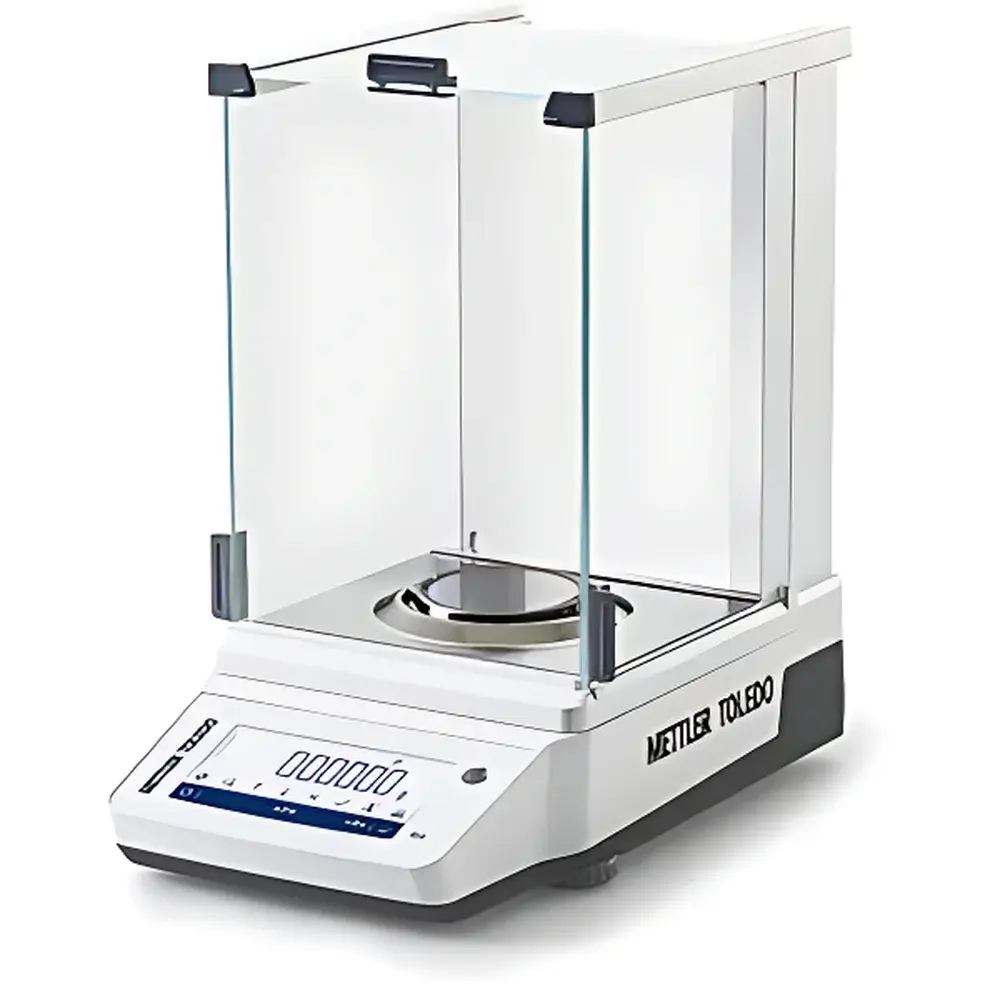
METTLER TOLEDO MA155DU/A Analytical Balance
| Brand | METTLER TOLEDO |
|---|---|
| Origin | Germany |
| Manufacturer Type | Authorized Distributor |
| Origin Category | Imported |
| Model | MA155DU/A |
| Instrument Type | Analytical Balance |
| Maximum Capacity | 62 g / 152 g |
| Readability | 0.01 mg / 0.1 mg |
| Repeatability (typ.) | 0.015 mg |
| Minimum Weight (USP <41>, 0.1% tolerance, typ.) | 30 mg |
| Stabilization Time | 4 s |
| Pan Diameter | 80 mm |
| Dimensions (H×W×D) | 354 mm × 209 mm × 354 mm |
| Verification Scale Interval | 1 mg |
| Display | LCD Hybrid Touchscreen |
| Interfaces | RS232, USB-A, Bluetooth (optional) |
| Compliance | Legal-for-Trade certified, GLP/GMP-ready, USP <41> compliant |
Overview
The METTLER TOLEDO MA155DU/A Analytical Balance is a high-precision weighing instrument engineered for routine and regulated laboratory applications requiring traceable accuracy, robust repeatability, and full compliance with international pharmacopeial and metrological standards. Based on electromagnetic force compensation (EMFC) technology, it delivers stable, drift-resistant measurements under variable environmental conditions—including minor air currents, temperature fluctuations, and electrostatic interference—common in QC labs, formulation development, and analytical chemistry workflows. Its dual-range configuration (62 g / 152 g) with selectable readability (0.01 mg or 0.1 mg) enables flexible use across low-mass sample preparation (e.g., reference standard dilution, catalyst dosing) and higher-capacity intermediate weighing tasks—without sacrificing resolution or regulatory traceability. The balance meets OIML R76 and NIST Handbook 44 requirements for legal-for-trade applications and is certified for use in environments governed by ISO/IEC 17025, FDA 21 CFR Part 11, and EU GMP Annex 11 when integrated with compliant software.
Key Features
- Hybrid touchscreen + physical key interface for glove-compatible, intuitive operation under controlled environments
- Internal calibration system with motorized, traceable test weights—fully automated and scheduled via user-defined intervals (e.g., daily, per shift, or on startup)
- Robust metal base and chemically resistant housing (IP54-rated enclosure) withstand repeated exposure to solvents, acids, and bases; surface geometry facilitates rapid wipe-down and residue removal
- Dynamic leveling assistance with visual tilt indicator and auto-compensated weighing algorithm—eliminates manual bubble-level adjustment errors
- GLP/GMP audit trail enabled by built-in event logging: records operator ID, timestamp, calibration status, error codes, and weight data with tamper-proof digital signature
- USB-A and RS232 ports support direct connection to LIMS, ELN, or ERP systems; optional Bluetooth module enables wireless data transfer to validated mobile devices
Sample Compatibility & Compliance
The MA155DU/A accommodates standard 80 mm diameter weighing pans and is compatible with universal sample containers—including glass vials, aluminum weighing boats, and antistatic polymer dishes. Its draft shield design minimizes convective interference while allowing unobstructed access during loading. All firmware and calibration routines comply with USP minimum weight validation protocols (minimum weight = 30 mg at 0.1% tolerance, k=2), and the instrument’s internal uncertainty budget supports ISO/IEC 17025 method validation. It carries CE, FCC, and MID (Measuring Instruments Directive) certification for use in EU markets and is supplied with factory-issued calibration certificate traceable to national metrology institutes (e.g., PTB, NIST).
Software & Data Management
METTLER TOLEDO LabX® software (sold separately) provides full 21 CFR Part 11 compliance—including electronic signatures, role-based access control, and immutable audit trails—for the MA155DU/A. Standalone operation includes password-protected user accounts (administrator, operator, technician), customizable report templates (PDF/CSV export), and automatic metadata tagging (date, time, environment ID, balance serial number). Data integrity is enforced through cyclic redundancy checks (CRC) on all transmitted weight values and encrypted local storage of calibration history. Optional integration with METTLER TOLEDO AutoCal™ allows remote monitoring of calibration status across multi-instrument networks.
Applications
- Pharmaceutical quality control: active pharmaceutical ingredient (API) assay, dissolution testing sample prep, excipient blending verification
- Academic and industrial research: gravimetric analysis, stoichiometric reagent dispensing, catalyst mass normalization
- Reference material certification: sub-milligram standard preparation under ISO Guide 35 conditions
- Environmental testing labs: filter weighing for PM2.5/PM10 analysis per EPA Method 201A
- Food and beverage QA: nutritional labeling compliance (e.g., vitamin fortification dosage), moisture content determination via loss-on-drying
FAQ
What is the minimum weight I can reliably weigh on the MA155DU/A?
The minimum weight is 30 mg when applying USP criteria (0.1% tolerance, k=2); for general lab use with 1% tolerance, the typical minimum is 3 mg.
Does the balance support external calibration with user-provided weights?
Yes—external calibration is supported via RS232 or USB, though internal calibration is recommended for routine use to ensure traceability and reduce operator dependency.
Can I connect this balance to my existing LIMS without third-party middleware?
Yes—the native ASCII protocol over RS232 or USB CDC mode enables direct LIMS integration using standard HL7 or ASTM E1384 message structures.
Is the touchscreen operable with nitrile gloves?
Yes—the hybrid capacitive/resistive touch layer is optimized for gloved operation and includes haptic feedback confirmation for critical actions.
How often does the internal calibration require verification?
Per ISO/IEC 17025, internal calibration should be verified against an accredited reference standard at least annually—or more frequently based on risk assessment, usage frequency, and environmental stability.