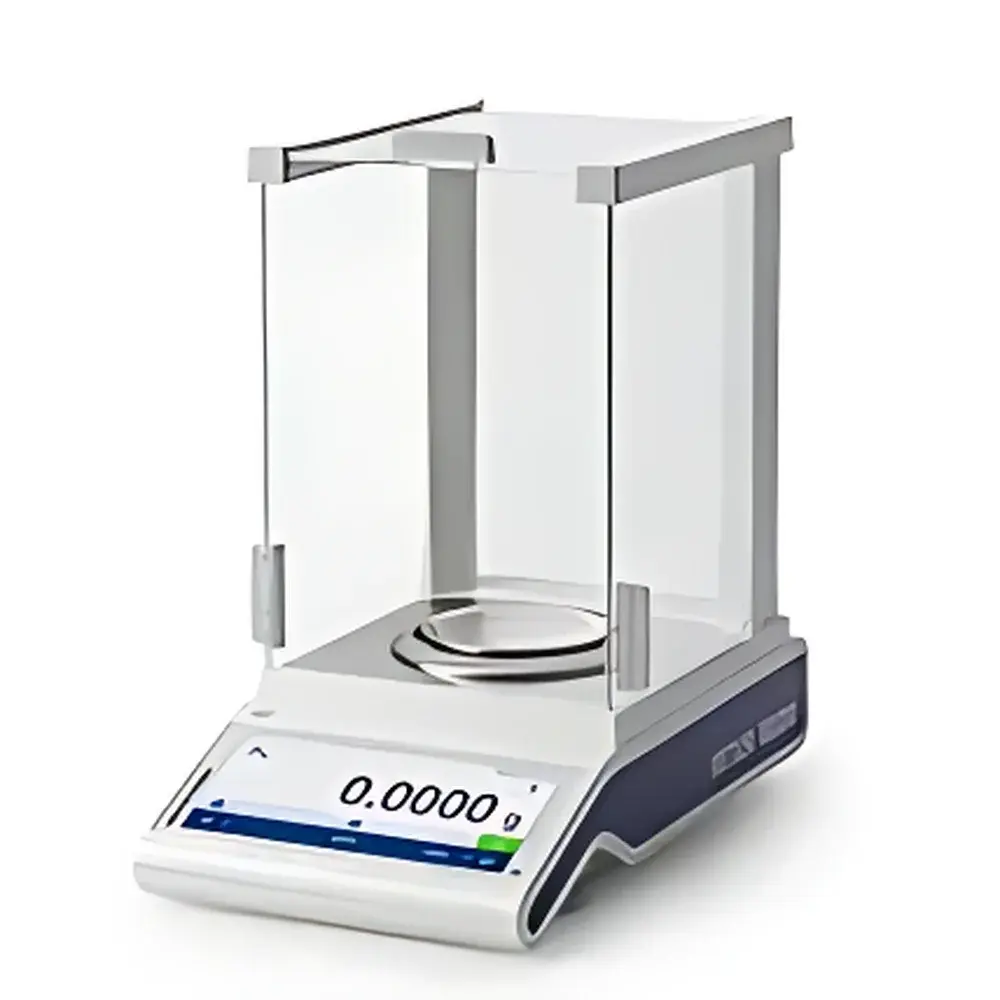
METTLER TOLEDO MS104TS Analytical Balance
| Brand | METTLER TOLEDO |
|---|---|
| Origin | Switzerland |
| Model | MS104TS |
| Instrument Type | Analytical Balance |
| Maximum Capacity | 120.0 g |
| Readability | 0.1 mg |
| Repeatability | 0.1 mg |
| Minimum Weight (USP <41> typical) | 160.0 mg |
| Calibration | Internal |
| Display | 7-inch full-color capacitive touchscreen |
| Connectivity | USB Host, USB Device, RS232, Bluetooth (optional) |
| Draft Shield | QuickLock removable without tools |
| Security | Password-protected access for calibration and configuration |
Overview
The METTLER TOLEDO MS104TS Analytical Balance is a high-precision mass measurement instrument engineered for routine analytical weighing tasks in regulated laboratory environments. Based on electromagnetic force compensation (EMFC) technology, it delivers stable, drift-free measurements with a readability of 0.1 mg across its 120.0 g maximum capacity. Designed to meet the stringent requirements of pharmacopeial standards—including USP “Balances” and EP 2.1.6—the MS104TS integrates core metrological safeguards such as proFCAT (fully automatic, temperature-compensated internal calibration), LevelControl (real-time tilt detection with visual guidance), and MinWeigh (dynamic minimum weight calculation based on repeatability and uncertainty). Its robust die-cast aluminum base and monolithic weighing cell architecture minimize mechanical hysteresis and environmental sensitivity, ensuring long-term stability under variable ambient conditions typical of QC labs, R&D facilities, and GLP-compliant testing suites.
Key Features
- proFCAT internal calibration system: Performs automatic recalibration triggered by time, temperature drift (>1.5 °C change), or user command—eliminating manual intervention while maintaining traceability to national standards.
- LevelControl integrated leveling assistant: Uses built-in inclinometers to detect imbalance and guides users via on-screen prompts to adjust leveling feet—reducing setup error and supporting ISO/IEC 17025 compliance.
- MinWeigh function: Dynamically calculates and displays the minimum sample weight required to achieve target measurement uncertainty per USP , preventing sub-threshold weighing that compromises data integrity.
- 7-inch capacitive color touchscreen: Supports multi-touch gestures, customizable home screen layouts, and intuitive icon-driven navigation—optimized for gloved operation and rapid method selection.
- QuickLock draft shield: Tool-free, one-click removal and reinstallation of the three-sided glass enclosure—enabling fast cleaning and unobstructed access during volumetric transfers or powder handling.
- Multi-interface connectivity: Native support for USB host (for saving data to flash drives), USB device (for PC integration), RS232 (legacy LIMS compatibility), and optional Bluetooth 4.2 (wireless transmission to mobile devices or printers).
Sample Compatibility & Compliance
The MS104TS accommodates standard laboratory vessels—including weighing boats, vials, crucibles, and filter papers—within its 120 g load limit and 180 mm pan diameter. Its anti-static ionizer-compatible design mitigates electrostatic interference during low-mass solid dosing. The balance conforms to OIML R 76-1 Class I (analytical grade), EN 45501, and ANSI/NCSL Z540-1 metrological frameworks. For regulated industries, it supports audit-trail-enabled operation when paired with METTLER TOLEDO LabX software (sold separately), fulfilling FDA 21 CFR Part 11 requirements for electronic records and signatures—including user authentication, action logging, and immutable data archiving.
Software & Data Management
While standalone operation is fully functional, the MS104TS achieves full data governance capability when interfaced with LabX software. LabX enables centralized method management, automated report generation (PDF/CSV), real-time statistical process control (SPC), and seamless integration with ERP or LIMS platforms via OPC UA or direct database connectors. All weighing events—including tare, net, and differential modes—are timestamped, user-ID stamped, and stored with full contextual metadata (environmental readings, calibration history, and uncertainty estimates). Local USB storage allows immediate export of raw datasets compliant with ALCOA+ principles (Attributable, Legible, Contemporaneous, Original, Accurate, Complete, Consistent, Enduring, Available).
Applications
The MS104TS serves critical roles across pharmaceutical quality control (e.g., active pharmaceutical ingredient (API) assay, reference standard preparation, and dissolution tablet weight checks), chemical synthesis (reaction stoichiometry verification, catalyst loading), food safety testing (nutrient labeling verification per FDA 21 CFR 101), and academic research requiring reproducible microgram-level mass quantification. Its internal calibration and MinWeigh functionality make it particularly suitable for compendial testing workflows governed by USP, EP, JP, or ISO 17025-accredited laboratories.
FAQ
What regulatory standards does the MS104TS support out of the box?
It complies with OIML R 76-1 Class I, EN 45501, and USP minimum weight requirements. Full 21 CFR Part 11 compliance requires LabX software deployment.
Is external calibration required if proFCAT is enabled?
No—proFCAT satisfies routine calibration needs; however, periodic external verification using certified weights (e.g., ASTM E617 Class S-1) is recommended for audit readiness.
Can the touchscreen be operated with laboratory gloves?
Yes—the capacitive display responds reliably to standard nitrile and latex gloves without requiring stylus assistance.
How is data integrity ensured during power interruption?
All active weighing sessions are cached in non-volatile memory and restored upon reboot; no transient data is lost during brief outages.
Does the MS104TS support multiple user profiles with differentiated permissions?
Yes—up to 10 user accounts with configurable access levels (operator, supervisor, administrator) can be defined locally; password complexity rules enforce ISO 27001-aligned security practices.