
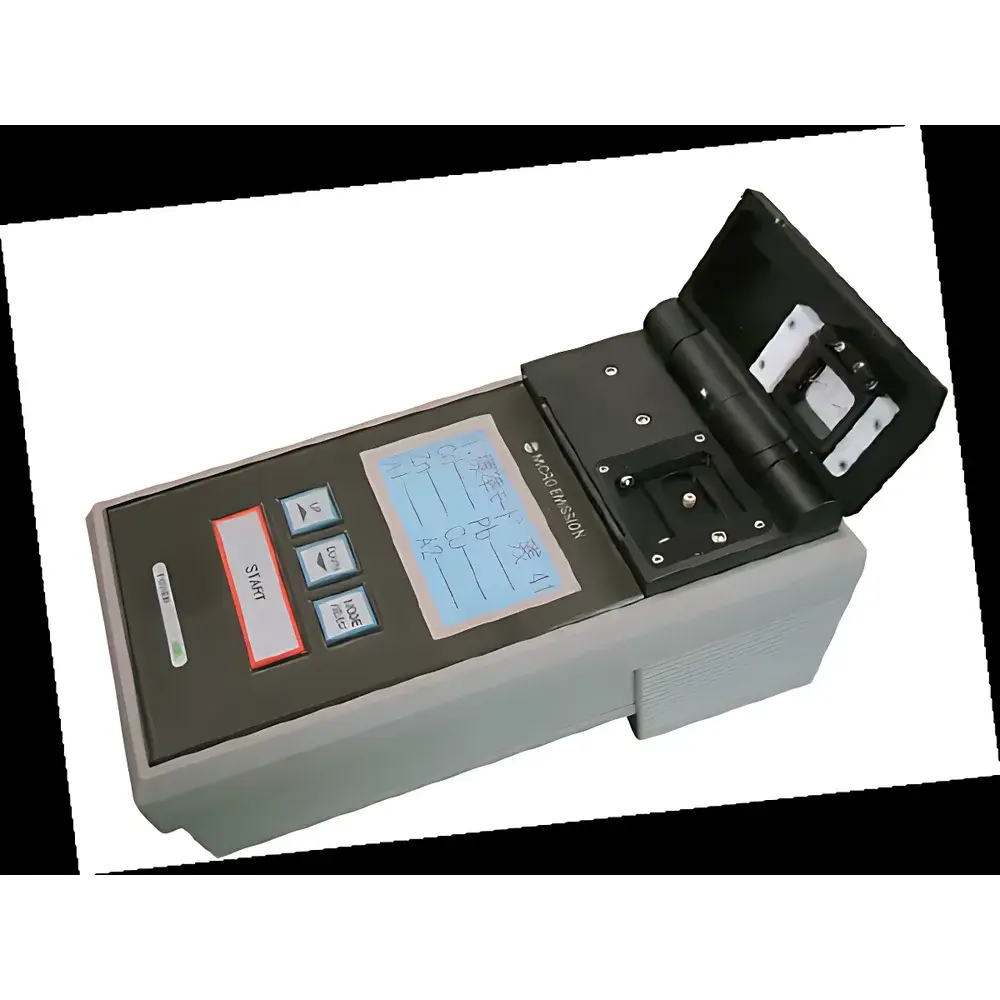
MH-5000 Portable Inductively Coupled Plasma Optical Emission Spectrometer (ICP-OES)
| Origin | Japan |
|---|---|
| Manufacturer Type | Authorized Distributor |
| Origin Category | Imported |
| Model | MH-5000 |
| Pricing | Available Upon Request |
Overview
The MH-5000 Portable Inductively Coupled Plasma Optical Emission Spectrometer (ICP-OES) is an engineered field-deployable analytical instrument designed for on-site elemental quantification and semi-quantitative screening of metals in liquid matrices. Unlike laboratory-bound ICP-OES systems, the MH-5000 integrates a miniaturized RF plasma source, compact echelle spectrometer with solid-state detector, and integrated sample introduction module into a ruggedized, battery-operated chassis. It operates on the fundamental principle of inductively coupled plasma excitation: liquid samples are nebulized into fine aerosol, transported into a high-temperature (~6,000–10,000 K) argon plasma where atoms and ions are thermally excited; emitted characteristic wavelengths are resolved via high-resolution optical dispersion and quantified by photon counting. This enables direct detection of emission lines corresponding to key metallic elements—including As, Cd, Cr, Cu, Fe, Pb, Zn, Na, K, Ca, Mg, and Mn—without requiring pre-concentration or matrix separation under typical field conditions.
Key Features
- True field-portable architecture: weighs under 18 kg, equipped with integrated Li-ion battery pack supporting ≥4 hours of continuous operation and hot-swappable power modules.
- Multi-element simultaneous analysis: capable of concurrent detection and quantification of up to seven elements per measurement cycle without spectral re-scanning.
- Low sample consumption: requires only 40 µL of clarified aqueous or acid-diluted liquid sample per analysis—ideal for limited-volume environmental, industrial, or clinical specimens.
- Robust plasma stabilization: employs frequency-tuned 27.12 MHz RF generator with automatic impedance matching to maintain stable plasma ignition across variable ambient temperatures (−10 °C to +45 °C) and humidity levels (up to 90% RH non-condensing).
- Integrated calibration management: supports single-point, multi-point, and bracketing calibration protocols with built-in drift correction algorithms based on internal reference line monitoring.
Sample Compatibility & Compliance
The MH-5000 accepts clarified aqueous solutions, diluted acid digests (e.g., HNO₃, HCl), and low-TDS (3% NaCl), or suspended particulates >5 µm. Sample introduction utilizes a cross-flow nebulizer with sapphire tip and cyclonic spray chamber to minimize clogging and memory effects. The system complies with ISO/IEC 17025:2017 requirements for field instrumentation validation and supports audit-ready documentation per GLP and EPA Method 200.7 (for metals in drinking water). Optional accessories include certified reference material kits traceable to NIST SRMs and portable acid digestion blocks for on-site sample preparation.
Software & Data Management
Control and data acquisition are managed via the MH-Control Suite v3.2—a Windows-based application with intuitive touch-optimized interface. Software features include real-time spectral preview, automated peak identification using NIST Atomic Spectra Database (ASD) libraries, customizable reporting templates (PDF/CSV/XLSX), and secure local storage with AES-256 encryption. All analytical sessions generate immutable metadata logs including operator ID, GPS coordinates (when enabled), ambient sensor readings (T/RH/pressure), and full audit trail compliant with FDA 21 CFR Part 11 for electronic records and signatures. Data export supports LIMS integration via ASTM E1384-compliant XML schema.
Applications
- Environmental field screening: rapid assessment of heavy metal contamination (Pb, Cd, As) in groundwater, surface water, and leachates at remediation sites.
- Industrial process control: real-time monitoring of coolant, boiler feedwater, and plating bath chemistries for Na⁺, K⁺, Ca²⁺, Mg²⁺, and transition metals.
- Food safety verification: on-farm or port-of-entry testing of irrigation water and processing rinse solutions for regulatory compliance (EU Directive 2020/2184, US EPA 503.9).
- Geological exploration support: semi-quantitative reconnaissance of base metal indicators (Cu, Zn, Ni) in stream sediments and soil extracts.
- Emergency response: first-responder deployment for post-disaster water quality triage following floods or industrial spills.
FAQ
What plasma gas is required for operation?
The MH-5000 uses compressed argon gas supplied from a standard 10-L portable cylinder (CGA 580 fitting); optional integrated argon recycler module reduces consumption by ~40% during extended deployments.
Is method validation support available?
Yes—application notes, ICP-OES performance qualification (PQ) checklists, and third-party verification reports aligned with ISO 17025 are provided with each unit.
Can the instrument detect non-metals such as P or S?
No—the MH-5000 is optimized for metallic elements with strong emission lines in the 175–800 nm range; non-metals require vacuum UV optics and are outside its design scope.
What maintenance intervals are recommended?
Nebulizer and torch cleaning every 50 analyses; RF coil inspection and spectrometer wavelength calibration every 200 hours of plasma runtime; full preventive maintenance annually by certified service engineers.
Does it meet CE or FCC certification requirements?
Yes—the MH-5000 carries CE marking (EMC Directive 2014/30/EU, RoHS 2011/65/EU) and FCC Part 15 Class B certification for electromagnetic compatibility in commercial environments.






