
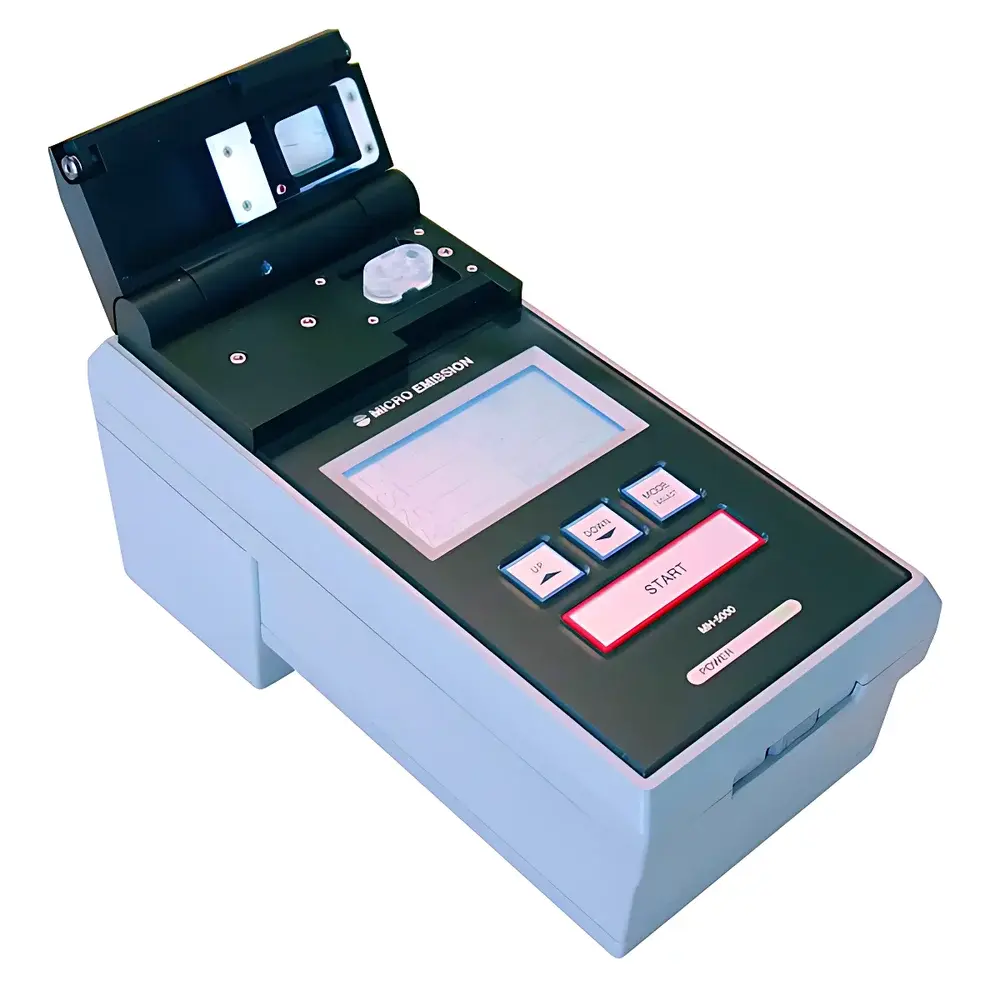
Micro Emission MH-5000 Portable Liquid Electrode Capillary Plasma Optical Emission Spectrometer (LECP-OES)
| Brand | Micro Emission |
|---|---|
| Origin | Japan |
| Model | MH-5000 |
| Instrument Type | Full-Spectrum Direct-Reading OES |
| Wavelength Range | 200–860 nm |
| Weight | 1.4 kg (including battery) |
| Power Supply | 6 AA batteries or AC adapter |
| Sample Volume | 40 µL |
| Element Coverage | >40 elements (including Na, Mg, Al, K, Ca, Ti, V, Cr, Mn, Fe, Co, Ni, Cu, Zn, As, Se, Sr, Cd, Ba, Pb, and rare earths) |
Overview
The Micro Emission MH-5000 is a field-deployable liquid electrode capillary plasma optical emission spectrometer (LECP-OES), engineered for rapid, multi-element quantitative analysis of liquid samples in non-laboratory environments. Unlike conventional inductively coupled plasma optical emission spectrometers (ICP-OES), the MH-5000 eliminates dependence on high-power RF generators, argon plasma torches, water-cooled RF coils, and vacuum-pumped exhaust systems. Instead, it employs a patented liquid electrode excitation architecture—where sample solution itself serves as one electrode in a micro-capillary plasma discharge—generating stable, low-energy plasma directly within the sample stream. This principle enables robust elemental excitation across the UV-Vis spectral range (200–860 nm) without requiring external gas supply or thermal management infrastructure. Designed for regulatory-constrained field applications—including environmental monitoring, agricultural soil leachate screening, industrial wastewater compliance checks, and food safety verification—the MH-5000 delivers laboratory-grade qualitative and semi-quantitative elemental profiling with full-spectrum acquisition capability and integrated spectral deconvolution algorithms.
Key Features
- True portability: Compact form factor (20 × 10 × 11 cm), total mass of 1.4 kg including rechargeable battery pack—fits within standard field carry cases and operates unattended for >4 hours on AA cells.
- Gas-free operation: No argon, nitrogen, or compressed air required; eliminates gas cylinder logistics, pressure regulation, and associated safety protocols.
- Minimal sample consumption: Quantitative analysis achievable from 40 µL of aqueous or acid-digested samples—reducing reagent use and waste generation.
- Integrated optical bench: Fixed-grating spectrometer with CCD detector optimized for signal-to-noise ratio across 200–860 nm; no moving parts or wavelength calibration drift during transport.
- Self-contained excitation source: Liquid electrode capillary plasma module requires no alignment, torch cleaning, or nebulizer maintenance—designed for GLP-aligned field deployment with minimal operator training.
- Low power demand: Operates at <5 W average draw—compatible with portable power banks, vehicle DC outlets, or standard AC adapters (100–240 V, 50/60 Hz).
Sample Compatibility & Compliance
The MH-5000 accepts clarified aqueous solutions, acid-digested environmental extracts (EPA Method 3050B/3051A), filtered drinking water, and diluted food digestates. It is validated for direct analysis of samples with total dissolved solids (TDS) ≤0.2% w/v and chloride content <100 mg/L to prevent electrode fouling. While not certified to ISO/IEC 17025 for accredited testing, the instrument supports audit-ready data workflows compliant with EPA Region 10 Field Screening Guidance, ASTM D5673 (for metals in water), and EU Regulation (EC) No 1881/2006 (contaminant limits in food). All spectral acquisitions include timestamped metadata, detector temperature logs, and lamp intensity references—enabling traceability per FDA 21 CFR Part 11 principles when used with validated software configurations.
Software & Data Management
The MH-5000 is controlled via the standalone Micro Emission LECP Suite v3.x (Windows 10/11), which provides real-time spectral visualization, peak identification using NIST Atomic Spectra Database (ASD) libraries, and multivariate calibration modeling (PLS-R, MLR). Raw .spe files contain full 2D spectral matrices (wavelength × intensity) with embedded hardware configuration parameters. Export options include CSV (peak area/intensity), PDF reports (with QA/QC flags), and LIMS-compatible XML formats. Audit trail functionality records all user actions—including method edits, calibration updates, and result approvals—with immutable timestamps and operator ID tagging. Software validation packages (IQ/OQ documentation) are available upon request for regulated environments.
Applications
- Environmental Field Screening: On-site quantification of heavy metals (Pb, Cd, As, Cr) in surface water, groundwater, and soil pore water—supporting rapid decision-making during Phase I/II site assessments.
- Agricultural Soil Testing: Multi-element nutrient profiling (K, Ca, Mg, Zn, Mn, Cu) from Mehlich-3 or ammonium acetate extracts—enabling precision fertilizer recommendations without lab turnaround delays.
- Food Safety Monitoring: Detection of toxic elements (As, Pb, Cd) in rice, seafood, and fruit juices following AOAC 999.10 sample preparation protocols.
- Industrial Process Control: Real-time monitoring of metal ion concentrations in electroplating baths, boiler feedwater, and semiconductor rinse effluents.
- Educational & Training Use: Demonstrates fundamental atomic emission principles, plasma physics, and chemometrics in undergraduate analytical chemistry curricula—without facility retrofitting requirements.
FAQ
Does the MH-5000 require argon or other support gases?
No. The liquid electrode capillary plasma design generates excitation energy directly from the sample matrix—eliminating all gas dependencies.
What sample preparation is required prior to analysis?
Samples must be filtered (0.45 µm membrane), acidified to pH <2 with ultrapure HNO₃, and free of suspended solids or organic emulsions.
Can the MH-5000 analyze solid samples directly?
No. Solids require digestion per EPA 3050B, 3051A, or ISO 11466 prior to analysis; no laser ablation or direct solid sampling capability is provided.
Is spectral interference correction supported?
Yes. The software includes built-in inter-element correction (IEC) matrices derived from NIST SRM 3100 series and user-defined interference studies.
How is calibration performed?
Calibration uses external standard addition or bracketing with multi-level aqueous standards (e.g., Inorganic Ventures ICV/CCV sets); internal standardization (Y or Sc) is optional but recommended for complex matrices.



