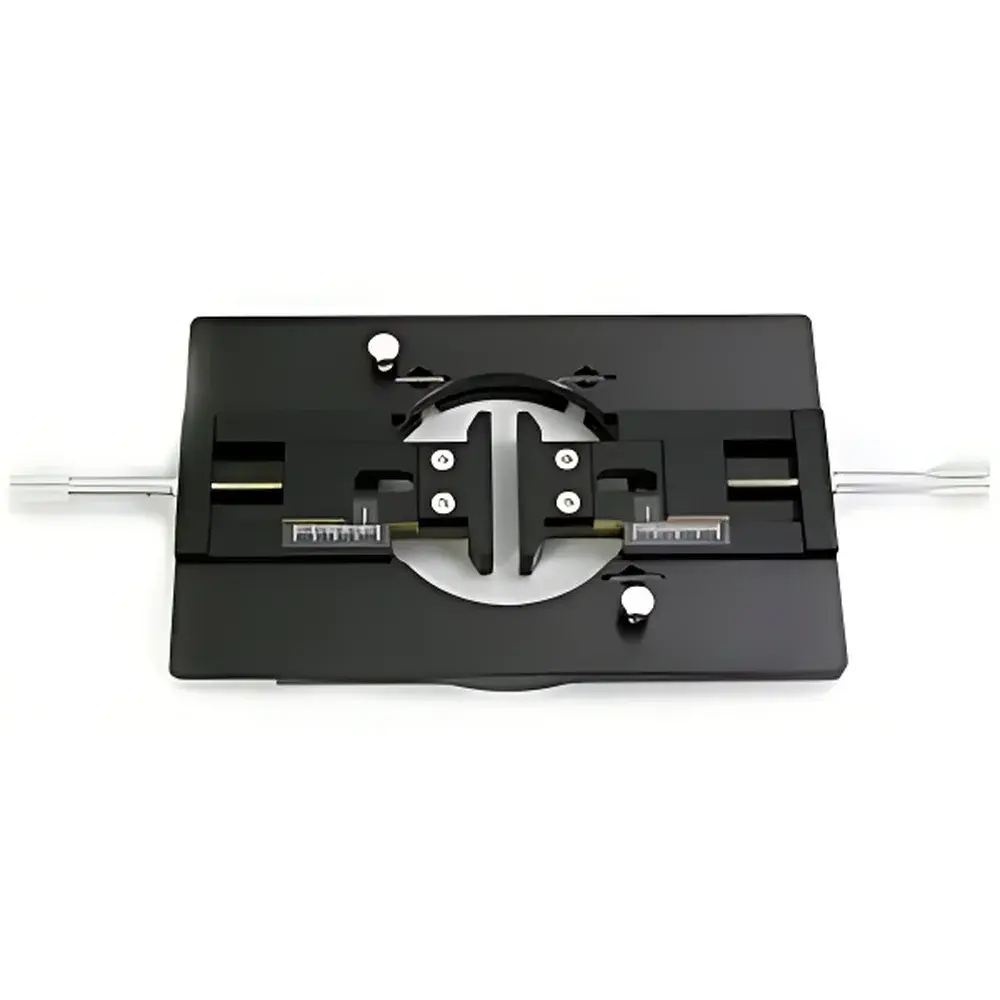
Micro Vice for Microscopy Sample Mounting – S.T. Japan

| Brand | S.T. Japan |
|---|---|
| Origin | Japan |
| Model | Micro Vice |
| Type | Precision Microscopy Sample Holder & Rotational Stage Accessory |
| Mounting Compatibility | Standard Microscope Stage (e.g., Nikon, Olympus, Zeiss, Leica) |
| Angular Adjustment | 0° (horizontal), 15°, and 30° fixed-angle positions |
| Material | Stainless Steel (AISI 304) with Hard-Anodized Aluminum Base |
| Clamping Force Range | 0.2–5 N (adjustable via micrometer screw) |
| Minimum Sample Thickness | 10 µm |
| Maximum Sample Width | 25 mm |
| Repeatability | ±0.5° rotational alignment |
| Weight | 85 g |
Ask about pricing, availability and specifications.
Overview
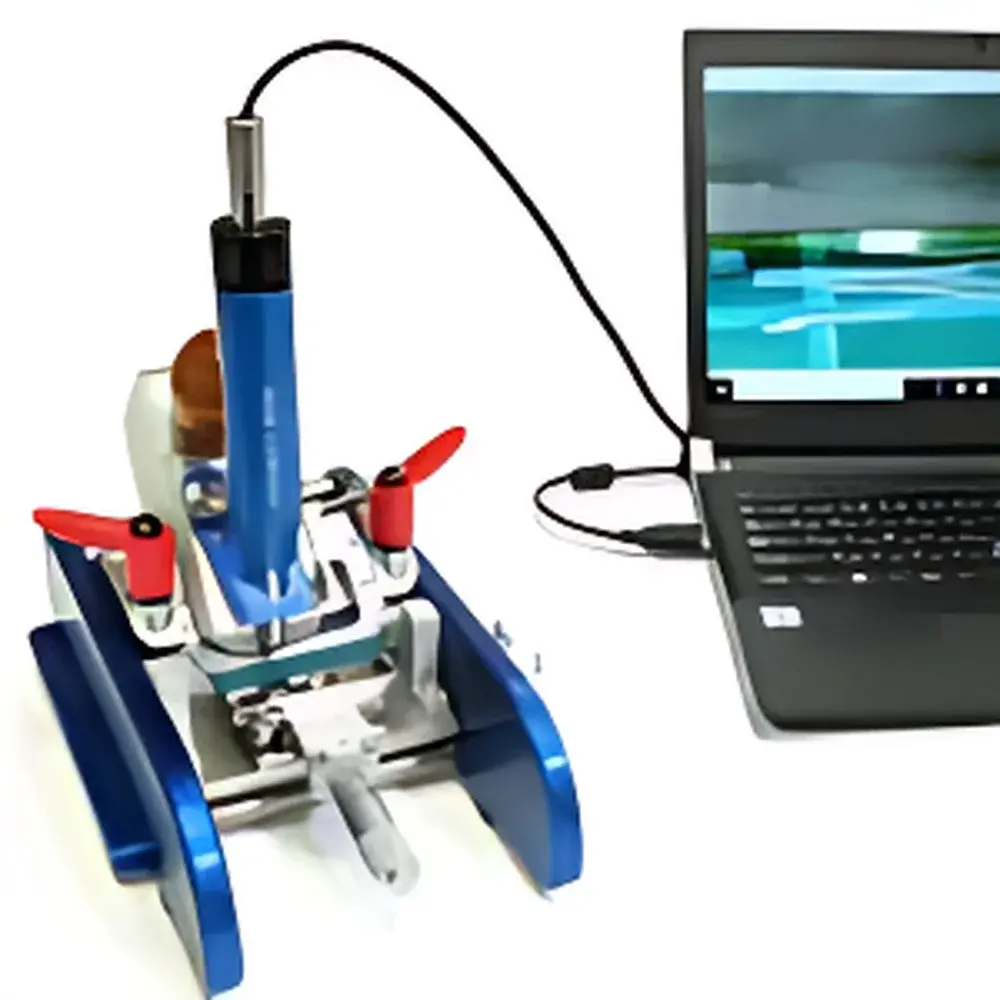
The Micro Vice for Microscopy Sample Mounting – S.T. Japan is a precision-engineered mechanical accessory designed to enhance positional control and angular reproducibility during micro-scale spectroscopic and imaging analyses. Unlike generic stage clamps, this device integrates dual functionality: fine translational sample fixation and discrete angular orientation (0°, 15°, and 30°), enabling controlled cross-sectional exposure of thin films, multilayer stacks, and anisotropic specimens under optical, Raman, or FTIR microscopes. Its operation relies on passive mechanical constraint—no motors, electronics, or software interface—ensuring electromagnetic compatibility, vacuum compatibility (up to 10⁻³ Pa), and thermal stability across ambient to 60 °C operating ranges. The vice is calibrated for minimal hysteresis in clamping force (0.2–5 N range) and maintains sub-degree angular repeatability (±0.5°) over repeated positioning cycles, critical for layer-resolved depth profiling and oblique-angle reflectance measurements.
Key Features
- Precision micrometer-driven clamping mechanism with tactile feedback and engraved torque scale for consistent, non-destructive sample immobilization
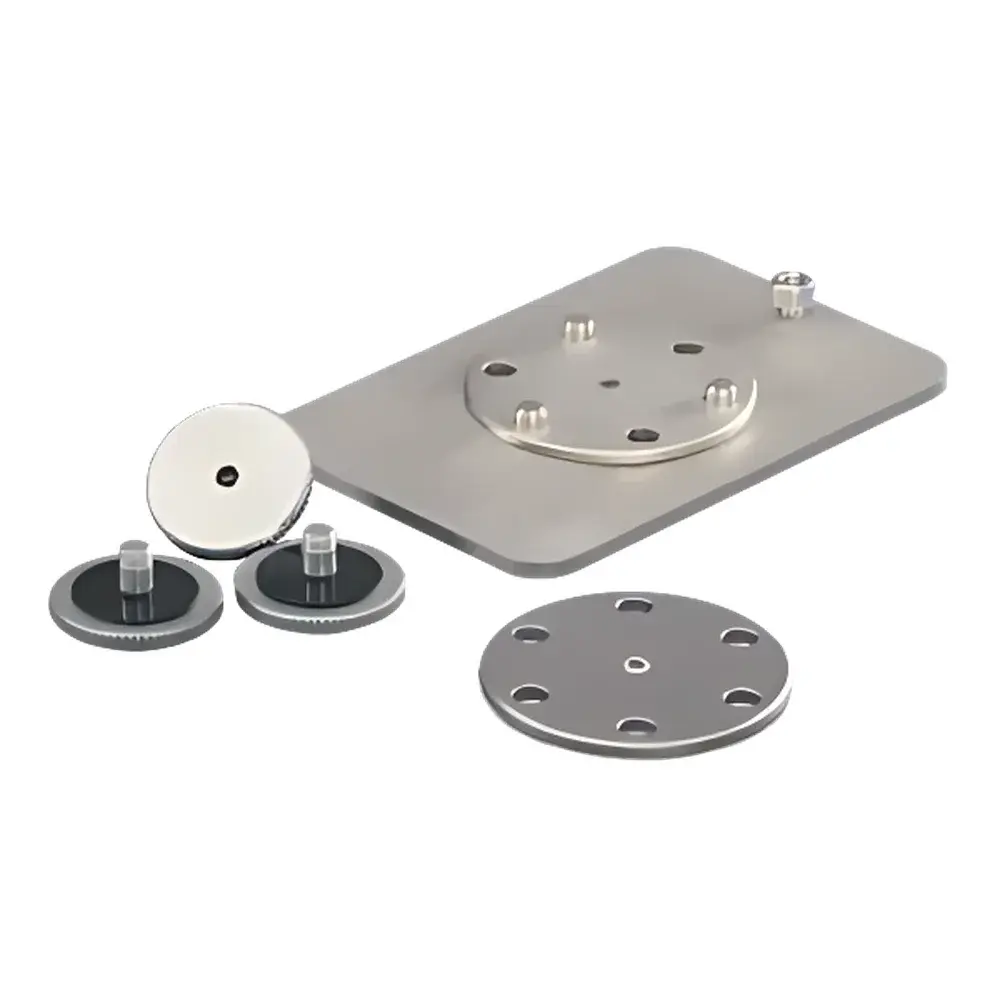
- Interchangeable angular base plates: three pre-calibrated orientation modules (0°, 15°, 30°) secured via M3 dowel-pin alignment for rapid reconfiguration without recalibration
- Modular mounting interface compliant with ISO 8039 standard microscope stage dovetails (width: 76 mm, groove depth: 3.5 mm)
- Corrosion-resistant construction: AISI 304 stainless steel jaws with 1.2 µm surface roughness (Ra) and hard-anodized aluminum base (6061-T6, 50 µm oxide layer)
- Zero-backlash rotational stage with integrated detent mechanism ensuring stable angular retention under vibration or stage drift
- Compact footprint (62 × 48 × 22 mm) optimized for confined space applications including inverted microscope configurations and confocal Raman platforms
Sample Compatibility & Compliance
The Micro Vice accommodates rigid and semi-rigid planar samples—including polymer films, metal foils, semiconductor wafers, glass substrates, and coated optics—with thicknesses from 10 µm to 1.2 mm and widths up to 25 mm. Its jaw geometry supports edge-clamping without obscuring central measurement zones, preserving optical access for objective-lens-based techniques. All materials comply with RoHS Directive 2011/65/EU and REACH Regulation (EC) No. 1907/2006. The device is routinely deployed in laboratories adhering to ISO/IEC 17025:2017 for testing and calibration competence, supporting documented traceability of angular positioning via included calibration certificate (NIST-traceable angle gauge verification). It meets mechanical safety requirements per IEC 61000-4-2 (ESD immunity) and IEC 60529 IP20 for indoor laboratory use.
Software & Data Management
As a purely mechanical positioning tool, the Micro Vice requires no firmware, drivers, or proprietary software. Angular orientation and clamping state are manually set and physically verified—eliminating software validation overhead and ensuring full compatibility with third-party acquisition platforms (e.g., Horiba LabSpec, Thermo OMNIC, Renishaw WiRE). Users integrate positional metadata directly into experiment logs using standardized fields (e.g., “Stage_Angle_deg”, “Clamp_Force_N”) within LIMS or ELN systems. For GLP/GMP environments, manual entry is supported by audit-trail-capable electronic lab notebooks (e.g., LabArchives, Benchling) that timestamp and attribute each positional configuration change.
Applications
- Cross-sectional Raman mapping of multilayer barrier films (e.g., PET/AlOx/SiOx stacks) at controlled incidence angles
- Angle-resolved FTIR transmission analysis of oriented polymer crystallinity
- Micro-reflectance profiling of graded optical coatings on silicon wafers
- In-situ tensile testing of freestanding nanomembranes mounted on rigid frames
- Controlled cleavage plane selection for TEM lamella preparation prior to FIB milling
- Reproducible alignment of anisotropic 2D materials (e.g., MoS₂, h-BN) under polarized optical microscopy
FAQ
Is the Micro Vice compatible with motorized microscope stages?
Yes—it mounts mechanically to standard dovetail or slot-based stages and does not interfere with automated XY/Z motion or autofocus functions.
Can it be used under vacuum or inert atmosphere?
Yes—its all-metal construction and absence of lubricants or elastomers permit use in vacuum chambers (10⁻³ Pa) and gloveboxes (N₂ or Ar environments).
Does S.T. Japan provide calibration documentation?
Each unit ships with a factory calibration report verifying angular accuracy against NIST-traceable angle blocks and clamping force linearity via calibrated load cell.
Are replacement angular base plates available separately?
Yes—part numbers for 0°, 15°, and 30° bases are listed in the S.T. Japan Spectroscopy Accessories Catalog (Rev. 2024), with lead time of 4–6 weeks ex-warehouse Osaka.
What is the maximum recommended clamping force for brittle samples like CaF₂ crystals?
For low-fracture-toughness substrates, we recommend limiting clamping force to ≤1.5 N, verified using the integrated torque scale; optional soft-jaw inserts (PTFE-coated, order code MV-SJ-01) are available upon request.