
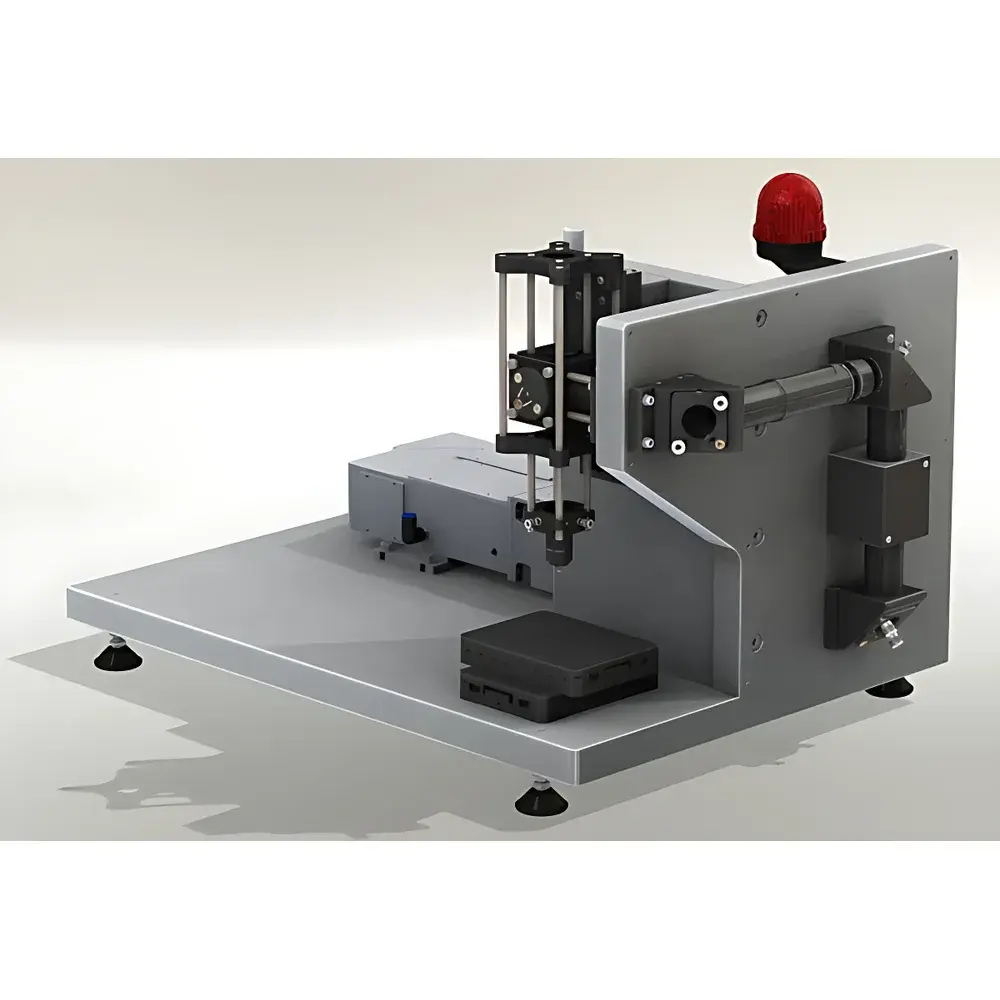
MicroLAB by ELAS – Compact Desktop Laser Micromachining System for Laboratory Research
| Brand | ELAS |
|---|---|
| Model | MicroLAB |
| Core Laser Source | EKSPLA NL200 Ultra-Compact Q-Switched Nd:YAG Laser |
| Wavelengths | 1064 nm (fundamental), 532 nm, 355 nm (harmonic options) |
| Pulse Energy | >0.9 mJ @ 1064 nm |
| Pulse Duration | ≤7 ns |
| Position Synchronization | Integrated PSO (Position Synchronized Output) |
| Motion Control | Physik Instrumente Piezo-Motor-Driven X-Y Stages |
| Control Platform | Dedicated Laptop-Based SCA Software Suite |
| Harmonic Switching | Automatic or Manual Selection of Up to 3 Harmonics |
| Stage Travel | Customizable X-Y Range |
| Application Scope | Micro-ablation, Surface & Bulk Marking, Biomedical Device Prototyping, Thin-Film Patterning, Solar Cell Scribing |
Overview
The MicroLAB by ELAS is a purpose-engineered desktop laser micromachining platform designed for precision material processing in academic, pharmaceutical, and industrial R&D laboratories. Built around the EKSPLA NL200 ultra-compact Q-switched Nd:YAG laser, the system delivers nanosecond-pulsed irradiation with high temporal stability and beam quality—enabling reproducible ablation, marking, and surface structuring across transparent, metallic, polymeric, and biological substrates. Its core architecture integrates time-resolved pulse delivery with spatially resolved motion control via Position Synchronized Output (PSO), ensuring each laser pulse is triggered only at pre-defined coordinates within the work envelope. This deterministic synchronization eliminates timing jitter between motion and lasing events—a critical requirement for high-fidelity micro-feature generation in applications such as stent scribing, cell scaffold fabrication, and photovoltaic selective emitter patterning.
Key Features
- Ultra-compact footprint (< 600 × 450 × 300 mm) optimized for benchtop integration in ISO Class 5–7 cleanrooms or shared lab environments.
- Triple-wavelength capability: Fundamental output at 1064 nm (≥0.9 mJ/pulse), plus harmonically generated 532 nm and 355 nm beams—selectable manually or automatically via motorized harmonic separator.
- Sub-micron positional repeatability achieved through Physik Instrumente piezo-motor-driven XY stages, engineered for low-vibration, high-acceleration scanning and step-and-repeat operation.
- SCA software suite with real-time PSO logic, enabling direct hardware-level coordination between stage encoder feedback and laser trigger signals—no external timing controllers required.
- Modular optical path design supporting optional beam expanders, telecentric F-theta lenses, and inline process monitoring modules (e.g., plasma emission detection).
- Compliance-ready architecture: All firmware logs include timestamped audit trails; SCA supports user role-based access control and configurable data export formats (CSV, HDF5, TIFF stack) for GLP/GMP-aligned documentation.
Sample Compatibility & Compliance
The MicroLAB accommodates samples up to 150 × 150 mm on its vacuum-compatible stage, with Z-height adjustability for focus optimization across thicknesses from 50 µm (thin films) to 10 mm (bulk ceramics). It has been validated for use with ISO 10993-compliant biomaterials (e.g., PEEK, Ti-6Al-4V, hydrogels), ASTM F2129-tested metallic implants, and IEC 61215-relevant solar cell substrates (Si, CIGS, perovskite layers). The system meets CE marking requirements under Directive 2006/42/EC (Machinery) and 2014/35/EU (LVD), with embedded laser safety interlocks compliant with IEC 60825-1:2014 Class 4 operational protocols. Full documentation—including risk assessment files, EC Declaration of Conformity, and laser classification reports—is provided with each unit shipment.
Software & Data Management
SCA (System Control & Ablation) software serves as the unified interface for laser parameter configuration, motion path programming (G-code or proprietary vector scripting), and real-time diagnostics. It implements FDA 21 CFR Part 11–compliant electronic signature workflows, including mandatory operator authentication, immutable audit logs of all parameter changes, and encrypted local storage of raw acquisition metadata (pulse count, energy monitor readings, stage position history). Exported datasets retain traceable linkage to calibration certificates (NIST-traceable energy meter calibration, stage encoder linearity verification), facilitating regulatory submissions under ISO 13485 or ICH M10 guidelines.
Applications
- Biomedical device prototyping: Selective ablation of polymer coatings on nitinol stents; microfluidic channel fabrication in PMMA and PDMS.
- Medical research: Intravital tissue marking in ex vivo murine models; laser-induced forward transfer (LIFT) of biomolecules onto functionalized substrates.
- Solar energy R&D: Edge isolation scribing of thin-film PV modules; selective contact opening in TOPCon and heterojunction architectures.
- Surface engineering: Functional micro-texturing of orthopedic implant surfaces to modulate osteoblast adhesion kinetics.
- In-volume modification: Non-linear absorption-driven internal waveguide writing in fused silica and phosphate glasses.
FAQ
Is the MicroLAB compatible with third-party motion stages or laser sources?
Yes—SCA supports standard RS-232, USB CDC, and Ethernet-based communication protocols. OEM integration kits (including API documentation and DLL libraries) are available upon request for custom hardware interfacing.
What maintenance intervals are recommended for the NL200 laser module?
EKSPLA specifies 10,000 hours of diode pump lifetime under nominal operating conditions. Annual preventive maintenance includes cavity alignment verification, thermal lensing characterization, and flashlamp replacement if applicable (model-dependent).
Can PSO functionality be used with arbitrary motion profiles, such as circular or spiral trajectories?
Yes—SCA accepts parametric curve definitions (e.g., Archimedean spirals, Bézier curves) and dynamically calculates equidistant trigger points along the path based on user-defined pulse spacing and velocity constraints.
Does the system support real-time process monitoring during ablation?
The base configuration includes TTL-triggered external camera synchronization. Optional add-ons include spectrally resolved plasma emission sensors (200–1100 nm) and high-speed CMOS imaging modules (up to 1 MHz framing rate) for melt pool dynamics analysis.
Are calibration certificates included with shipment?
Each system ships with NIST-traceable calibration reports for pulse energy (at all wavelengths), beam pointing stability (±2 µrad over 8 hours), and stage positioning accuracy (±0.5 µm over full travel range), all performed in accordance with ISO/IEC 17025-accredited procedures.





