
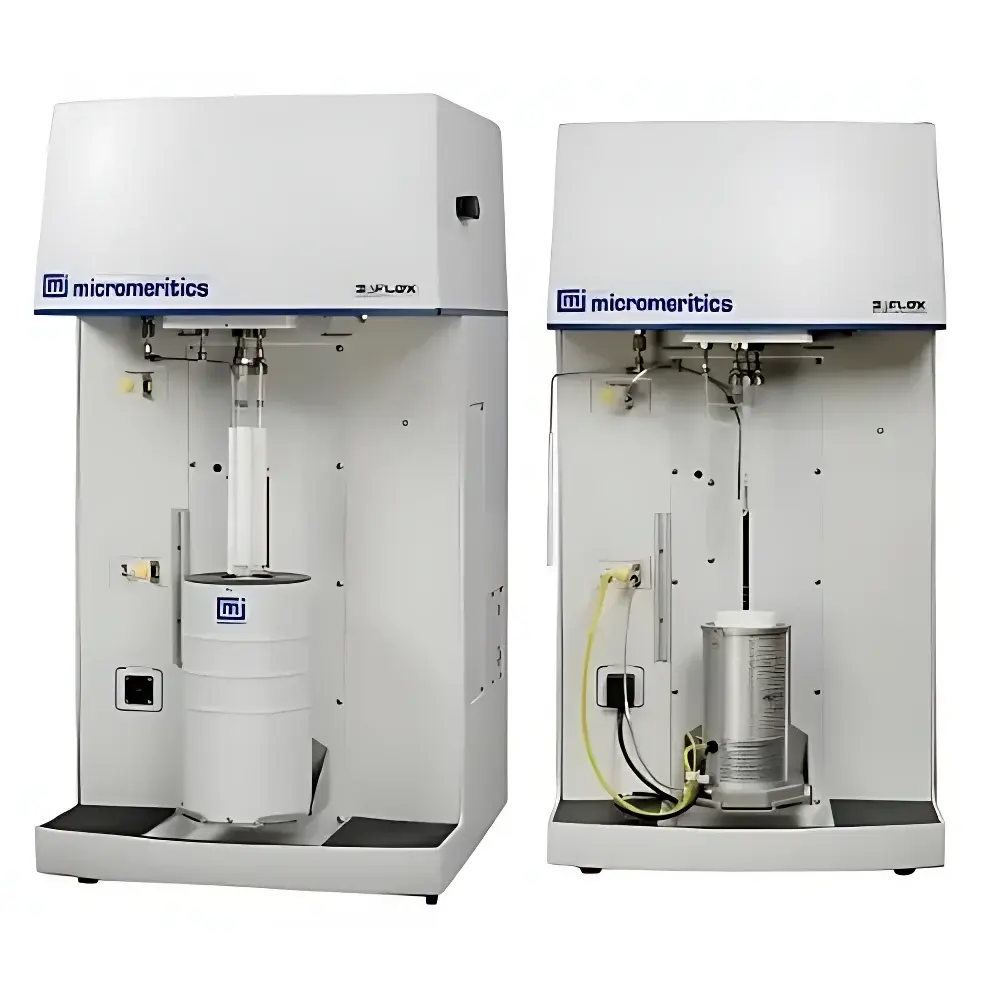
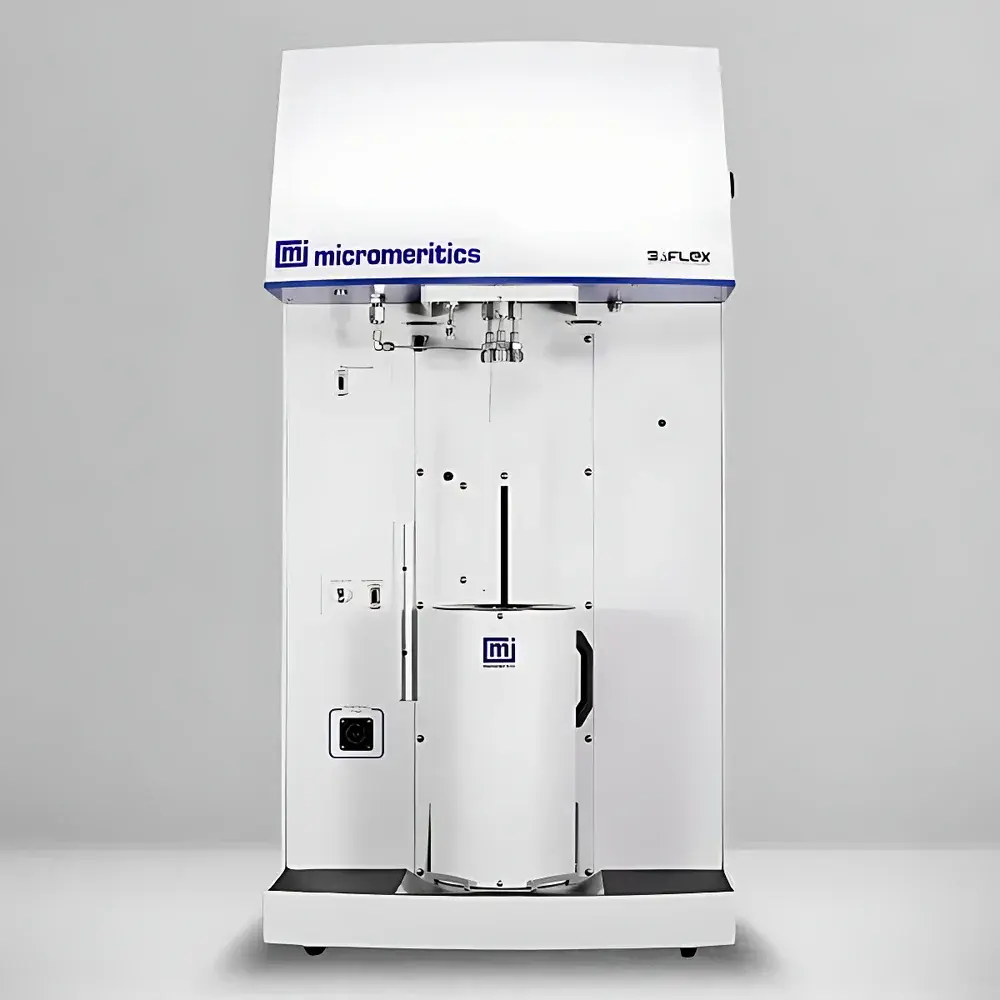
Micromeritics 3Flex Series Tri-Station Advanced Gas Sorption Analyzer
| Brand | Micromeritics |
|---|---|
| Origin | USA |
| Model | 3Flex Series |
| Instrument Type | Physical & Chemical Sorption Analyzer |
| Measurement Principle | Static Volumetric Method |
| Number of Gas Inlet Ports | 16 |
| High-Temperature Furnace Range | Up to 1100 °C |
| Pressure Range | P/P₀ down to 10⁻⁹ |
| Core Functional Capabilities | High-Precision TPR, TPO, and TPD Analysis |
| Sensor Resolution | 29-bit A/D Conversion |
| Manifold Architecture | Independently temperature-controlled (45 °C)歧管, P₀ tube, and analysis stations |
| Vacuum Control | Servo-Valve-Actuated Automated Gas Dosing & Evacuation |
| Sealing Standard | 316 Stainless Steel VCR Fittings |
| Optional Modules | Steam Sorption (H₂O & Organic Vapors), Kr Adsorption for Low-Surface-Area Materials, TCD-Based Chemisorption |
Overview
The Micromeritics 3Flex Series Tri-Station Advanced Gas Sorption Analyzer is a high-precision, static volumetric sorption platform engineered for comprehensive surface area, pore size distribution (micropore to mesopore), and chemically resolved adsorption/desorption characterization. It operates on the gravimetrically referenced static manometric principle—measuring equilibrium gas uptake at precisely controlled pressures and temperatures across three independent analysis stations. Designed for rigorous materials science and catalysis research, the 3Flex delivers reproducible isotherms down to P/P₀ = 10⁻⁹, enabling accurate micropore volume quantification via t-plot, DR, HK, and DA methods per ISO 15901-2 and ASTM D6556. Its integrated high-temperature furnace (up to 1100 °C) supports in situ thermal pretreatment and dynamic chemisorption experiments under controlled atmospheres.
Key Features
- Tri-station parallel architecture: Simultaneous physical adsorption analysis on three samples—enabling throughput optimization without cross-contamination or sequential delay.
- Ultra-high vacuum integrity: All manifold lines, P₀ reference tubes, and analysis cells maintained at 45 °C to eliminate condensation artifacts and ensure thermodynamic consistency; sealed with 316SS VCR fittings for leak-tight performance (<1×10⁻⁹ mbar·L/s).
- 29-bit high-resolution pressure transducers: Deliver sub-micropascal sensitivity across the full 0–133 kPa range, critical for low-pressure (<10⁻³ kPa) micropore filling detection.
- Servo-valve gas delivery system: Enables automated, stepwise dosing and evacuation with <±0.05% pressure setpoint accuracy—essential for reproducible monolayer formation and incremental isotherm construction.
- Modular expandability: Factory-integrated options include Kr adsorption for surfaces <1 m²/g (per ISO 9277), steam sorption modules (H₂O, ethanol, toluene) compliant with ISO 15916, and TCD-based chemisorption for dynamic temperature-programmed experiments.
Sample Compatibility & Compliance
The 3Flex accommodates solid powders, pellets, monoliths, and supported catalysts (0.05–2 g typical mass). Sample holders are compatible with standard quartz U-tubes and crucibles rated for 1100 °C operation. The system meets GLP/GMP documentation requirements through audit-trail-enabled software logging (21 CFR Part 11 compliant when paired with validated MicroActive Enterprise). All physical adsorption measurements adhere to ISO 9277 (BET surface area), ISO 15901-1 (mesopore analysis), and ISO 15901-2 (micropore analysis). Chemisorption protocols align with ASTM E1783 (TPD), ASTM D7215 (TPR), and IUPAC recommendations for catalyst characterization.
Software & Data Management
MicroActive software provides interactive, standards-compliant data reduction—including automatic BET linear range selection, t-plot slope validation, and DFT/NLDFT kernel selection (carbon, silica, alumina models). Users generate customizable reports with embedded uncertainty propagation (based on transducer calibration certificates and mass measurement traceability to NIST SRM). Real-time instrument diagnostics monitor valve actuation cycles, pressure drift rates, temperature stability (±0.1 °C), and vacuum decay—flagging deviations before data acquisition proceeds. Raw data files (.3FX) are ASCII-exportable for third-party modeling (e.g., MATLAB, Python SciPy) and long-term archival per ISO/IEC 17025 clause 7.5.3.
Applications
- Catalyst development: Quantifying active metal dispersion via H₂ or CO pulse chemisorption; evaluating reducibility (TPR), oxidation state stability (TPO), and acid site strength/distribution (NH₃-TPD).
- Energy materials: Characterizing MOFs and COFs for gas storage (H₂, CH₄, CO₂) using sub-ambient isotherms and isosteric heat mapping.
- Pharmaceutical excipients: Assessing moisture sorption hysteresis (ISO 15916) and surface energetics of amorphous APIs.
- Environmental sorbents: Determining micropore volume and surface heterogeneity of activated carbons for VOC capture.
- Advanced ceramics: Measuring sintering-induced pore closure kinetics via in situ isotherm series at elevated temperatures.
FAQ
What distinguishes the 3Flex from single-station sorption analyzers?
Its tri-station design enables statistically robust replicate analysis or multi-condition screening (e.g., different pretreatment temperatures) within a single run—reducing inter-run variability and accelerating method development.
Can the 3Flex perform both physisorption and chemisorption on the same sample without hardware reconfiguration?
Yes—via software-selectable gas sequences and temperature ramps; the TCD module integrates seamlessly into the same manifold, allowing sequential or hybrid isotherm + TPR workflows without manual valve changes.
Is calibration traceable to national standards?
All pressure transducers are factory-calibrated against NIST-traceable deadweight testers; mass flow controllers are certified per ISO/IEC 17025 by an A2LA-accredited lab.
How does the system handle data integrity for regulated environments?
MicroActive Enterprise supports electronic signatures, role-based access control, and immutable audit trails—including user actions, parameter edits, and raw sensor outputs—fully aligned with FDA 21 CFR Part 11 and EU Annex 11 requirements.
What sample preparation accessories are available?
Vacuum degassing stations with programmable ramp/soak profiles, liquid nitrogen auto-fill dewars with level monitoring, and high-vacuum turbomolecular pumps (10⁻⁸ mbar base pressure) are optional OEM-integrated configurations.



