
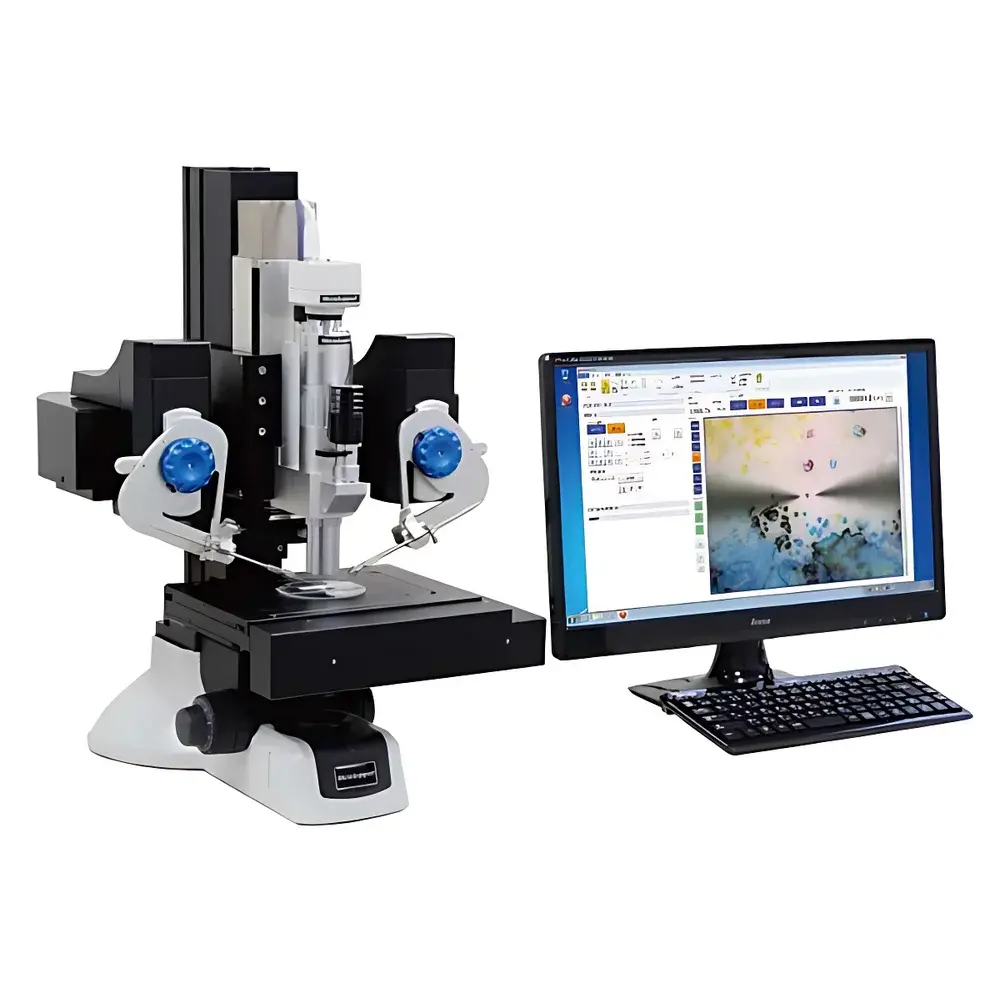
MicroSupport Axis Pro Micro-Sampling System
| Origin | Japan |
|---|---|
| Manufacturer Type | Authorized Distributor |
| Origin Category | Imported |
| Model | Axis Pro |
| Pricing | Available Upon Request |
Overview
The MicroSupport Axis Pro Micro-Sampling System is a precision-engineered, motorized micro-manipulation platform designed for non-destructive, high-fidelity isolation and exposure of sub-millimeter specimens in preparation for advanced analytical characterization. Operating under optical or electron microscopy guidance (e.g., SEM, optical stereomicroscopy), the system employs closed-loop piezoelectric actuators and programmable XYZ-θ rotational stages to achieve micron-level positional repeatability (<±0.5 µm) and angular control (±0.1°). Its core function is to resolve critical sample-access challenges inherent to micro-analytical workflows—such as buried, overlaid, agglomerated, or embedded particles—where conventional macro-scale tools fail due to mechanical interference, thermal damage, or spatial inaccessibility. Unlike manual micro-dissection or FIB-only approaches, the Axis Pro integrates mechanical, ultrasonic, vacuum, and electrostatic handling modalities within a single coordinated platform, enabling sequential, multi-step sample conditioning without transfer-induced contamination or structural compromise. It is routinely deployed upstream of FTIR microscopy, Raman mapping, XRD micro-diffraction, SEM-EDS, and TEM lamella preparation—particularly where regulatory traceability, minimal sample perturbation, and documented procedural reproducibility are required.
Key Features
- Modular, tool-agnostic architecture supporting rapid interchange of 12+ certified micro-handling modules—including tungsten micro-probes, diamond-coated ultrasonic milling tips, silicon-nitride micro-tweezers, electrostatic particle collectors, vacuum micro-suction nozzles, and sapphire micro-knives.
- Integrated real-time coordinate registration: All tool positions and sample manipulations are logged with timestamped stage coordinates (X, Y, Z, θ), compatible with downstream image correlation in SEM/TEM software suites (e.g., Thermo Fisher Avizo, Zeiss SmartSEM).
- Programmable multi-axis motion sequences: Users define repeatable trajectories (e.g., “lift-and-rotate”, “peel-and-transfer”, “scan-and-collect”) via intuitive GUI; motion profiles support acceleration ramping to prevent inertial displacement of fragile specimens.
- Optical compatibility: Designed for seamless integration with inverted and upright microscopes (Leica, Olympus, Zeiss); includes standardized dovetail mounts and parfocal alignment references for sub-µm co-registration between sampling and imaging fields-of-view.
- GLP-compliant operation: Audit trail logging (user ID, timestamp, tool ID, motion parameters) meets requirements for ISO/IEC 17025-accredited laboratories and FDA 21 CFR Part 11–aligned data integrity frameworks.
Sample Compatibility & Compliance
The Axis Pro accommodates specimens ranging from isolated nanoparticles (<100 nm) to multilayer thin-film stacks (up to 500 µm thick) and heterogeneous composite cross-sections (e.g., OLED stacks, battery electrode laminates, polymer packaging films). Compatible substrates include Si wafers, TEM grids, conductive carbon tape, glass slides, and flexible polymer foils. All contact tools meet ISO 8502-3 cleanliness standards for particulate-free handling. The system complies with IEC 61000-6-2 (EMC immunity) and IEC 61010-1 (safety for laboratory equipment). Tool sterilization protocols (e.g., plasma cleaning, UV-ozone treatment) are validated per ISO 14644-1 Class 5 cleanroom requirements when used in semiconductor or pharmaceutical QC environments.
Software & Data Management
Control is executed via MicroSupport’s proprietary AxisControl v4.2 software, running on Windows 10/11 x64 with TLS 1.2 encryption. The software provides dual-mode operation: guided wizard-based workflows for routine tasks (e.g., “FIB Lamella Transfer”, “Contaminant Isolation”) and scriptable Python API access (via PyAxis SDK) for custom automation. All manipulation logs export in CSV and HDF5 formats, preserving hierarchical metadata (tool calibration coefficients, environmental sensor readings, operator annotations). Raw coordinate data is natively importable into MATLAB, Python (NumPy/Pandas), and commercial metrology platforms (e.g., Bruker NanoScope Analysis, Oxford AZtec).
Applications
- Failure analysis of display panels: Selective delamination and extraction of individual pixel-layer contaminants (e.g., metal flakes, organic residues) from AMOLED or micro-LED architectures prior to TOF-SIMS or nano-FTIR.
- Pharmaceutical solid dosage form investigation: Isolation of excipient-drug interface particles from compressed tablets for Raman chemical mapping and polymorph identification.
- Automotive battery R&D: Precise sectioning of SEI layers from cycled anode cross-sections for TEM-EDX line scans and electron energy-loss spectroscopy (EELS).
- Forensic trace evidence: Electrostatic collection and transfer of sub-500 nm textile fibers onto SiN membranes for subsequent SEM-EDS elemental fingerprinting.
- FIB-SEM workflow acceleration: Automated rotation and repositioning of pre-thinned TEM lamellae onto Omniprobe lift-out posts, reducing manual intervention time by >70% versus conventional micromanipulators.
FAQ
Is the Axis Pro compatible with existing SEM/FIB systems from Thermo Fisher, Zeiss, or Hitachi?
Yes—standardized mounting interfaces (M4 and M6 threaded holes, ±0.02 mm flatness tolerance) and RS-232/Ethernet communication protocols ensure plug-and-play integration with all major FIB-SEM platforms.
Can tool wear be monitored and compensated automatically?
Each tool module contains embedded RFID tags storing calibration history, tip geometry profiles, and usage counters; software triggers alerts at predefined wear thresholds and applies dynamic offset correction during motion planning.
Does the system support remote operation for cleanroom or hazardous environment deployment?
Fully supported via secure VNC-over-HTTPS with role-based access control (RBAC); optional fiber-optic stage feedback loop eliminates EMI concerns in MRI-adjacent or high-voltage lab settings.
What validation documentation is provided for regulated industries?
Includes Factory Acceptance Test (FAT) report, IQ/OQ protocol templates aligned with ASTM E2500 and USP , and electronic calibration certificates traceable to NIST SRM 2036.



