MicroVacuum OWLS 3000 Optical Waveguide Lightmode Spectroscopy Analyzer
| Origin | Imported |
|---|---|
| Manufacturer Type | Authorized Distributor |
| Detection Range | DNA, proteins, lipids, and other biomolecules |
| Sample Volume | 0.1–2 mL |
| Injection Volume | Adjustable (50–500 µL typical) |
| Analysis Time | Real-time, down to 1 ms resolution (Biosense 2.5 software) |
| Temperature Control Range | 4–80 °C ± 0.1 °C |
| Detection Limit | <1 ng/cm² |
| Compliance | ISO/IEC 17025-ready architecture, supports GLP/GMP audit trails per FDA 21 CFR Part 11 |
Overview
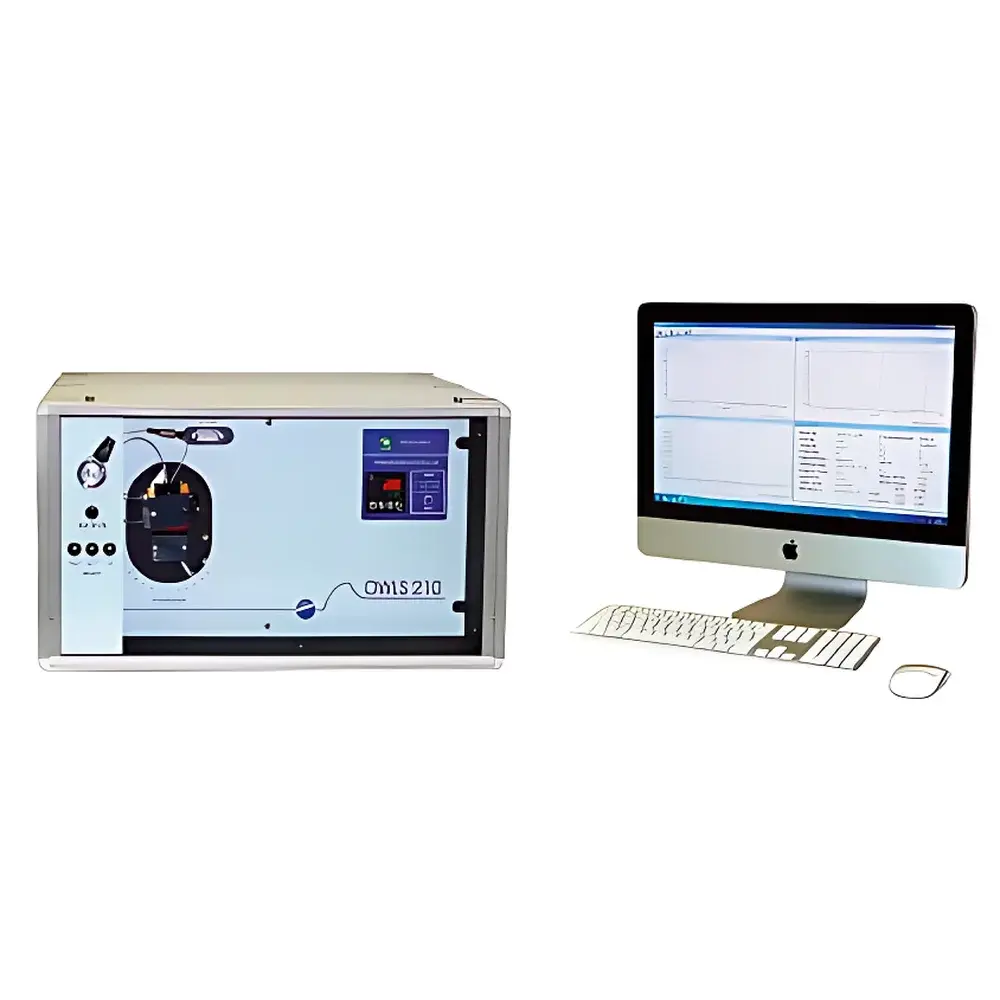
The MicroVacuum OWLS 3000 is a label-free, real-time optical biosensor platform based on Optical Waveguide Lightmode Spectroscopy (OWLS), engineered for quantitative analysis of molecular interactions at solid–liquid interfaces. Unlike surface plasmon resonance (SPR) or ellipsometry, OWLS operates via guided-mode excitation in a planar titanium dioxide or SiO₂ waveguide layer using a diffraction grating-coupled, p-polarized laser beam. As biomolecules adsorb onto the functionalized waveguide surface, they induce measurable shifts in the effective refractive index (neff) and propagation angle of the guided mode—parameters directly linked to both adsorbed mass density (Γ, in ng/cm²) and layer thickness (dA, in nm) through Feijter’s formalism. This dual-parameter output enables absolute quantification without calibration curves or fluorescent tags, supporting rigorous kinetic modeling (kon, koff, KD) under physiologically relevant conditions. The system is optimized for low-noise, high-stability operation across temperature-controlled microfluidic flow cells, making it suitable for demanding applications in biopharmaceutical characterization, membrane biophysics, and regulatory-compliant assay development.
Key Features
- Label-free, real-time monitoring of binding events with sub-ng/cm² mass sensitivity
- Dual-parameter output: simultaneous determination of adsorbed layer thickness (dA) and refractive index (nA) from angular mode shifts
- High-precision thermostatic control (4–80 °C, ±0.1 °C stability) integrated with laminar-flow microfluidics
- Sub-second temporal resolution (down to 1 ms with Biosense 2.5 software) for rapid kinetic profiling
- Modular sensor chip design: compatible with amine-, thiol-, streptavidin-, Ni-NTA-, and lipid bilayer-functionalized surfaces
- Automated baseline stabilization, buffer referencing, and regeneration cycles—minimizing operator dependency
- Robust optical architecture with thermally stabilized HeNe laser source and high-resolution angular encoder
Sample Compatibility & Compliance
The OWLS 3000 accommodates a broad range of biological analytes—including monoclonal antibodies, recombinant proteins, oligonucleotides, glycoproteins, exosomes, and supported lipid bilayers—without chemical modification. Its non-destructive, surface-confined detection mechanism preserves native conformation and activity. The system meets foundational requirements for regulated environments: data integrity is ensured via electronic signatures, time-stamped audit trails, and user-access controls aligned with FDA 21 CFR Part 11. Instrument qualification documentation (IQ/OQ/PQ) templates are provided, and the platform supports traceable calibration against NIST-traceable refractive index standards. It complies with ISO 10993-5 (cytotoxicity screening) and ASTM F2623 (surface characterization of biomaterials), facilitating use in preclinical safety assessment and IVD assay validation.
Software & Data Management
Biosense 2.5 software provides a validated, Windows-based environment for instrument control, data acquisition, and kinetic modeling. Key modules include: (1) Auto-calibration workflow for waveguide parameter initialization (nwg, dwg); (2) Real-time overlay of multiple sensorgrams with drift correction; (3) Global fitting engine supporting 1:1 Langmuir, bivalent analyte, heterogeneous ligand, and mass-transport-limited models; (4) Export to CSV, Excel, and GRAMS/AI formats; (5) Role-based user management with password-protected method locking. All raw data files are stored in encrypted, timestamped binary format with SHA-256 checksum verification—ensuring full traceability from acquisition to final report generation.
Applications
- Quantitative epitope binning and affinity ranking of therapeutic antibodies
- In situ formation and stability assessment of tethered lipid bilayers (SLBs) and polymer-cushioned membranes
- Real-time monitoring of DNA hybridization kinetics and mismatch discrimination
- Characterization of protein–small molecule interactions in fragment-based drug discovery
- Toxicity screening of nanomaterials via protein corona formation kinetics
- Development of label-free ELISA alternatives compliant with USP endotoxin interference testing guidelines
- Validation of biosimilar binding equivalence per ICH Q5E and Q5C
FAQ
How does OWLS differ fundamentally from SPR in terms of physical principle and data interpretation?
OWLS measures guided-mode angular shifts induced by changes in effective refractive index at the waveguide surface, enabling direct calculation of both mass density and thickness. SPR relies on evanescent field coupling to surface plasmons in gold films, yielding only a single resonance shift that correlates indirectly with mass and is highly sensitive to bulk RI changes.
Can the OWLS 3000 be used for kinetic analysis of low-affinity interactions (KD > 10 µM)?
Yes—the system’s low intrinsic noise floor and high angular resolution support reliable koff determination even for transient interactions, especially when combined with multi-cycle regeneration and high-concentration analyte injection protocols.
Is surface regeneration repeatable across >100 binding–regeneration cycles?
With appropriate chemistry (e.g., mild glycine-HCl pH 2.5 or 10 mM NaOH), TiO₂-coated chips maintain >95% baseline recovery over 200+ cycles; lifetime exceeds 500 cycles under optimized conditions.
Does the system support 384-well plate integration or automated liquid handling?
While the OWLS 3000 uses discrete flow-cell cartridges, it is compatible with third-party autosamplers (e.g., Cytiva ÄKTA systems) via TTL-triggered start/stop signals and analog voltage output for external synchronization.
What level of training is required for routine operation and data analysis?
Basic operation requires ≤2 days of hands-on training; advanced kinetic modeling and assay development typically involve an additional 3-day workshop led by certified application scientists.