
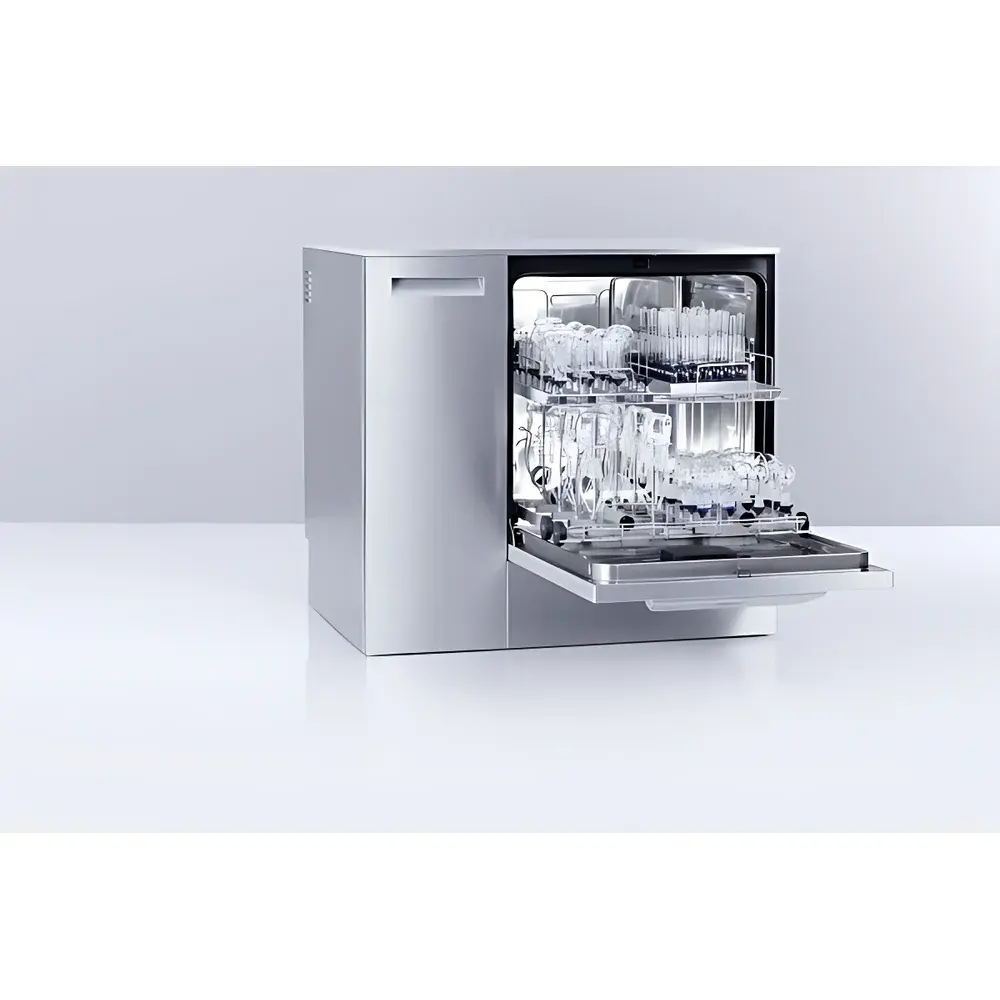
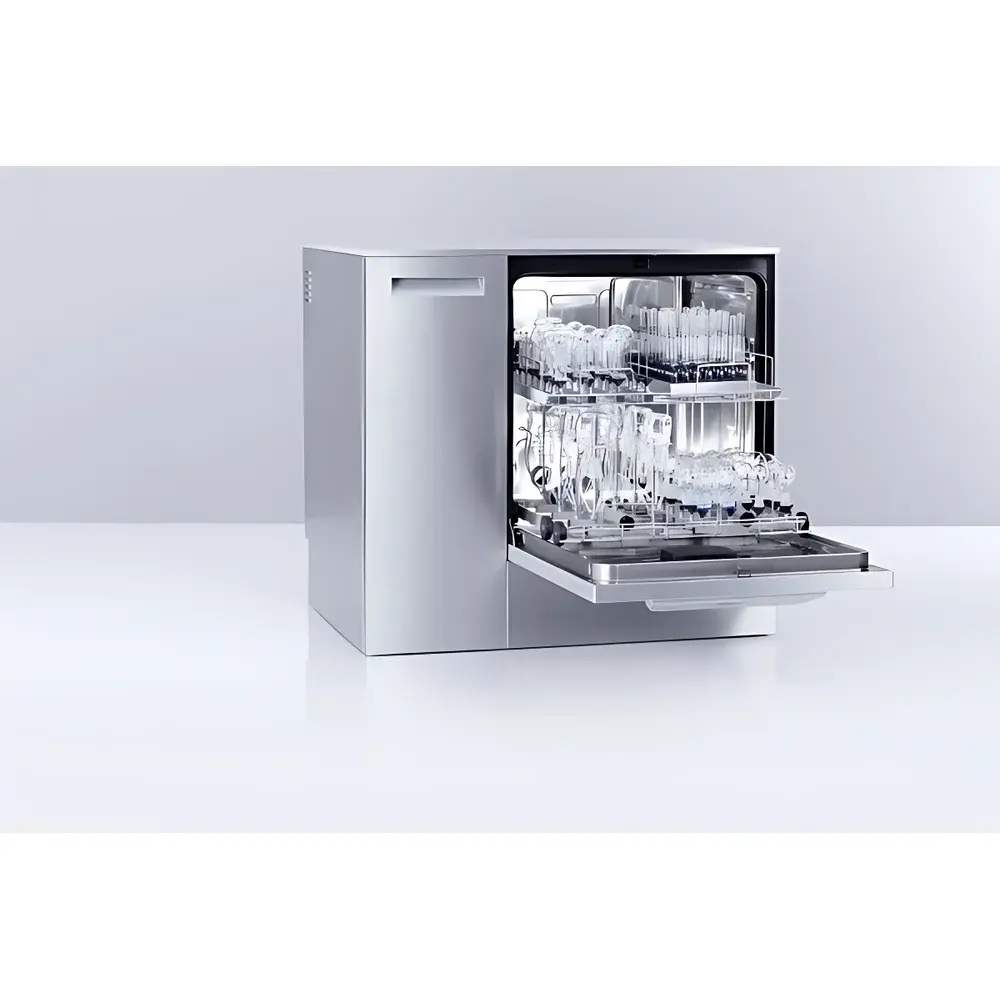
Miele PG8583CD Laboratory Bottle Washer
| Brand | Miele |
|---|---|
| Origin | Germany |
| Model | PG8583CD |
| Chamber Volume | 175 L |
| Heating Power | Not Specified |
| Temperature Range | 10–93 °C |
| Detergent Capacity | 5 L / 10 L (dual reservoir) |
| External Dimensions (L×W×D) | 835 × 900 × 600 mm |
| Water Softening System | Integrated WES |
| Control System | Fully Programmable PLC-Based Interface |
| Circulation Pump Flow Rate | 500 L/min |
| Built-in Dosing Pumps | Yes |
| Drawer-Type Detergent Dispenser | Yes |
| Drying Method | DryPlus HEPA-Filtered Hot Air |
| Conductivity Monitoring | Real-time Rinse Water Conductivity Sensor |
| Load Capacity | 280 volumetric flasks OR 1,600 test tubes OR 98 pipettes + 32 volumetric flasks OR 196 HPLC vials + 64 volumetric flasks |
Overview
The Miele PG8583CD is a high-capacity, fully programmable laboratory bottle washer engineered for reproducible, validated cleaning of critical glassware and instrumentation components in regulated environments. Designed according to ISO 15883-1 (washer-disinfectors for medical devices) and aligned with Good Laboratory Practice (GLP), Good Manufacturing Practice (GMP), and FDA 21 CFR Part 11 requirements, the PG8583CD integrates precision fluid dynamics, thermal control, and automated documentation into a single platform. Its operation relies on a closed-loop recirculation system delivering 500 L/min of heated, filtered wash solution at precisely controlled temperatures (10–93 °C), ensuring removal of organic residues, inorganic salts, proteins, and microbial contaminants across diverse sample matrices. The unit’s 175-liter chamber accommodates large-volume or high-mix loads—common in pharmaceutical QC labs, clinical diagnostics, environmental testing, and academic research facilities—while maintaining mechanical stability and thermal uniformity throughout each cycle.
Key Features
- Integrated WES (Water Efficiency System) built-in water softener prevents scale formation and extends component service life without external softening infrastructure.
- DryPlus drying module employs HEPA-filtered hot air (up to 93 °C) with adjustable duration and airflow profiles, minimizing residual moisture and preventing recontamination during cooling.
- Real-time conductivity monitoring of final rinse water provides objective, traceable evidence of detergent removal—critical for residue validation per ICH Q5C and USP .
- Modular drawer-type detergent dispensing system supports dual reservoirs (5 L and 10 L) for sequential or parallel dosing of alkaline, acidic, and enzymatic formulations.
- Programmable PLC-based control interface enables creation, storage, and audit-trail logging of up to 99 user-defined cycles—including pre-wash, main wash, intermediate rinse, neutralization, final rinse, and drying phases.
- Full chamber interlock mechanism ensures mechanical and electrical safety compliance during operation; door remains locked until temperature and pressure conditions fall within safe thresholds.
Sample Compatibility & Compliance
The PG8583CD processes a broad spectrum of laboratory vessels—including volumetric flasks (up to 2 L), borosilicate test tubes, serological pipettes, HPLC vials, Petri dishes, centrifuge tubes, and reusable chromatography columns—without requiring manual repositioning. Racks and carriers are configurable to ISO-standard dimensions and compatible with autoclavable polymer trays. All cleaning programs can be validated per ASTM E3083-17 (Standard Guide for Validation of Automated Cleaning Processes for Laboratory Glassware) and support IQ/OQ/PQ protocols. Cycle data—including time stamps, temperature curves, conductivity logs, pump pressure, and door status—is exportable in CSV or PDF format with digital signature capability for regulatory submission.
Software & Data Management
The embedded control software records all operational parameters with timestamped, tamper-evident audit trails compliant with FDA 21 CFR Part 11 Annex 11 and EU GMP Annex 11. User access levels (Operator, Supervisor, Administrator) are enforced via password and optional RFID authentication. Remote diagnostics and firmware updates are supported via Ethernet connection. Data export includes full cycle reports with pass/fail indicators based on preset conductivity and temperature thresholds. Optional integration with LIMS or MES systems is available through OPC UA or Modbus TCP protocols.
Applications
- Pharmaceutical quality control laboratories performing extractables/leachables studies and container-closure integrity testing.
- Clinical microbiology labs requiring sterile, endotoxin-free glassware for culture media preparation and assay calibration.
- Environmental testing facilities processing soil extracts, wastewater samples, and heavy-metal digestates under EPA Method 3005A/3015A guidelines.
- Academic research groups conducting trace-metal analysis (ICP-MS, AAS) where sub-ppt contamination must be excluded.
- Biotechnology manufacturing sites validating cleaning procedures for multi-product bioreactor accessories and sampling tools.
FAQ
Does the PG8583CD support automated validation reporting?
Yes—each cycle generates a digitally signed report containing temperature profiles, conductivity decay curves, pump performance metrics, and operator identification, meeting ALCOA+ data integrity principles.
Can detergent concentration be adjusted per phase within a single program?
Yes—the dual-reservoir dosing system allows independent volume and timing control for up to four different chemical agents across wash, neutralization, and rinse stages.
Is HEPA filtration mandatory for the DryPlus system?
Yes—HEPA H14 filtration is integrated as standard to ensure particulate-free drying air, essential for ISO Class 5 cleanroom-compatible operations.
What documentation is provided for installation qualification (IQ)?
Miele supplies factory-certified IQ templates, utility interface diagrams, and material-of-construction declarations (316L stainless steel chamber, EPDM seals, NSF-listed plastics) compliant with ISO 13485 and GAMP5.
How is water hardness monitored and compensated during operation?
The WES system continuously measures inlet water conductivity and automatically adjusts regeneration cycles and salt dosing—no manual calibration required.



