
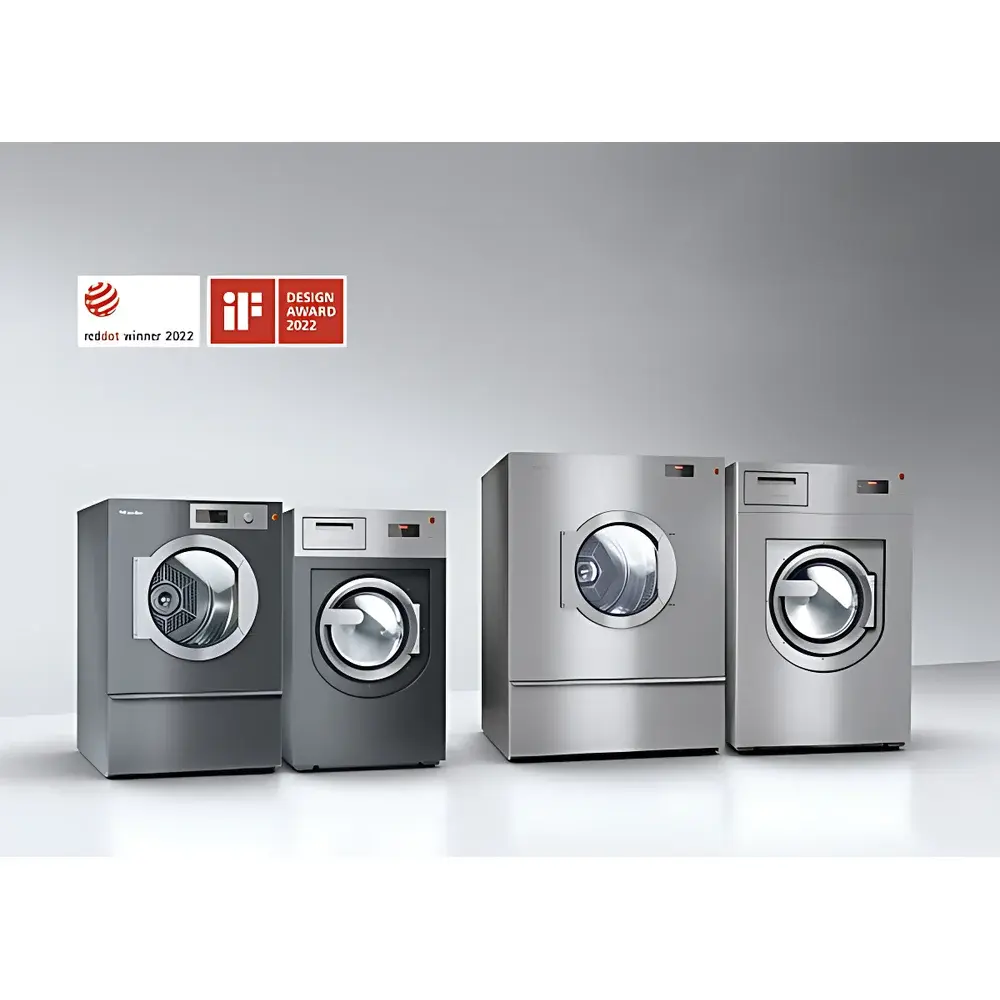
Miele Professional New Benchmark Series Laundry Washer-Extractor and Dryer System
| Brand | Miele |
|---|---|
| Origin | Germany |
| Model | New Benchmark Washer-Extractor (PWM 912/916/920) & Dryer (PDR 914/918/922/928/944) |
| Load Capacity | 12–44 kg |
| Drum Volume | 110–800 L |
| Max Spin Speed | 1,075–1,150 rpm |
| g-Force | 460 g |
| Residual Moisture | ≤44% |
| Cycle Time (Cotton 60°C) | 42–44 min (Washer), 31–38 min (Dryer) |
| Control Interface | M Touch Pro Plus (Washers), M Touch Pro (Dryers) |
| Compliance | IEST-RP-CC003.3, VDI 2083 Part 5.2, cGMP (2010), FDA 21 CFR Part 11 (with optional audit trail module), ISO 13485-aligned validation support |
Overview
The Miele Professional New Benchmark Series is a purpose-engineered laundry washer-extractor and dryer system designed specifically for regulated textile processing environments—including pharmaceutical cleanrooms, biotechnology facilities, hospital central sterile supply departments (CSSD), and high-integrity contract cleaning operations. Unlike commercial-grade appliances, this system operates on validated, repeatable thermodynamic and mechanical principles: wash cycles leverage precisely controlled temperature ramping (4–95°C), programmable water volume dosing, multi-stage extraction (up to 460 g-force), and ISO-compliant rinse efficiency monitoring; drying employs intelligent ventilation-based heat transfer with real-time humidity feedback and load-adaptive airflow modulation. Each unit is constructed from electropolished stainless steel (AISI 316L contact surfaces optional), fully traceable via serial-numbered component documentation, and engineered to meet the physical and microbiological performance criteria defined in IEST-RP-CC003.3 (garment integrity), VDI 2083 Part 5.2 (cleanroom textile decontamination), and Annex 1 of the EU GMP Guidelines (2022 revision). The system is not a consumer appliance—it is a process-critical piece of equipment intended for integration into quality management systems requiring full lifecycle traceability.
Key Features
- Modular scalability: Select from five washer-extractor models (PWM 912–920) and five dryer models (PDR 914–944), enabling precise capacity matching—from 12 kg batch loads in small cleanroom laundries to 44 kg throughput in centralized GMP-compliant textile reprocessing units.
- M Touch Pro Plus interface (washers) and M Touch Pro (dryers): Full-color, glove-compatible touchscreen with configurable user roles, encrypted parameter locking, and built-in cycle logging compliant with ALCOA+ data integrity principles.
- GMP-ready hardware architecture: Optional integrated water conductivity sensors, temperature probes (±0.3°C accuracy), and pressure transducers enable IQ/OQ protocol execution; all firmware supports version-controlled updates with change logs.
- Energy and water optimization: Dynamic load-sensing algorithms adjust detergent dosing, water volume, and spin acceleration profiles—reducing average water consumption by up to 28% versus fixed-program alternatives without compromising soil removal efficacy (per ISO 15714:2021).
- Material compatibility engineering: Drum geometry, lift design, and drum rotation profiles are optimized for low-abrasion handling of critical textiles—including Tyvek® coveralls, polyester-cotton blends, silicone-coated gloves, hydrophobic filter bags, and microfiber wipers—minimizing fiber shedding and tensile degradation over 500+ cycles.
Sample Compatibility & Compliance
The New Benchmark system processes a defined scope of regulated textile items under documented, auditable conditions: sterile area garments (Grade A/B), controlled area gowns (Grade C/D), non-sterile workwear, nitrile and latex gloves, surgical masks, cleanroom footwear, pharmaceutical-grade filter media, and lint-free wiping materials. All standard programs—including “Pharma Clean,” “Sterile Linen,” and “Low-Lint Decon”—are pre-validated per ISO 15714 (soil removal), ISO 15883-4 (thermal disinfection), and EN 14065 (RABC compliance). Optional validation packages include FAT/SAT documentation, thermocouple mapping reports, and residual moisture uniformity testing across full-load configurations. The system supports integration with external environmental monitoring systems (EMS) and LIMS via Modbus TCP or OPC UA, ensuring alignment with FDA 21 CFR Part 11 electronic record requirements when paired with Miele’s optional Audit Trail & Electronic Signature module.
Software & Data Management
Miele Professional’s integrated software suite—Miele Connect Suite v4.2—provides secure, role-based access to cycle history, error logs, maintenance alerts, and energy usage analytics. Raw data exports comply with CSV and PDF/A-1a formats for regulatory submission. Cycle parameters are stored with cryptographic hashing to prevent post-execution tampering; all user actions (start, pause, override, parameter edit) are timestamped, attributed, and retained for ≥36 months. For clients operating under GLP or GMP, optional 21 CFR Part 11 compliance includes electronic signatures, audit trail review functionality, and system-level password complexity enforcement (minimum 8 characters, mixed case, numeric, special). Firmware updates undergo formal change control, with release notes and impact assessments available upon request.
Applications
- Pharmaceutical manufacturing: Reprocessing of Grade A–D cleanroom garments, isolator gloves, and filtration components under Annex 1-aligned protocols.
- Hospital CSSD: Batch processing of surgical drapes, gowns, and linen with thermal disinfection verification (≥Log6 reduction of Geobacillus stearothermophilus spores at 75°C).
- Biotech R&D labs: Gentle, reproducible cleaning of sensitive protein-binding fabrics and electrostatic-dissipative lab coats without compromising antistatic properties.
- Contract sterilization providers: Multi-client batch segregation via RFID-tagged load carriers and program-specific access permissions.
- Aerospace & semiconductor: Low-particulate laundering of ESD-safe garments and wipe materials, validated per SEMI F21 standards for particle generation.
FAQ
Is the New Benchmark system suitable for sterile garment reprocessing in Grade A environments?
Yes—when configured with optional steam sterilization modules, validated water purification integration, and full-cycle environmental monitoring, it meets the material reprocessing requirements outlined in EU GMP Annex 1 (2022) and PDA Technical Report No. 56.
Can cycle data be exported to our existing MES or QMS platform?
Yes—via native Modbus TCP, OPC UA, or optional REST API middleware, supporting structured data exchange with SAP QM, MasterControl, Veeva Vault, or TrackWise.
Does Miele provide IQ/OQ documentation and on-site validation support?
Yes—Miele Professional offers turnkey qualification services including protocol development, execution, and final report generation, aligned with ASTM E2500 and ISPE GAMP 5 principles.
What is the expected service life and mean time between failures (MTBF) for critical components?
Based on field data from >12,000 installed units in regulated environments, main bearings and drive motors demonstrate MTBF >15,000 hours; programmable logic controllers (PLCs) exceed 100,000 operational hours under continuous duty.
Are detergent and chemical compatibility profiles available for validation purposes?
Yes—Miele maintains an updated library of third-party tested compatibility matrices for >47 industrial detergents, neutralizers, and anti-static agents, including Alconox®, Solujet®, and Liquinox®, with residue testing protocols included.




