
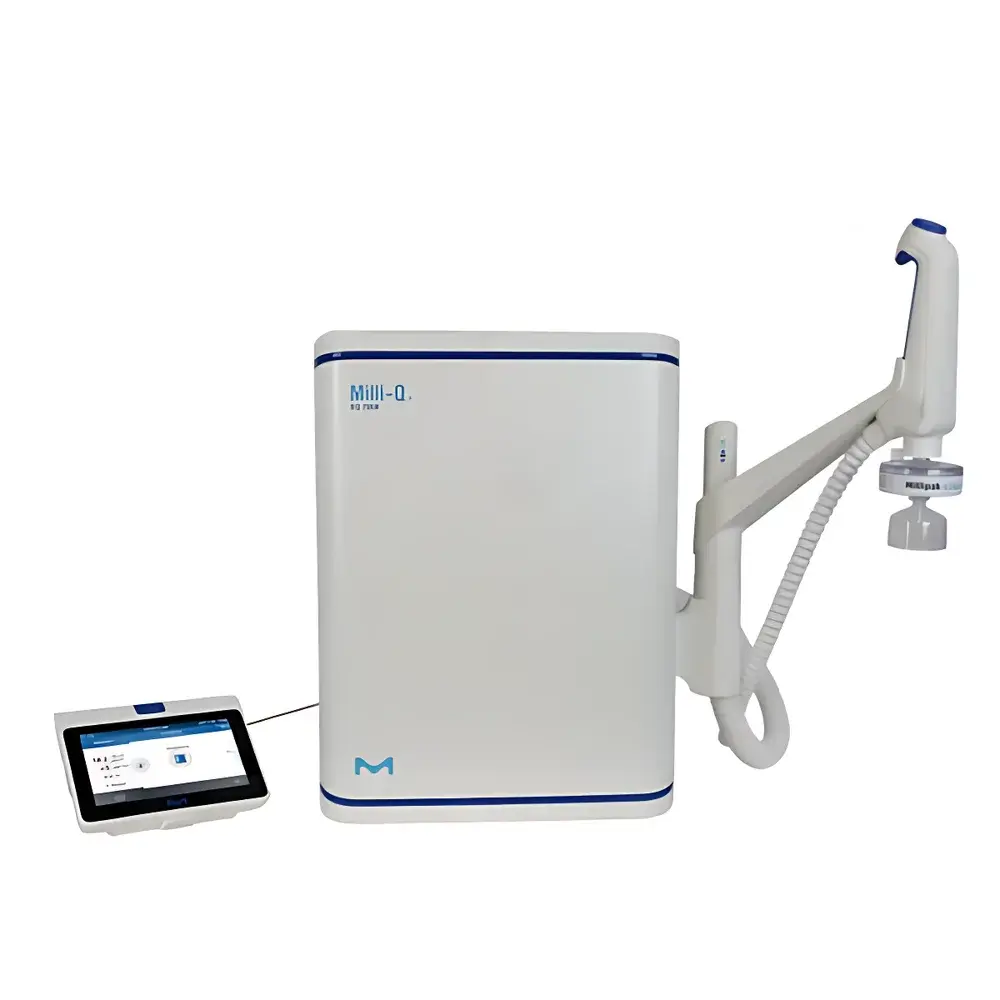
Milli-Q® EQ7008 & EQ7016 Integrated Pure and Ultrapure Water System
| Brand | Milli-Q |
|---|---|
| Origin | France |
| Manufacturer | Merck KGaA |
| Product Type | Imported Laboratory Water Purification System |
| Model | Milli-Q® EQ7008 & Milli-Q® EQ7016 |
| Pure Water Grade | ASTM Type I (Ultrapure) & Type III (Pure) |
| Resistivity | 18.2 MΩ·cm @ 25 °C |
| Total Organic Carbon (TOC) | ≤ 5 ppb |
| Microbial Count | < 0.01 CFU/mL |
| Endotoxin | < 0.001 EU/mL |
| Particles (>0.22 µm) | None detectable |
| Flow Rate | 2 L/min (ultrapure), 8 L/h (EQ7008 RO), 16 L/h (EQ7016 RO) |
Overview
The Milli-Q® EQ7008 and EQ7016 Integrated Pure and Ultrapure Water Systems are engineered for laboratories requiring simultaneous, on-demand access to both ASTM Type I ultrapure water and ASTM Type III pure water—directly from municipal tap feed water. These systems integrate reverse osmosis (RO), electrodeionization (EDI), dual-wavelength UV photooxidation (185/254 nm), and final point-of-use filtration into a single compact architecture. The core purification pathway leverages multi-stage physical and electrochemical separation: RO membranes reject >97% of dissolved ions and >99% of organic contaminants; EDI modules provide continuous ion removal without chemical regeneration; and 185 nm UV light catalytically oxidizes residual organics to CO₂, enabling precise TOC control. Final polishing is achieved via integrated Q-POD® dispensing arms equipped with application-specific POD-Pak® cartridges (e.g., Biopak®, Millipak® Gold), ensuring compliance with stringent analytical, life science, and pharmaceutical water specifications—including USP , ISO 3696:1995, CLSI EP22-A2, and ASTM D1193-20.
Key Features
- Modular installation flexibility: benchtop, under-bench, or wall-mounted configurations—reducing footprint by up to 42% versus previous-generation Milli-Q® Direct systems
- Intelligent Q-POD® dispensing arm with three flow-rate settings (low/medium/high) and programmable volumetric dispensing (1 mL–99.9 L)
- Extended reach: Q-POD® arm operable up to 3 meters from the main unit, with optional footswitch for hands-free operation
- Real-time, non-temperature-compensated resistivity monitoring (per USP requirements), plus continuous TOC and temperature measurement at point-of-use
- Embedded ech2O™ mercury-free UV lamp (254 nm) in integrated storage tank, minimizing hazardous waste generation and supporting lab sustainability goals
- Lab-wide energy optimization: “Lab Shutdown Mode” automatically reduces power draw during non-operational hours while preserving system integrity and cartridge hydration
Sample Compatibility & Compliance
The EQ7008/EQ7016 systems deliver water meeting or exceeding international standards for critical applications. Ultrapure water output complies with ASTM Type I specifications: resistivity ≥18.2 MΩ·cm @ 25 °C, TOC ≤5 ppb, bacteria <0.01 CFU/mL, endotoxin 0.22 µm undetectable—when used with appropriate POD-Pak® cartridges. For molecular biology workflows, Biopak® filters reduce RNase (<1 pg/mL), DNase (<5 pg/mL), and protease (7 log₁₀ and endotoxin reduction >4 log₁₀. RO-purified water meets ASTM Type III requirements: resistivity >0.05 MΩ·cm, TOC <200 ppb, and microbial load <1000 CFU/mL (with ASM prefilter). All performance claims are validated per ISO/IEC 17025-accredited test protocols and support GLP/GMP documentation requirements.
Software & Data Management
The 7-inch full-color capacitive touchscreen interface supports intuitive navigation across system status, real-time water quality metrics, consumable lifecycle tracking, and user-accessible audit trails. Data logging includes timestamped resistivity, TOC, temperature, flow volume, and POD-Pak® usage—stored locally with export capability via USB 2.0 to FAT32-formatted drives for paperless recordkeeping. Optional network connectivity enables remote monitoring via Merck’s LabManager™ cloud platform, supporting role-based access control and integration with laboratory information management systems (LIMS). All electronic records comply with FDA 21 CFR Part 11 requirements—including electronic signatures, audit trail immutability, and user authentication—facilitating regulatory inspections and internal quality audits.
Applications
These systems serve high-sensitivity analytical platforms including HPLC, UHPLC, LC-MS, GC-MS, and ICP-MS, where trace-level ionic or organic contamination compromises detection limits and column longevity. In life sciences, they supply water for PCR, qRT-PCR, next-generation sequencing library preparation, mammalian cell culture, and monoclonal antibody purification—where nuclease- and endotoxin-free water is mandatory. Pharmaceutical QC labs rely on them for dissolution testing, buffer preparation, and cleaning validation per USP . The dual-grade output also supports general lab use: glassware rinsing, media preparation, and instrument feed water—eliminating the need for separate pure and ultrapure water units.
FAQ
What is the difference between Milli-Q® EQ7008 and EQ7016?
The EQ7008 delivers RO-pure water at 8 L/h; the EQ7016 doubles that capacity to 16 L/h—ideal for larger labs or centralized distribution networks.
Can the system be validated for GMP environments?
Yes. Full IQ/OQ documentation packages, 21 CFR Part 11-compliant software, and factory-verified performance reports are available upon request.
How often must consumables be replaced?
Cartridge replacement intervals are dynamically calculated based on real-time usage metrics and displayed on the touchscreen; typical service life ranges from 6–12 months depending on feed water quality and daily demand.
Is remote diagnostics supported?
With LabManager™ subscription, engineers can perform secure remote health checks, firmware updates, and predictive maintenance alerts—minimizing downtime.
Does the system support third-party data integration?
Yes. RESTful API access and CSV/Excel export formats enable seamless ingestion into institutional LIMS, ELN, or enterprise analytics platforms.



