
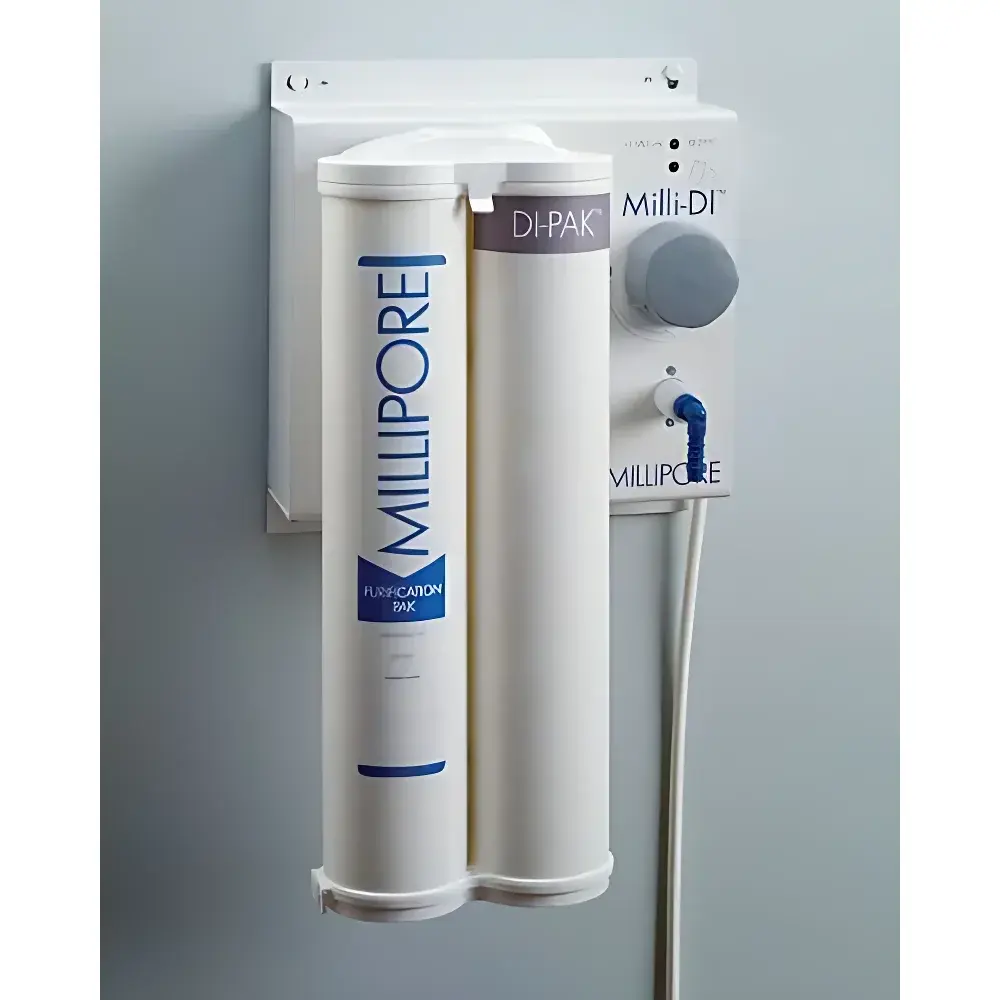
Millipore Milli-DI Deionization Water Purification System
| Brand | Millipore |
|---|---|
| Origin | France |
| Model | Milli-DI |
| Power Supply | Battery-operated |
| Resistivity (25°C) | >1 MΩ·cm |
| Flow Rate | 0.5–0.7 L/min |
| Dimensions (H×W×D) | 42.9 × 27 × 17 cm |
| Operating Weight | 5.6 kg |
| Feed Water Requirement | Municipal tap water, pressure 1–4.9 bar |
| DI Cartridge Capacity | 2.3 L ion-exchange resin, rated for 300 L feed water (at 400 µS/cm, CO₂-free) |
| Optional Sterile Filtration | 0.22 µm final filter |
Overview
The Millipore Milli-DI Deionization Water Purification System is a compact, battery-powered point-of-use unit engineered to convert standard municipal tap water into Type III laboratory-grade deionized (DI) water—meeting ASTM D1193-20 and ISO 3696:1987 specifications for Grade 3 water. Unlike centralized or mains-powered systems, the Milli-DI operates independently of electrical infrastructure, making it ideal for temporary labs, field deployments, mobile analytical units, or benchtop applications where outlet access is constrained. Its core purification mechanism relies on a single-stage, high-capacity mixed-bed ion-exchange cartridge (DI-PAK®), which removes cations and anions through reversible electrostatic exchange, yielding resistivity consistently exceeding 1 MΩ·cm at 25°C. The system does not incorporate reverse osmosis, UV oxidation, or ultrafiltration; therefore, it is not intended for ultrapure (Type I) water production or applications requiring endotoxin-free or nucleic acid-free water.
Key Features
- Battery-operated architecture eliminates dependency on AC power outlets—enabling deployment in fume hoods, biosafety cabinets, or remote workstations without rewiring.
- Real-time resistivity monitoring via integrated digital sensor with dual-color LED status indicator: green confirms acceptable DI water quality (>1 MΩ·cm); red signals cartridge exhaustion and imminent need for replacement.
- Tool-free DI-PAK® cartridge exchange mechanism—designed for leak-proof, one-handed insertion and ejection in under 5 seconds—minimizes downtime and operator exposure to ambient contaminants.
- Compact footprint (42.9 × 27 × 17 cm) and lightweight design (5.6 kg) support flexible placement on countertops, carts, or under-bench mounts without structural reinforcement.
- Optional 0.22 µm hydrophilic polyethersulfone (PES) final filter available as an add-on module to reduce viable microbial load to <1 CFU/mL, supporting ISO 8573-7-compliant sterile water requirements for microbiological media preparation.
Sample Compatibility & Compliance
The Milli-DI system is validated for use with standard municipal feed water conforming to WHO Guidelines for Drinking-water Quality and EU Council Directive 98/83/EC. Inlet water must exhibit total dissolved solids (TDS) ≤ 400 ppm, free chlorine ≤ 1 ppm, and absence of particulates >5 µm. It is not suitable for groundwater, well water, or pretreated RO permeate with elevated silica or organic carbon (TOC > 1 ppm). While the system itself carries CE marking per Directive 2014/30/EU (EMC) and 2014/35/EU (LVD), it does not bear FDA 510(k) clearance or ISO 13485 certification, as it is classified as a general-purpose laboratory utility—not a medical device or GMP-critical process system. Documentation includes full Declaration of Conformity, cartridge lot traceability, and material compatibility statements compliant with USP for polypropylene and polycarbonate wetted components.
Software & Data Management
The Milli-DI operates as a standalone hardware system with no embedded firmware, network interface, or data logging capability. All operational parameters—including resistivity readings, cartridge usage time, and visual status alerts—are conveyed exclusively through the front-panel LED interface. No software installation, driver configuration, or cloud connectivity is required or supported. This architecture ensures deterministic behavior, eliminates cybersecurity attack surfaces, and complies with environments enforcing air-gapped instrumentation policies (e.g., defense laboratories, secure government facilities). For audit-readiness under GLP or ISO/IEC 17025, users are advised to maintain manual logbooks recording cartridge installation dates, batch numbers, and daily resistivity verification checks using a calibrated handheld meter.
Applications
- Preparation of non-critical aqueous solutions, including pH calibration buffers (e.g., NIST-traceable phosphate and borate standards), rinse water for glassware, and diluent water for spectrophotometric assays.
- Formulation of microbiological growth media (e.g., LB broth, nutrient agar) where sterility—rather than ultrapurity—is the primary requirement; optional 0.22 µm filtration enables compliance with CLSI M22-A3 guidelines for culture medium water quality.
- Feed water for downstream purification systems (e.g., as pre-treatment for Milli-Q® or Elix® units) to extend the service life of RO membranes and polishing cartridges.
- General-purpose washing and cleaning in teaching laboratories, QC release testing labs, and environmental field stations where consistent, low-conductivity rinse water is needed but nanoparticle-free or pyrogen-free specifications are not mandated.
FAQ
What feed water quality is required for optimal Milli-DI performance?
Municipal tap water with conductivity ≤400 µS/cm, free chlorine ≤1 ppm, and absence of turbidity or particulate matter is mandatory. High hardness (>100 ppm CaCO₃) or iron content (>0.1 ppm) will significantly reduce cartridge lifespan.
Can the Milli-DI produce water suitable for HPLC or cell culture?
No. It delivers Type III water only. HPLC mobile phase preparation requires Type I water (≥18.2 MΩ·cm, TOC <5 ppb); mammalian cell culture demands endotoxin levels <0.03 EU/mL—both beyond the Milli-DI’s design scope.
Is the battery rechargeable, and what is its operational lifetime?
The system uses four AA alkaline batteries (not included), providing up to 6 months of continuous operation at average flow rates (0.6 L/min, 8 hrs/day). Rechargeable NiMH batteries are not recommended due to voltage regulation instability.
How is cartridge exhaustion determined?
Exhaustion is indicated solely by the red LED—triggered when effluent resistivity drops below 1.0 MΩ·cm. No timed-based or volume-based countdown is implemented; actual capacity varies with feed water ionic load and temperature.
Does the system include validation documentation for ISO 17025 accreditation?
No. The Milli-DI is supplied with a Certificate of Conformance and DI-PAK® cartridge CoA (Certificate of Analysis) listing resin capacity and conductivity test data. Full IQ/OQ/PQ protocols must be developed in-house per user-specific SOPs.



