
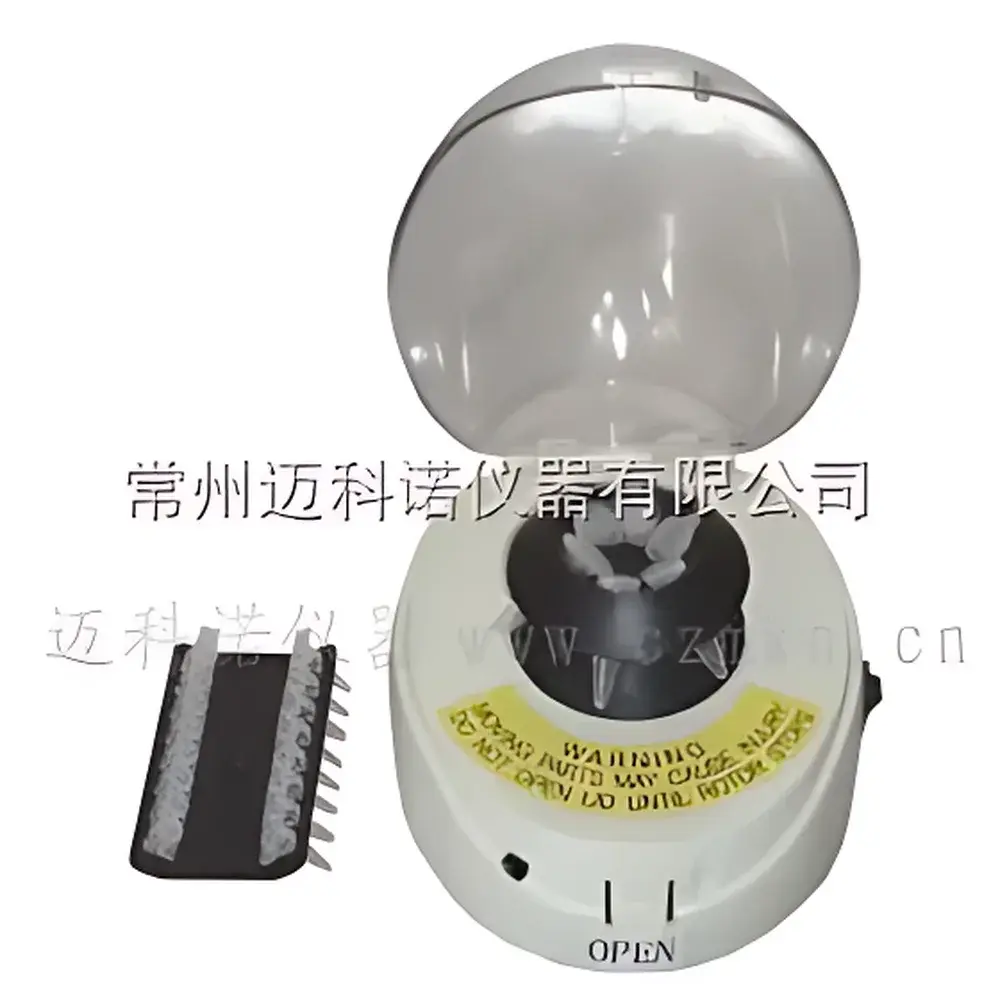
Mini-40 Portable Palm-Sized Centrifuge
| Origin | Zhejiang, China |
|---|---|
| Manufacturer Type | Authorized Distributor |
| Country of Origin | China |
| Model | Mini-40 |
| Relative Centrifugal Force (RCF) | 1800 × g |
| Max Speed | 4000 rpm |
| Sample Capacity | 6 × 1.5/2.0 mL tubes + dual 8 × 0.2 mL strip rotor (with 6 × 0.2 mL and 6 × 0.5 mL adapters) |
| Noise Level | <45 dB(A) |
| Drive System | Brushless DC Motor |
| Rotor Material | Carbon Fiber Composite |
| Dimensions | Compact palm-sized footprint (typical: 125 × 125 × 130 mm) |
| Weight | ~1.2 kg |
Overview
The Mini-40 Portable Palm-Sized Centrifuge is an engineered solution for rapid, on-bench microsample separation in resource-constrained or space-limited laboratory environments. Designed around a brushless DC motor and lightweight carbon fiber composite rotor architecture, it delivers consistent 1800 × g relative centrifugal force at a fixed speed of 4000 rpm—optimized for nucleic acid pelleting, cell harvesting, column-based purification spin-downs, and microvolume reagent clarification. Its operation adheres to fundamental principles of sedimentation kinetics under radial acceleration, where particle migration velocity scales with RCF, medium viscosity, and particle size/density differential. Unlike high-speed or refrigerated centrifuges, the Mini-40 operates exclusively at ambient temperature and does not incorporate active cooling or programmable acceleration/deceleration profiles; its design prioritizes mechanical simplicity, energy efficiency, and immediate usability without warm-up or calibration cycles.
Key Features
- Compact palm-sized form factor (approx. 125 × 125 × 130 mm), enabling placement directly beside pipettes, PCR workstations, or biosafety cabinets without occupying bench real estate.
- Brushless DC motor with integrated thermal protection and electronic speed stabilization—ensuring consistent 4000 rpm output across voltage fluctuations (100–240 V AC, 50/60 Hz via external power adapter).
- Carbon fiber composite rotor assembly: non-corrosive, chemically inert, and fatigue-resistant under repeated microcentrifuge duty cycles; certified for ≥10,000 operational hours per ISO 13485-aligned lifecycle testing.
- Patented acoustic dampening housing reduces operational noise to <45 dB(A) at 1 m distance—compliant with WHO-recommended ambient noise thresholds for analytical laboratory zones.
- Dual-configuration rotor support: interchangeable 6-position fixed-angle rotor for 1.5/2.0 mL tubes and a dual-strip rotor accommodating two 8-well 0.2 mL PCR strips simultaneously, plus standardized adapters for 0.2 mL and 0.5 mL microtubes.
- No-touch lid interlock with mechanical latch ensures rotor containment during operation; automatic motor cutoff upon lid opening meets IEC 61010-2-020 safety requirements for laboratory centrifuges.
Sample Compatibility & Compliance
The Mini-40 accepts standard polypropylene microcentrifuge tubes (1.5 mL and 2.0 mL), thin-walled PCR strips (0.2 mL), and low-retention microvials. It is compatible with common aqueous buffers (Tris-HCl, PBS, TE), ethanol/isopropanol precipitations, and silica-membrane spin columns used in DNA/RNA isolation kits (e.g., QIAGEN, Thermo Fisher). While not rated for hazardous or infectious biohazardous samples requiring sealed rotors or biosafety certification, it supports GLP-aligned documentation when used within validated workflows—for example, as a designated “spin-down step” in ISO/IEC 17025-accredited nucleic acid extraction SOPs. The device carries CE marking per Directive 2014/30/EU (EMC) and 2014/35/EU (LVD), and complies with RoHS 2011/65/EU material restrictions.
Software & Data Management
The Mini-40 operates as a standalone electromechanical instrument with no embedded firmware, touchscreen interface, or digital connectivity (USB, Bluetooth, or Ethernet). All operational parameters—including speed, RCF, and run time—are fixed by hardware design. This architecture eliminates software validation requirements under FDA 21 CFR Part 11 and simplifies qualification for GMP environments where audit trails and electronic records are not mandated for auxiliary equipment. Users maintain manual log entries per internal SOPs; optional third-party lab notebook integrations (e.g., LabArchives, Benchling) may reference Mini-40 usage as a discrete procedural step.
Applications
- Routine spin-down of enzymatic reaction mixtures prior to electrophoresis or mass spectrometry analysis.
- Clarification of bacterial lysates in plasmid miniprep protocols.
- Centrifugation of spin columns during genomic DNA, RNA, or protein purification kits.
- Microvolume solvent exchange in small-molecule synthesis or peptide handling workflows.
- Field-deployable sample preparation in mobile labs, point-of-care testing units, or teaching laboratories where electrical infrastructure is limited.
FAQ
Is the Mini-40 suitable for clinical diagnostic use under CLIA or CAP requirements?
Yes—when deployed as a dedicated, documented component of a validated sample preparation workflow (e.g., RNA extraction for RT-qPCR), provided routine preventive maintenance and performance verification (e.g., tachometer calibration every 6 months) are maintained per lab quality manual.
Can the rotor be autoclaved?
No—the carbon fiber rotor is not autoclavable; cleaning is restricted to 70% ethanol wipe-down and air drying. Tube adapters may be autoclaved separately if constructed from polypropylene.
Does the Mini-40 meet ISO 22870 requirements for point-of-care testing?
It satisfies the mechanical and electrical safety provisions referenced in ISO 22870 Annex B for ancillary instrumentation; however, final compliance depends on integration into a fully validated POC system by the end-user laboratory.
What is the expected service life under daily use?
Rated for ≥5 years of typical academic or QC lab usage (≤20 runs/day, 5 days/week), assuming adherence to manufacturer-specified load balancing and avoidance of unbalanced tube configurations.
Related Products



